Your 2027 Budget Planner Setup Guide (Do It in One Sitting)
By Nora Bennett · August 6, 2026

There's a version of January where the budget is already set before the year starts: every month planned, the ambush expenses pre-funded, one clear goal on the board, and the first Sunday of the year is a ten-minute check-in instead of a financial reckoning. That version costs about one hour in late December, and this budget planner setup guide is that hour, step by step. It's written for the free Sunday Budget planner but the sequence works in any system; and if you're reading this in March or August, everything here works mid-year too (fresh starts are renewable).
What you need: one hour, one drink, last year's data
The single most valuable input for next year's budget is this year's reality: twelve months of what things actually cost, when the ambushes actually landed, which categories were fiction. If you've been running the planner, the Dashboard and Expense Log are that data. If this is year one: pull your last 2–3 bank statements instead, the beginner excavation, and know that next December's setup will be even easier, because future-you will have the receipts.
Step 1: Set the income baseline (5 minutes)
Real take-home, never gross. If income is steady, type it once on the Start Here tab and move on. If it varies, baseline at your lowest recent month, conservative base, bonuses assigned on arrival, and if you're paid biweekly, note now which two months of 2027 contain the third paycheck and mark their jobs on the calendar before the year can absorb them.
Step 2: Audit the category list (10 minutes)
Read last year's categories with two questions: what never got used (kill it, a shorter list is a list you'll maintain) and what kept appearing in "other" (promote it, recurring mystery spending deserves a name). Check the defaults against reality: if groceries ran $520 every month, the 2027 plan says $520, not the aspirational $400. This is also the moment to add the fun money line if last year's budget was joyless. You now have twelve months of evidence about how that went.
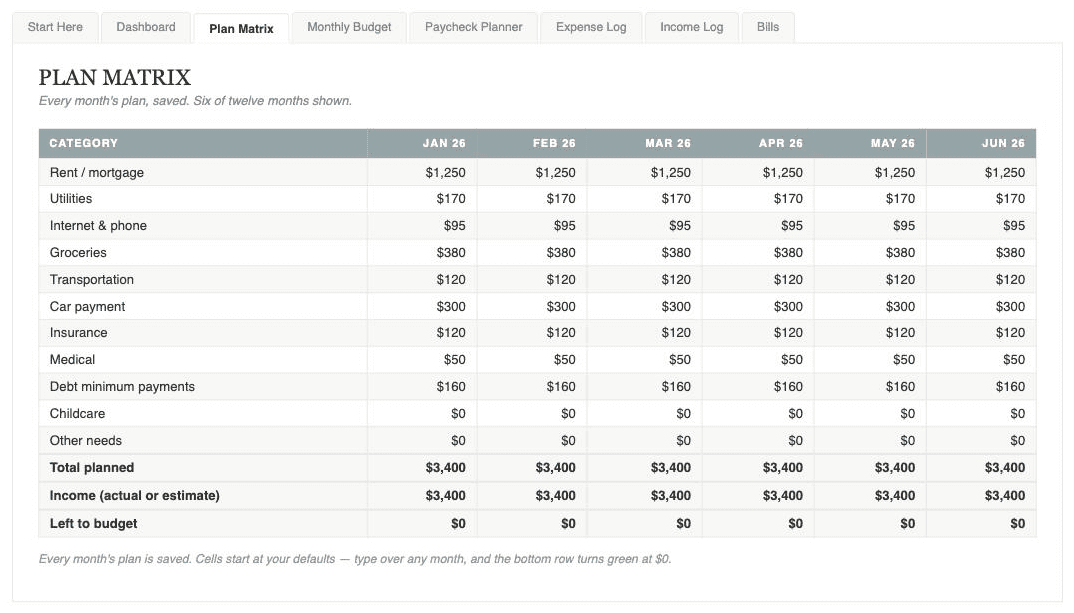
Step 3: Plan all twelve months at once (15 minutes, the power step)
This is the step most people skip and the one that changes the year. In the planner's Plan Matrix, every month starts at your defaults, so you only edit the known deviations, and you know them now:
- December gets the holiday budget: mapped in January, funded all year
- Back-to-school months get their bump; birthday months get theirs
- Summer gets vacation reality; the insurance months get the premium hits
- The third-paycheck months get their extra income assigned to its pre-decided job
Ten minutes of typing, and January-through-December already know their shapes. Mid-year surprises still happen, but the scheduled surprises, the ones that wreck most budgets, are now just… the plan.
Step 4: Load the sinking funds calendar (10 minutes)
Last year's ambushes are next year's sinking funds: scan the year for every expense that arrived as a "surprise" (car repair, vet, holiday, annual renewals, the wedding season) and give each a fund: target ÷ months until due = monthly transfer. The planner's Sinking Funds tab computes the pacing and tells you all year whether each fund is on track. A typical household lands at $150–250/month across funds, which sounds like a cost until you remember it's just December and the mechanic, paid in twelfths, without interest.
Step 5: Pick the year's first goal, just one (5 minutes)
Not five resolutions, one formula-complete goal for the first quarter: the starter emergency fund if you don't have it, the cruelest debt if you do, the three-month fund if you're past both. Number, date, required-monthly, first action, and its home on the Goals tab. Quarters two through four get chosen in quarters two through four, informed by how one actually went.
Step 6: The automation audit (10 minutes)
The year runs on whatever fires automatically, so verify the machinery while you're here: savings transfer the day after payday, sinking-fund transfers, minimum payments on autopay without exception, and one subscription sweep, the January renewals are lurking in last year's statements, and canceling the dead ones is the year's first found money. If any bill's due date fought your paycheck timing all year, this is the phone call moment.
Step 7: Book the first Sunday (2 minutes)
The setup is the launch; the Sunday reset is the flight. Put a recurring ten-minute block on the actual calendar: first Sunday of the year, then every Sunday, with the first-of-the-month editions adding the net-worth row. A year of budgeting is not one heroic January effort; it's fifty-two small check-ins, and this hour just made every one of them shorter.
The December note-to-self (do this part in December 2027)
Before closing the setup session, write three lines somewhere the planner will show you next December: what worked this year, what leaked, what to change. The Year in Review tab computes the numbers, savings rate, biggest category, net worth change, debt progress, but the three lines are the part the numbers can't say. Next year's setup hour starts by reading them, and that loop, plan, live, review, re-plan, is the entire practice, compounding annually.
Frequently asked questions
Do I have to wait for January 1st? No: the fresh-start energy is useful, not necessary. This exact sequence works started any month: plan the remaining months in step 3, prorate the sinking funds, and let the first full year happen whenever it happens. The worst start date is "after things settle down."
Should I carry over last year's budget or start clean? Carry the structure (categories that worked, funds, automations), reset the numbers to last year's actuals. A full clean slate throws away your most expensive asset, twelve months of evidence: while pure carry-over preserves last year's fictions. Audit, don't restart.
How do couples do the setup session? Together, once, with snacks: this hour is the annual money summit: shared numbers through step 4, the shared goal in step 5, and each person's fun-money line ratified without debate. One hour a year of alignment prevents fifty-two weeks of small collisions.
What if last year went badly and I don't want to look at the data? That's the strongest possible reason to run the hour, the numbers are a coordinate, not a grade, and every fiction you replace with a real number this December is a failure that can't repeat next year. Bad data beats no data; it's also, conveniently, exactly how everyone starts.
One hour, whenever you're reading this
Grab the planner, last year's numbers, and the drink of the season: income baseline, category audit, twelve months planned, sinking funds loaded, one goal, automations verified, first Sunday booked. An hour of December-you's time is the single best gift January-you will get, and unlike everything else under the tree, this one compounds.







Written by
I fixed my own money with a spreadsheet and a Sunday morning, and now I build the tools I wish I’d had. I manage a dental practice in Greensboro, North Carolina, and I have never once told anyone their problem was the coffee.