Holiday Budgeting: How to Avoid January Debt
By Nora Bennett · August 2, 2026

Every January, the same bill arrives at millions of houses: the holiday credit card statement, routinely $1,000–1,500 of December cheer, now wearing 24% APR and a payback schedule that stretches past Easter. Here's the thing these Christmas budget tips are built on: the holidays are the single most predictable expense in the entire year. December 25th has never once moved. January debt isn't a splurge problem. It's a sinking-fund problem, and it's completely solvable with a number, a list, and a head start. (Reading this in August or September? Perfect. You're exactly on time.)
Step 1: Set the total before the season sets it for you
Holiday overspending doesn't happen at the mall; it happens by never deciding the total. Each individual purchase gets judged alone ("it's only $30") against no ceiling, and forty reasonable decisions add up to an unreasonable January.
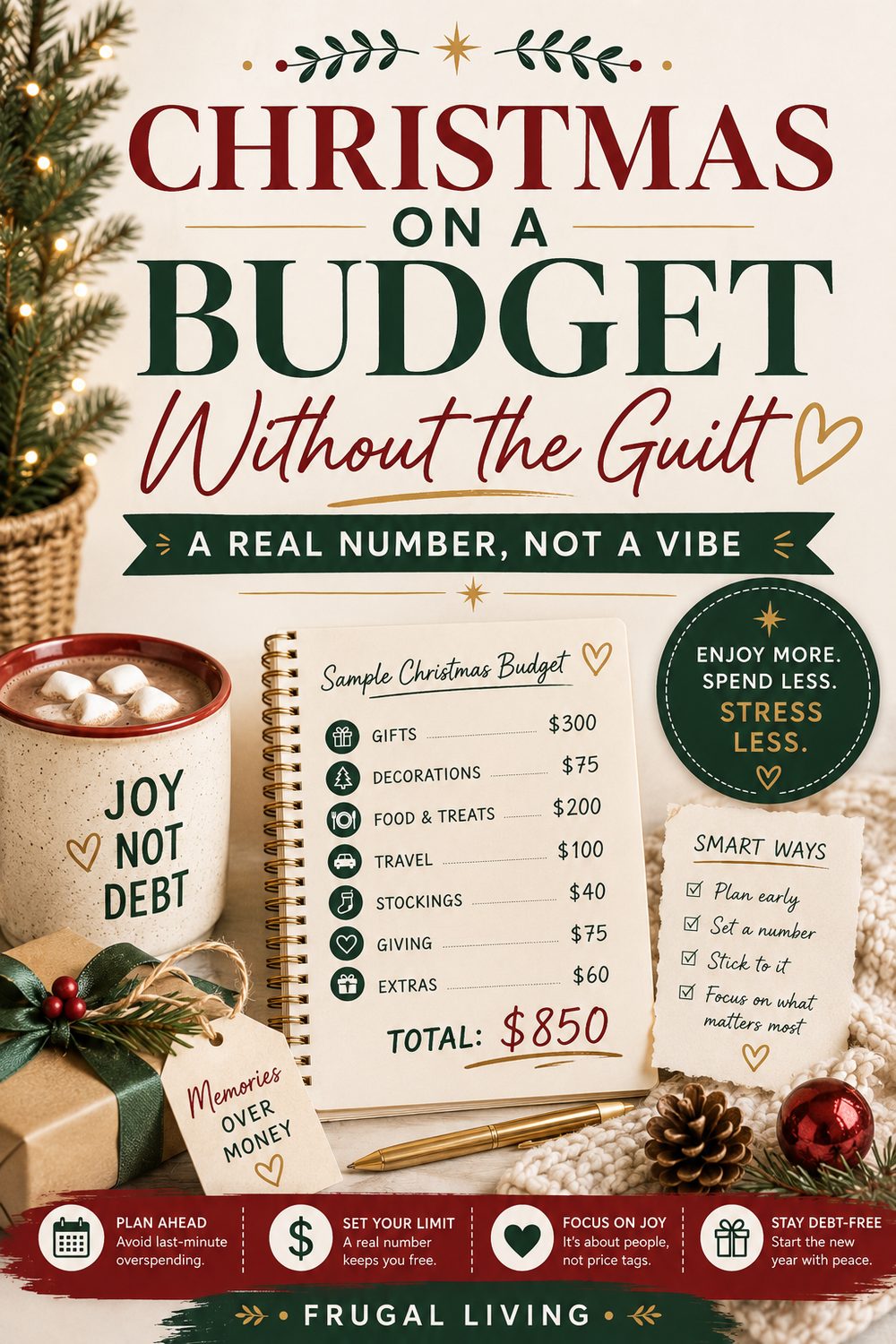
So decide the one number first: what can this year's holidays cost without borrowing? Work backward from your real budget, not from last year's habits, for many households the honest number is $400–900 all-in. Write it down. Every holiday decision for the rest of the year is now a allocation question inside a fixed number, not a fresh negotiation with a store display.
Step 2: Budget the whole holiday, not just the gifts
The classic failure: budgeting $500 "for Christmas," spending $500 on gifts, and then funding the rest of December on the card. The full holiday cost list, budget every line that applies:
- Gifts (the list, plus the forgotten-person buffer, someone always materializes)
- Food & hosting, the big meals, the baking, the "just picking up wine" trips
- Travel, gas, flights, the pet sitter, the airport sandwiches that cost like entrées
- Decor & tree, even modest years have a line here
- Wrapping, cards & postage, invisible until it's $60
- Events & outfits, the party, the kids' concert gear, the photos
- Tips & giving, teachers, service folks, the charitable giving that belongs in December's plan, not its aftermath
Assign each line a slice of the Step-1 total in the planner: a December that's fully mapped in November is a December that stays inside its number.
The December before I started budgeting, I put $1,140 on a credit card without ever deciding to. No single purchase felt reckless. I just made forty small decisions with no ceiling anywhere, and then paid for that month until April, with interest, long after the wrapping paper was out of the house.
Step 3: The holiday sinking fund (the whole trick)
The difference between a December that wrecks January and one that doesn't is rarely the amount spent. It's whether the money existed before the spending. That's the sinking fund, holiday edition:
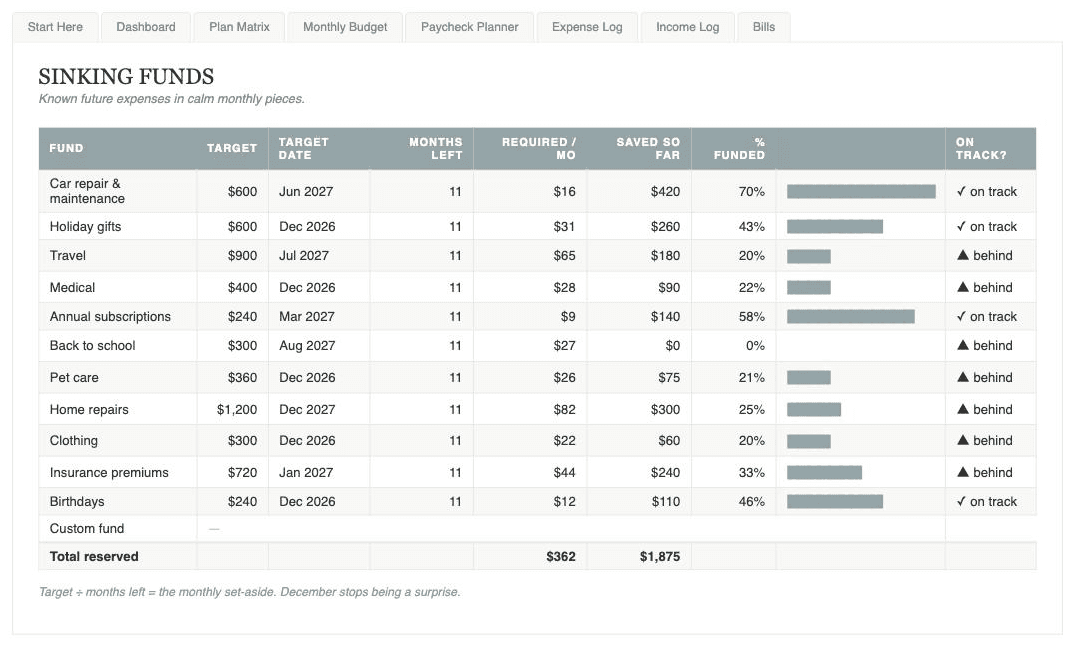
Your total ÷ months remaining = the monthly set-aside.
A $600 holiday starting in January costs a painless $50/month. Starting in August, $120/month, steeper but very doable. Starting the week of Thanksgiving… is why the card gets involved. The fund turns the exact same December into a withdrawal instead of a debt: whenever you start, divide and automate the transfer today, because every month you wait moves the remainder onto next year's statement.
(If you're reading this in time: the planner's Sinking Funds tab ships with "Holiday gifts" pre-loaded, set the target and date and it computes the monthly number and whether you're on pace.)
Step 4: Shrink the gift list without shrinking the joy
The gift line is the biggest and the most negotiable, with strategies that consistently make the season better, not thinner:
- Draw names among adults. One thoughtful $50 gift beats eight obligatory $15 ones. Most extended families are one group text away from this upgrade, and someone else is already hoping you'll send it.
- Set caps out loud. "$25 limit this year" is a gift to every participant's January; the first person to say it is briefly awkward and permanently thanked.
- Give from skills, the babysitting voucher, the famous lasagna, the fixed bike: cheaper, and the only gifts anyone remembers in March.
- Kids: the four-gift rhythm, want, need, wear, read, turns quantity-pressure into structure kids genuinely enjoy anticipating.
- Start early, spread the cost. Buying from the list (never near the list) across October–December softens the cash-flow and beats the December price panic. Season-funeral logic applies to next year too: the 26th is when wrapping paper costs nothing.
Step 5: December operations
- Go envelope-style for gift spending: cash or a dedicated bucket; when it's empty, the list is done. The hard stop matters most in the season engineered to dissolve them.
- Track against the lines weekly: December's Sunday resets are the season's guardrails; ten minutes confirms which lines have room and which are done.
- Beware "self-gifting" drift: retailers aim half of holiday marketing at you-for-you; if you want a treat, budget it as a line, on purpose, guilt-free.
- Protect the January buffer. The goal isn't spending the fund to zero; it's ending December with the regular budget untouched and January boring. Boring Januaries are the entire victory.
If it's already too late this year
Reading this in December with no fund? Damage-control mode: set the total now (smaller than you wish), cover it from cut flexible categories and a quick lump rather than the card where possible, and give from skills liberally. Then, this is the important part, open next year's fund on January 1st at $50/month, and this becomes the last January that hurts. The best time to start the fund was last January; the second-best time is the moment this year's wrapping paper hits the recycling.
Frequently asked questions
How much should I budget for the holidays in total? A workable frame: 1–1.5% of annual take-home for a modest year, scaled by family size and travel. The real answer is whatever number your budget can produce without borrowing, a smaller debt-free holiday beats a bigger financed one in every month that isn't December.
Isn't holiday budgeting… kind of joyless? The opposite, in practice: the fund and the list remove the guilt layer from every purchase, December spending becomes pre-approved, pre-funded, and anxiety-free. What's joyless is math you're afraid to look at until January 3rd.
How do I handle gift-giving imbalances. They spend more on us than we can spend on them? Reciprocity is about thought, not receipts, and most "imbalances" exist only in your head. If it's explicit, name your cap warmly ("we're keeping it small this year — $25?"). Anyone who resents a spending boundary was giving invoices, not gifts.
What about Black Friday: save the fund for the deals? Buy from the list during sales and the deals are real; browse the deals without a list and November eats the fund a month early. Same rule as always: the list decides, the sale just prices it.
The math to do today
One number for the total, the full cost list, and this division: total ÷ months until December = your monthly transfer. Set it up in the planner today, automate it, and let this be the year the January statement arrives, and it's just… a statement. Same lights, same feast, same generosity. No aftermath.



Written by
I fixed my own money with a spreadsheet and a Sunday morning, and now I build the tools I wish I’d had. I manage a dental practice in Greensboro, North Carolina, and I have never once told anyone their problem was the coffee.