How to Make a Budget for Beginners (Step by Step)
By Nora Bennett · June 30, 2026 · Updated August 6, 2026

A budget is a plan for the money available to you. It connects income, bills, everyday spending, savings, and debt payments before those dollars compete in the checking account.
The arithmetic is simple:
Money available − money assigned = money still unassigned
The difficult part is using complete numbers and matching the plan to when money actually arrives. A monthly total can look balanced while the account still runs short three days before payday.
This guide builds both pieces: a realistic monthly plan and a cash-flow check that tests whether each bill can be paid on time.
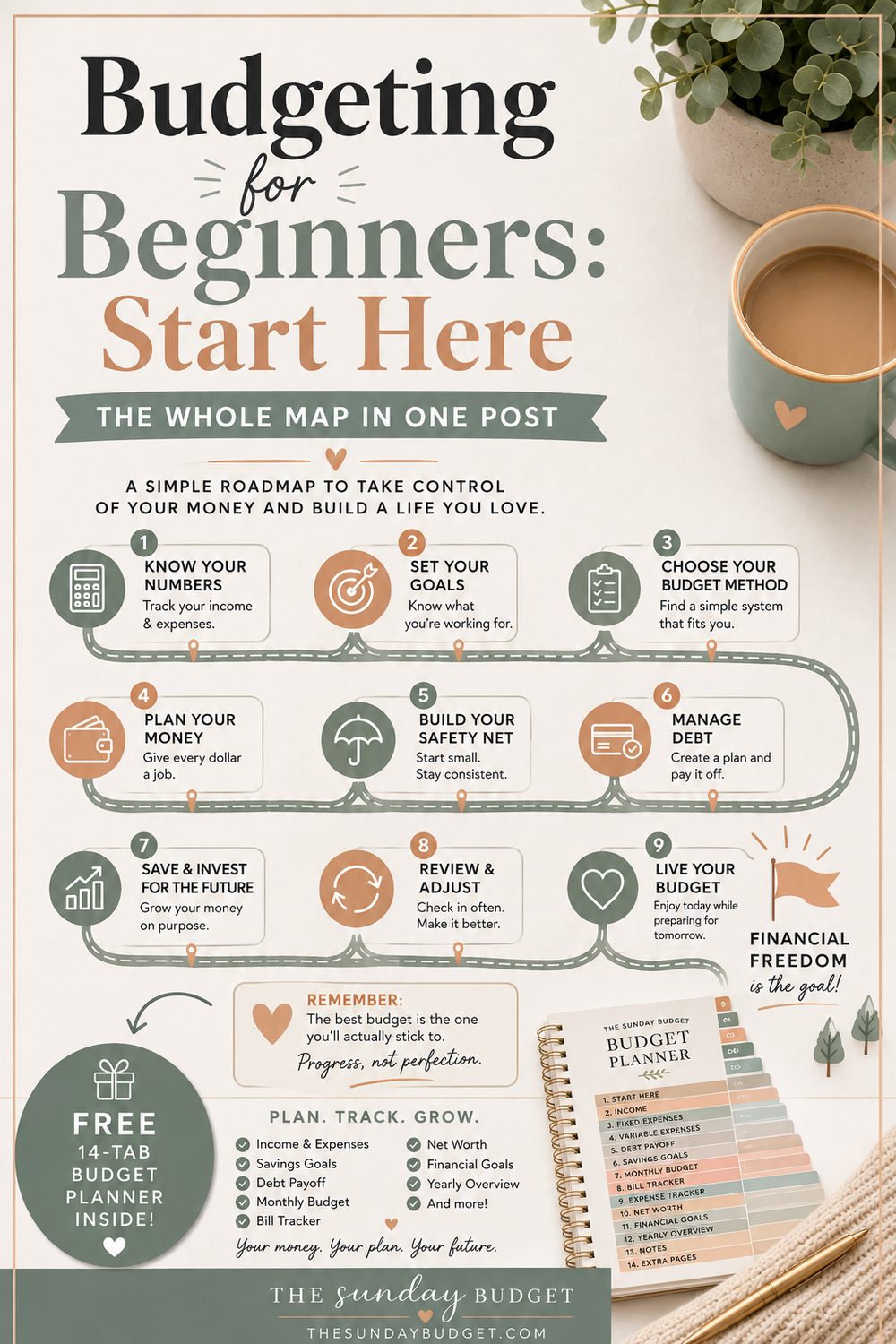
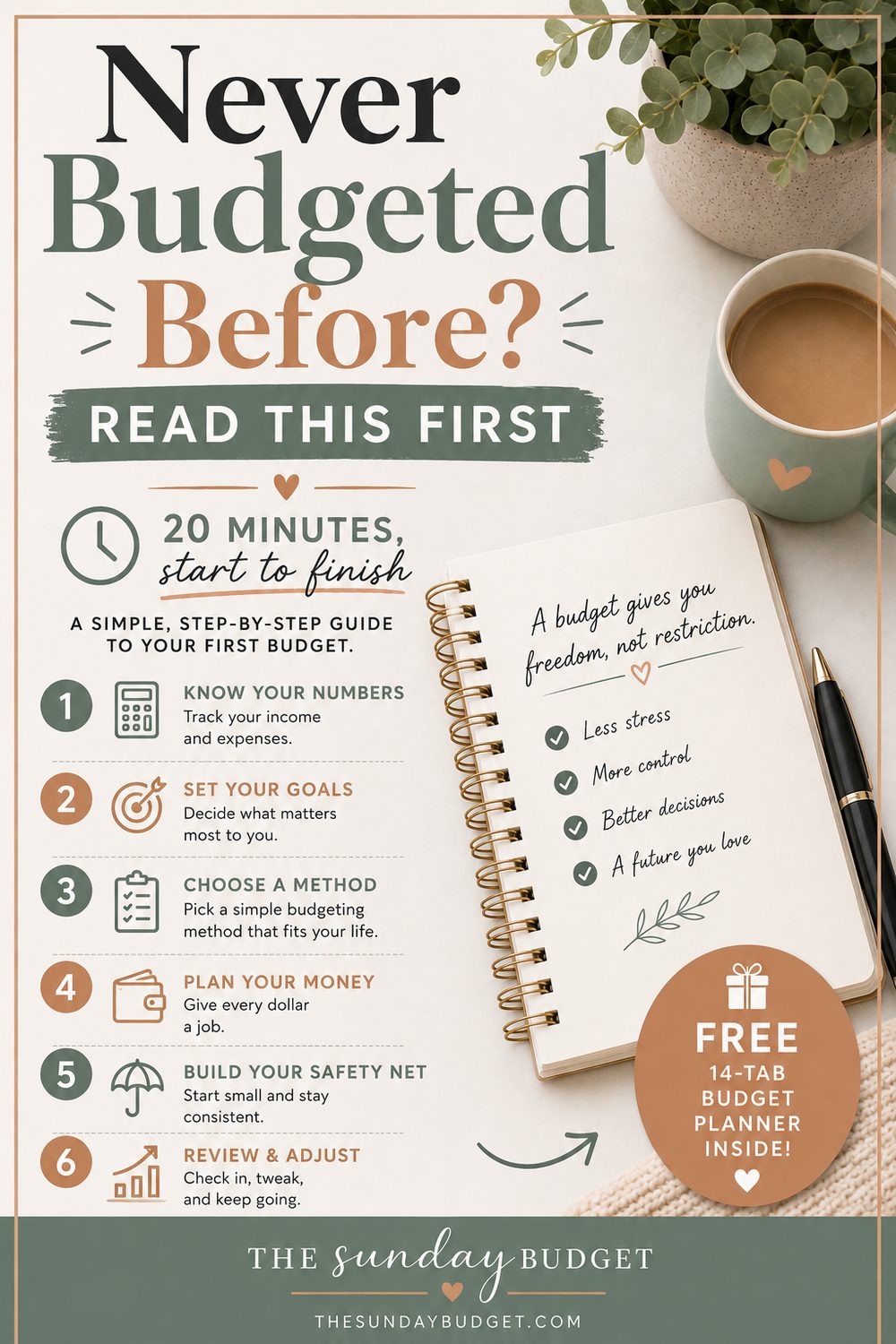
The beginner budget in eight steps
If you need the short version, follow this order:
- Choose the month and record the starting balance available for it.
- List income you reasonably expect to receive during that month.
- Review recent spending instead of guessing category amounts.
- List bills, required payments, and due dates.
- Add variable and non-monthly expenses.
- Assign money to essentials, goals, and flexible categories.
- Check the monthly total and the timing between paydays.
- Track spending weekly and use the result to build the next budget.
Consumer.gov describes a budget as a written monthly plan showing income and spending. Its basic process is to list expenses, list income, and subtract expenses from income. The Consumer Financial Protection Bureau adds an important layer: track when income and bills occur so the plan reflects cash flow, not only monthly totals.
You can review the official Consumer.gov budgeting guide and the CFPB's budgeting and bill-calendar workflow.
What to gather before you start
Use real records whenever possible. Gather:
- the last three months of checking and savings statements;
- the last three months of credit-card statements;
- recent pay statements or income records;
- a list of current account balances;
- bills showing amounts and due dates;
- minimum debt payments;
- annual or seasonal costs expected during the next year; and
- paper, a spreadsheet, or a budgeting app.
Three months will not capture every irregular expense, but it is enough to expose most recurring charges and establish useful averages. Review twelve months for highly seasonal utilities, school costs, insurance renewals, travel, holidays, and taxes.
Keep login credentials and sensitive account details out of the budget file. You need categories, amounts, and dates—not full account numbers.
Step 1: choose the planning period and starting balance
Most beginners should create one budget for one calendar month. You can later plan by paycheck or build annual projections, but begin with a small window you can verify.
Write down:
- the month being planned;
- the checking balance available on day one;
- money in that balance already reserved for a prior bill; and
- the truly available starting balance after those reservations.
Do not count the same money twice
Suppose checking contains $900 on the first day of the month, but $650 is reserved for rent that belonged to the previous pay cycle. The usable starting balance is not $900 for new categories.
Also separate transfers from income. Moving $500 from savings to checking changes the location of the cash; it does not create $500 of new income. If the transfer is intentionally funding this month's plan, record it as money brought forward from savings so the source remains clear.
Step 2: calculate usable income
Use the amount expected to reach the household after payroll deductions—the cash available for this budget. Include reliable sources such as wages, benefits, support received, pension income, or other funds that will actually be available during the month.
Do not include uncertain bonuses, refunds, gifts, sales proceeds, or freelance invoices until receipt is reasonably dependable. You can create a separate plan for those dollars when they arrive.
Common pay schedules
| Pay schedule | Number of checks | Useful calculation |
|---|---|---|
| Monthly | 12 per year | One net paycheck |
| Semimonthly | 24 per year | Two net paychecks per month |
| Biweekly | 26 per year | Use the actual two or three checks arriving in the month |
| Weekly | 52 per year | Use the actual four or five checks arriving in the month |
For long-term estimates, weekly pay × 52 ÷ 12 or biweekly pay × 26 ÷ 12 produces a monthly average. For a working cash-flow budget, however, use the checks that will arrive during the specific month. An average cannot pay a bill before the extra-paycheck month occurs.
Budgeting irregular income
An average is useful for annual planning but can be too optimistic for fixed commitments. Use two views:
- Annual planning average: total net income from the last twelve months ÷ 12, adjusted for known changes.
- Commitment baseline: a conservative amount you can reasonably build required monthly expenses around.
There is no universal formula for the baseline. Review the lowest ordinary months, seasonal pattern, contracts already booked, benefits, and income volatility. Avoid building rent, required debt payments, or other fixed obligations around a best month.
When income exceeds the baseline, assign the extra in a written order. For example:
- catch up any current essentials;
- fill next month's income buffer;
- fund upcoming sinking funds;
- build emergency savings;
- make extra debt payments; and
- fund optional goals.
If income is highly seasonal, map the entire year instead of assuming every month resembles the average.
Step 3: find what you actually spend
Look through bank and credit-card activity and group spending into categories. Do not begin with what you think a category should be.
Separate expenses into four types:
| Type | Description | Examples |
|---|---|---|
| Fixed | Usually the same amount and date | rent, loan payment, subscription |
| Variable essential | Necessary but changes | groceries, utilities, fuel, medication |
| Flexible | Can usually be reduced or delayed | restaurants, hobbies, entertainment |
| Non-monthly | Predictable but not paid every month | registration, annual insurance, gifts, repairs |
The label should describe the current decision. A phone bill may be required in this month's plan but negotiable over a longer horizon. Groceries are essential, but the amount still has a flexible range.
Use averages carefully
For a variable category, calculate:
Recent category total ÷ months reviewed = starting monthly estimate
If groceries were $470, $510, and $490:
($470 + $510 + $490) ÷ 3 = $490 average
Use $490 as evidence, then adjust for the month ahead. Guests, school holidays, dietary changes, or a planned pantry week may change the target.
For seasonal bills, compare the same month last year rather than flattening the year. A winter heating bill may be very different from a summer bill.
Audit recurring charges without assuming every subscription is waste
Identify each recurring charge and ask:
- Do we recognize it?
- Do we use it?
- Is the price still correct?
- Is there a duplicate or overlapping service?
- When does it renew?
Canceling an unused service is useful. Keeping a service that supports work, health, connection, or enjoyment can also be a valid budget decision.
Step 4: build a bill calendar
A list of monthly totals does not reveal timing. Add every expected inflow and required outflow to a calendar.
Record:
- payday or expected deposit date;
- bill due date;
- scheduled autopay date;
- amount or reasonable estimate;
- which paycheck will cover it; and
- how many processing days the payment method needs.
The CFPB's current Your Money, Your Goals toolkit includes a bill calendar and cash-flow budget for this purpose.
Why a balanced month can still overdraft
Consider a household receiving $1,700 on the 1st and $1,700 on the 15th. The monthly income is $3,400, and the monthly plan also totals $3,400. The account begins with a $300 cash cushion.
| Event | Change | Running balance |
|---|---|---|
| Opening available balance | $300 | |
| Paycheck on the 1st | +$1,700 | $2,000 |
| Rent, utilities, and phone | −$1,540 | $460 |
| First-half groceries and fuel | −$265 | $195 |
| Debt minimum before the 15th | −$80 | $115 |
| Paycheck on the 15th | +$1,700 | $1,815 |
| Remaining monthly assignments | −$1,515 | $300 |
The monthly plan balances, but only $115 remains before the second paycheck. Scheduling a $150 savings transfer on the 2nd would create a timing problem even though the month works on paper.
Possible fixes include moving a transfer, requesting a different due date where the provider allows it, splitting a flexible category by paycheck, or building a larger checking cushion. Confirm any due-date change directly with the company before relying on it.
Step 5: list every monthly assignment
Build the spending plan in a protective order. The exact order depends on consequences, but a useful default is:
- basic food, housing, utilities, medication, and essential transport;
- required insurance and legal obligations;
- minimum debt payments and other current bills;
- non-monthly essentials due soon;
- a realistic amount for variable necessities;
- emergency savings, other savings, and extra debt payments; and
- flexible wants and optional goals.
Savings can be a planned budget category, but “pay yourself first” does not mean transferring money while rent, food, medication, required insurance, or current minimum payments go unpaid.
If there is not enough for every bill, do not distribute small amounts randomly. Review consequences and contact creditors or service providers before the due date. The CFPB provides a prioritizing-bills worksheet for situations where cash is short.
Step 6: add non-monthly expenses
Annual and irregular costs belong in the monthly budget even when no bill arrives this month.
Use a sinking fund:
(Target − amount already saved) ÷ deposits before due date = required contribution
Examples include:
- insurance premiums;
- car registration and maintenance;
- school costs;
- medical and dental expenses;
- holiday travel and gifts;
- annual software and memberships; and
- replacement of essential equipment.
Read Sinking Funds Explained for the full calculation, category priority system, and account options.
Add a clearly defined cushion
A cushion is a small amount left available for estimation error or a minor unplanned cost. It is not a substitute for an emergency fund and should not become an unlimited miscellaneous category.
Choose the amount from the budget's volatility and available cash. A household with unpredictable utilities or frequent small school charges may need more margin than one with stable expenses. If no cushion fits yet, acknowledge that the plan has no slack and review it more frequently.
Step 7: make the monthly math work
Add every assignment and subtract the total from available income.
If money remains
Give it a job. Options include:
- keep part as a checking cushion;
- increase an underfunded essential category;
- add to emergency savings;
- fund a known future expense;
- make an extra debt payment; or
- fund a planned want.
Leaving money intentionally unassigned as a cushion is still an assignment. Label it so it does not become invisible spending.
If the result is negative
The budget is showing that planned outflow exceeds planned inflow. Use this order:
- Check for duplicated bills, transfers counted as spending twice, or gross income entered instead of usable income.
- Remove or reduce flexible spending.
- Adjust goals and extra payments that are not currently required.
- Review variable essentials for realistic, safe reductions.
- Examine larger fixed costs and available assistance.
- Identify feasible ways to increase income or benefits.
- Contact billers early if a payment will be missed.
Do not force the spreadsheet to zero by entering numbers that cannot support food, transport, or the real utility bill. A negative result may indicate a structural income-versus-cost gap, not a lack of discipline. The low-income budgeting guide covers bill triage, a survival budget, and rebuilding from a shortfall.
A complete $3,400 beginner budget
Here is a balanced example for $3,400 of take-home income. It is an illustration, not a recommended category standard.
| Category | Planned amount |
|---|---|
| Rent | $1,250 |
| Utilities | $180 |
| Phone and internet | $110 |
| Vehicle payment | $250 |
| Auto insurance | $140 |
| Fuel or transit | $130 |
| Groceries | $400 |
| Household and personal care | $90 |
| Medical | $60 |
| Minimum debt payments | $160 |
| Sinking funds | $140 |
| Emergency savings | $150 |
| Eating out and fun | $160 |
| Budget cushion | $130 |
| Extra debt payment | $50 |
| Total assigned | $3,400 |
This plan works mathematically because total assignments equal income. It works operationally only if the bill calendar confirms the timing and the category amounts reflect the household's actual costs.
Notice what the example does not prove:
- that $400 is enough for every household's groceries;
- that $150 is the correct savings amount;
- that rent should equal a certain percentage; or
- that everyone should make an extra debt payment.
Build from your own statements and consequences.
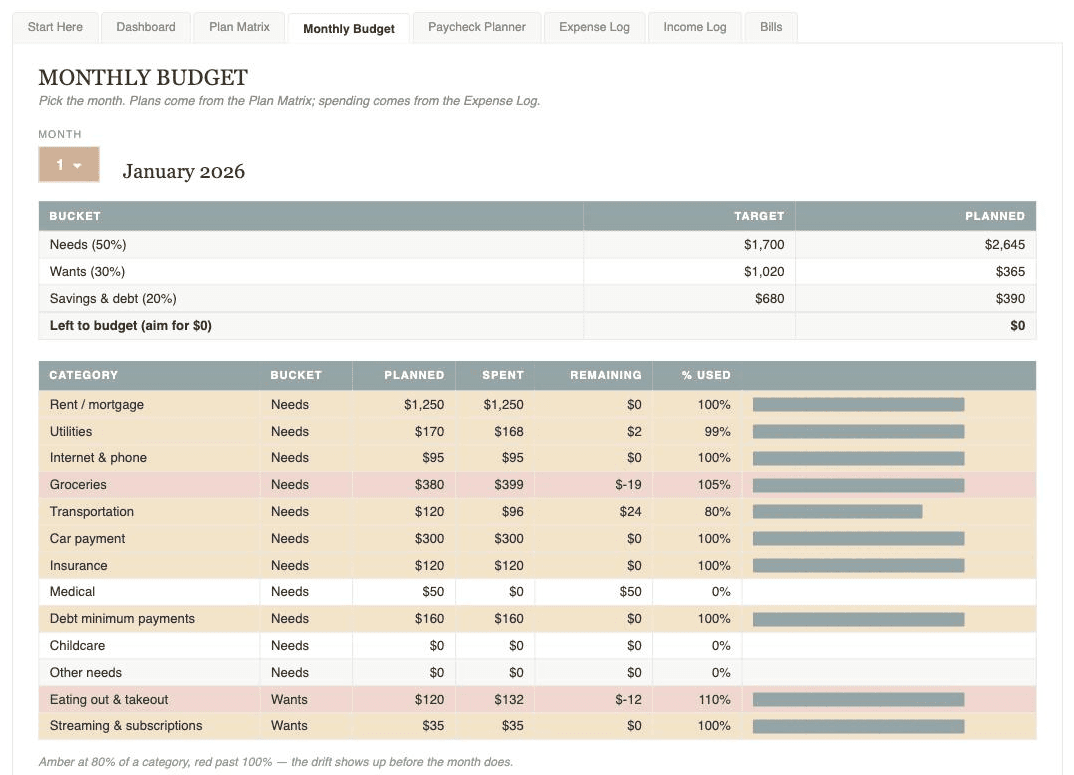
The free Sunday Budget planner provides monthly planned, actual, and remaining amounts. The tool performs calculations; you still decide which income is dependable and which categories receive priority.
Step 8: run a weekly budget review
A budget becomes useful when actual transactions are compared with the plan while choices can still change.
Set a recurring weekly review. Ten to twenty minutes is enough for a simple household once the system is current.
The weekly checklist
- Reconcile the current checking and credit-card activity.
- Categorize new transactions.
- Compare planned, spent, and remaining amounts.
- Look at bills and income due before the next review.
- Adjust flexible categories if one has changed.
- Record transfers between categories.
- Confirm that automatic payments have enough cash behind them.
If groceries run $40 over plan, do not erase the transaction or call the month ruined. Decide where the $40 comes from: another flexible category, the cushion, or a deliberate reduction elsewhere.
Reconcile credit cards correctly
Credit-card spending should enter the budget when the purchase happens, not again when the card payment leaves checking. Otherwise the same expense may be counted twice.
The card payment is the movement of cash to settle purchases already categorized. If the card has a carried balance, separate the required or extra payoff amount from current-month purchases so the debt plan remains visible.
Choose a budgeting method after seeing the numbers
A budgeting method is a rule for organizing the plan, not a replacement for complete data.
| Method | Useful when | Watch for |
|---|---|---|
| Simple spending plan | You want income, expenses, and a positive remainder | Unassigned money may disappear without labels |
| Zero-based budget | You want every available dollar assigned intentionally | A zero on paper can still fail if bill timing is ignored |
| 50/30/20 framework | You want a quick needs, wants, and goals comparison | Categories can be ambiguous and local costs may not fit the percentages |
| Paycheck budget | Income timing causes shortfalls or pay varies | Requires assigning bills and categories to specific deposits |
The 50/30/20 guide, zero-based budgeting guide, and paycheck budgeting guide explain each system in detail.
For a first month, choose the method that answers the immediate problem:
- If spending has no boundaries, use a simple or zero-based category plan.
- If bills collide before payday, use a paycheck or cash-flow budget.
- If you want a high-level comparison, use percentage categories as a diagnostic—not a pass-or-fail score.
Budgeting with a partner or shared household
Before discussing category limits, agree on the scope:
- Which income is shared?
- Which bills are shared?
- Which debts are individual or household responsibilities?
- Which savings goals are shared?
- How are shared expenses contributed to and tracked?
- What spending amount requires discussion first?
Joint accounts, separate accounts, and hybrid systems can all support a shared budget. The important control is one agreed record of shared obligations, contributions, due dates, and category balances.
Include personal spending categories when possible. The amounts do not have to be identical in every household, but the rules should be explicit and mutually understood.
Common beginner budgeting mistakes
Using gross salary instead of available income
Build the spending plan from money expected to reach the household after payroll deductions. Review deductions separately so retirement contributions, insurance, and taxes are not forgotten.
Guessing from an ideal month
Use statements. A category can be reduced over time, but the first plan needs an honest starting point.
Forgetting current account balances
Income and expenses explain the month; the opening balance explains whether the first bills can clear.
Ignoring due dates
A $3,400 income total does not help if $2,000 is due before the first $1,700 paycheck.
Treating transfers as new spending or new income
Moving cash between your accounts is usually a transfer. Categorize the purpose once.
Omitting annual costs
Divide predictable future expenses across the deposits remaining before they are due.
Making every category too strict
Variable expenses vary. Use a realistic estimate and a defined adjustment process.
Waiting until month-end to look
Review weekly so a category can be corrected before the month is over.
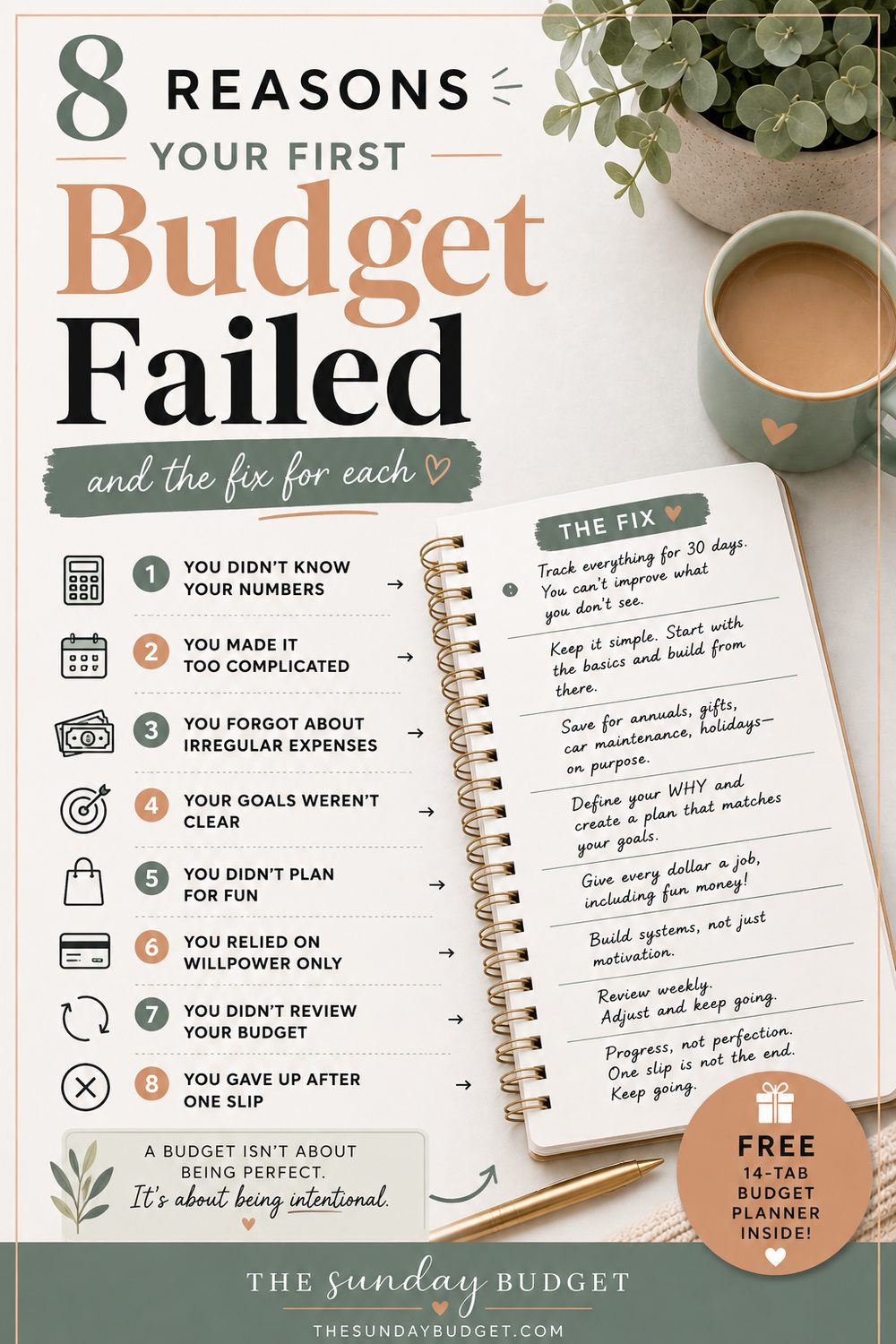
Quitting after an overspend
An overspend creates a reallocation decision. Record it, move money intentionally, and use the information in the next plan.
Frequently asked questions
How much should a beginner budget for each category?
There is no universal category amount. Use recent spending, upcoming obligations, household size, local costs, and current goals. Percentage frameworks can highlight tradeoffs but should not replace actual bills.
Should the budget include savings?
Yes. Record emergency savings, sinking funds, and other goal contributions as planned assignments. If essential bills cannot be paid, first protect urgent needs and review priorities rather than automating savings into an account you immediately have to withdraw.
Do I need a budgeting app?
No. Paper, a spreadsheet, a bank tool, or a dedicated app can work. Choose the tool you can update and reconcile. Automation can import transactions, but categories and account links still need review.
Should I budget monthly or by paycheck?
Use a monthly plan to see the whole month and a paycheck plan when timing matters. Many households benefit from both: monthly category targets plus each bill assigned to a specific paycheck.
How do I budget a three-paycheck month?
Include all three paychecks in that month's cash-flow calendar. Cover the full month first. Then assign the amount above the normal two-check plan to future bills, an income buffer, sinking funds, savings, debt, or another named goal. Do not assume the entire third check is free before checking annual and seasonal expenses.
What if income changes after the budget is finished?
Update the plan. If income falls, protect high-consequence expenses and reduce lower-priority assignments. If income rises, use a predetermined order so the extra does not become untracked spending.
What if a bill changes unexpectedly?
Replace the estimate with the actual amount and reassign the difference. If the increase is likely to recur, update next month's baseline.
When should I start a budget?
Start with the money and days remaining in the current month. Record the current available balance, expected income, bills due, and essential spending until the next planning date. You do not need to wait for the first day of a month.
How long does it take for a budget to become accurate?
The first plan is an estimate. Accuracy improves as you reconcile transactions and capture seasonal costs. Review the first three months closely, then compare against a full year as data becomes available.
Build your first budget this week
Create one page with:
- available starting balance;
- income expected this month;
- bills and due dates;
- variable category targets;
- non-monthly contributions;
- savings and debt assignments;
- a budget cushion if available; and
- a running balance between paydays.
Then schedule the first weekly review before spending decisions accumulate. A working budget is not a promise that every estimate will be right. It is a repeatable way to see the gap early, choose a response, and carry better information into the next month.

Written by
I fixed my own money with a spreadsheet and a Sunday morning, and now I build the tools I wish I’d had. I manage a dental practice in Greensboro, North Carolina, and I have never once told anyone their problem was the coffee.


