How to Set Money Goals You'll Actually Keep
By Nora Bennett · August 4, 2026

Every January, millions of people set the same money goal, "save more, spend less", and by February it's gone, not because they lacked discipline but because that isn't a goal; it's a mood. Money goals fail for structural reasons: they're vague, they're pure outcome with no system attached, and they're scheduled like wishes instead of like bills. This post fixes the structure, the five-part formula that makes goals keepable, a set of financial goals examples with the actual math attached, and the weekly ritual that does the "keeping" for you.
Why money goals die (it's the design, again)
The autopsy on abandoned money goals reads like the budgeting-mistakes list, because they're the same failures:
- Vague targets: "save more" can't be achieved because it can't be measured. More than what? By when?
- Outcome with no system: "$5,000 saved" names a destination with no vehicle. Outcomes are decided by systems; a goal without a weekly behavior attached is a lottery ticket.
- Annual scale: a December deadline in January is emotionally invisible for eleven months, then suddenly impossible. Nothing checked weekly ever surprises you in December.
- All at once: five simultaneous new goals is maximum difficulty on day one; the crash takes all five down together.
The five-part formula
A keepable money goal has all five, written down:
- A number, the target, exact.
- A date, creating the deadline math.
- The monthly (or weekly) required amount, number ÷ months. This is the goal's honesty test: if the required monthly doesn't fit your budget, the goal fails now, on paper, where it's cheap, resize the number or the date until it fits.
- A first action with a 48-hour deadline: open the account, automate the transfer, list the debts. Goals that start within two days survive; goals that start "next month" don't.
- A tracking home: where you'll see it weekly (the planner's Savings Goals tab computes required-monthly and the finish date automatically).
"Save more" becomes: "$1,000 emergency fund by November 30, $77/week, account opened and transfer automated by Tuesday, tracked on the Goals tab every Sunday." Same intention; entirely different survival odds.
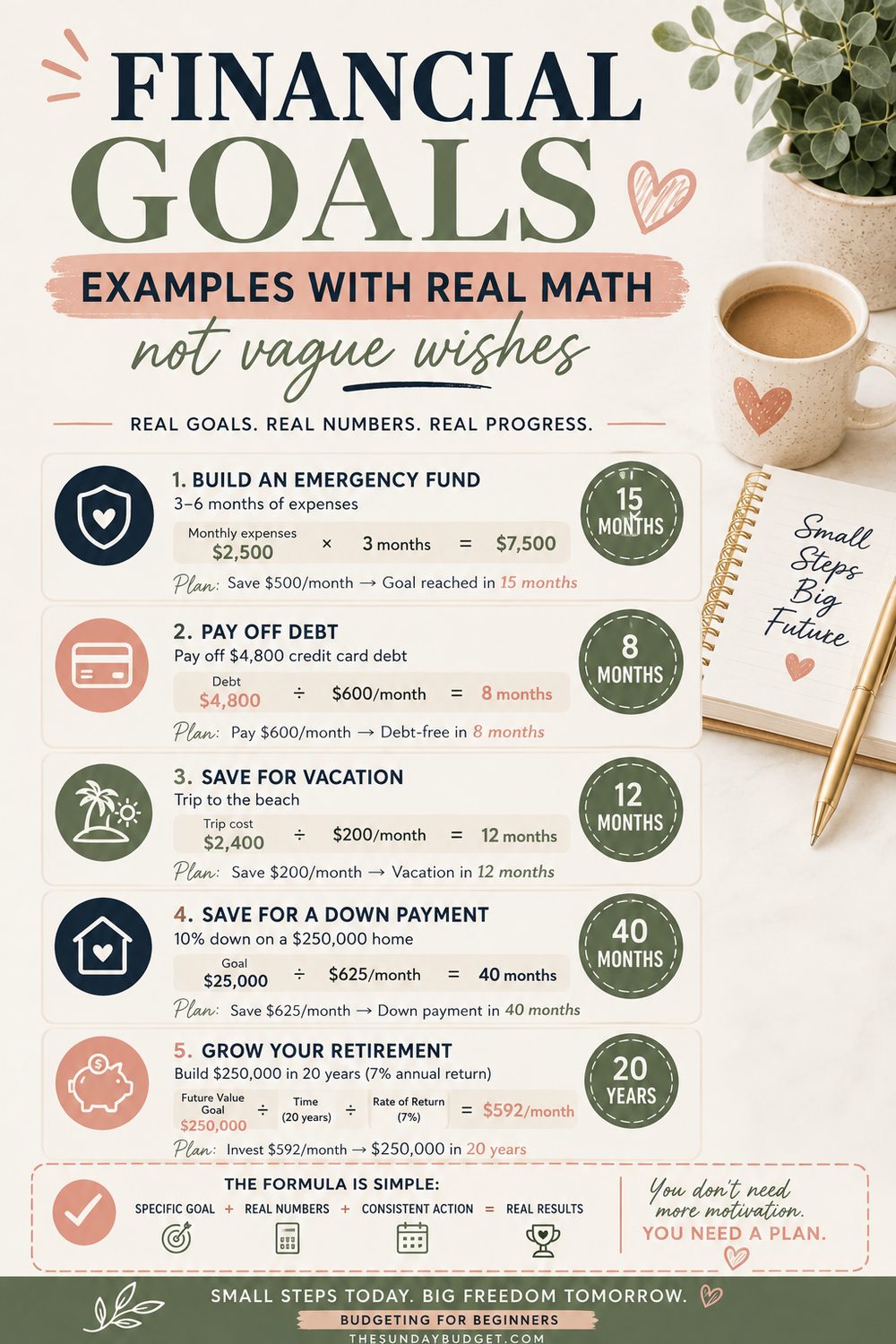
Financial goals examples, with the math done
Steal the one that matches your situation, each is formula-complete:
Stability tier:
- Starter emergency fund: $1,000 in 13 weeks, $77/week via three lanes. First action: open the named account.
- Kill the chaos tax: zero overdraft/late fees for 90 days, via autopay minimums + a $150 buffer. First action: the autopay audit.
- One month ahead on rent-cluster bills: one paycheck of buffer in 6 months, e.g., $1,570 ÷ 26 weeks = $60/week.
Momentum tier:
- First debt dead: store card ($900) gone in 5 months, $180/month via avalanche-with-a-snowball-opener. First action: the APR-sorted list.
- Sinking funds live: three funds (car, gifts, annual bills) running by month-end, ~$100/month total. First action: three named buckets, one automation.
- The grocery experiment: cut the food line $150/month via meal planning for 8 weeks. First action: this Sunday's five-dinner plan.
Growth tier:
- Three-month emergency fund: planner-computed target (3 × monthly needs, say $7,900) in 18 months = ~$440/month, lumps included.
- Retirement floor: contribution to the full employer match by next quarter, the instant-return move. First action: one HR email.
- Net worth +$5,000 this year: ~$417/month across debt principal + savings, tracked monthly, first Sunday.
- Income +$200/month: one side hustle at steady state by month 3. First action: the weekend step from the chooser matrix.
Run goals in seasons, not years
Annual goals have an eleven-month dead zone. Quarterly goals, one stability or momentum goal per 13 weeks: stay emotionally visible the whole way, produce four finish lines a year instead of one, and let you re-pick based on what actually happened rather than what January-you guessed. The 13-week length is why the emergency fund plan and the challenges are built at that scale: it's the longest distance motivation reliably survives.
One goal per season, two at absolute most, concentration beats coverage for goals exactly like it does for debts.
There is a specific Sunday I remember clearly: I sat down, opened the file, checked everything, and nothing was wrong. No fire, no surprise, nothing to fix. It took four minutes and I felt strange all morning, because I had never had a boring money day before. Boring is the whole goal. Boring is what winning looks like.
The keeping mechanism: Sundays, not willpower
Here's the part that actually answers the title. Goals aren't kept by resolve; they're kept by review cadence. The ten-minute Sunday reset already exists in your week. The goal just joins the agenda: did the automated transfer fire, what's the bar look like on the Goals tab, does anything need adjusting. Thirty seconds of attention, weekly, is the entire maintenance cost of a goal with a system behind it, because the system (the automation, the sinking fund, the meal plan) does the work between Sundays, and the review just catches drift while it's still small.
Two rules for the review: adjust without shame, a goal resized mid-season (life happened; the date moves a month) is a goal kept, not a failure; and celebrate the finish line properly. Each completed goal gets acknowledged before the next one starts, because finishing is the habit you're really building.
Frequently asked questions
Should goals be ambitious or realistic? The required-monthly test settles it without philosophy: ambitious enough that the monthly number matters, realistic enough that it fits the budget. A goal that fits snugly beats both the trivial one (no pull) and the fantasy one (guaranteed abandonment, and the abandonment costs future confidence).
What if my partner and I want different goals? Run the couples budget rules: one shared goal per season, chosen together, plus each person's own small goal from their own fun-money lane. Competing headline goals split the money and the motivation.
January 1st or any Sunday? Any Sunday: the fresh-start effect is real but renewable: quarters, months, birthdays, and Sundays all work. The worst start date is "after things settle down," which is a date that does not exist.
What about long goals, like a house deposit? Chunk them: the five-year deposit becomes this season's "$1,500 in the Deposit fund", same formula, nearer date, visible bar. Long goals survive as chains of seasons, not as five-year stares.
Write one this Sunday
Pick one example from the tier that matches your life, run it through the five parts, number, date, required-monthly, 48-hour first action, tracking home, and put it in the planner where Sunday-you will see it. One goal, one season, one weekly glance. That's the entire difference between the people whose money goals come true and the people who set them again every January.






Written by
I fixed my own money with a spreadsheet and a Sunday morning, and now I build the tools I wish I’d had. I manage a dental practice in Greensboro, North Carolina, and I have never once told anyone their problem was the coffee.