How to Track Your Net Worth (and Why It Matters)
By Nora Bennett · July 23, 2026

Net worth is the least dramatic useful number in personal finance. It does not buzz when you buy coffee. It does not congratulate you for a green budget category. It sits quietly behind everything, adding what you own, subtracting what you owe and showing whether years of financial decisions are moving you toward more stability.
That makes it powerful—but not magical. Net worth cannot tell you whether you can pay rent next Friday, whether your insurance is adequate or whether your spending reflects a life you enjoy. A person can have positive net worth and terrible cash flow. Another can have negative net worth, steady income and an excellent repayment plan.
Use net worth as a long-term scoreboard, not a grade. This guide shows you how to build the first statement, value each item conservatively, avoid double-counting, explain monthly changes and turn the result into one practical next move.
The formula
Net worth = total assets − total liabilities
Assets are things you own with measurable financial value. Liabilities are amounts you owe. The SEC's Investor.gov guide uses the same personal balance-sheet approach: list what you own, list what you owe and subtract.
If assets exceed liabilities, net worth is positive. If liabilities exceed assets, it is negative. Negative does not mean tracking failed. It means the statement found your starting coordinate.
Net worth is not income
Income measures money arriving during a period. Net worth measures the accumulated result at one point in time.
Someone earning $120,000 can have negative net worth after years of borrowing and spending. Someone earning $55,000 can build positive net worth through steady saving, affordable fixed costs and time. Income creates capacity; it does not automatically create wealth.
Net worth is not cash flow
Cash flow asks whether this month's income can cover this month's obligations. Net worth includes assets that may be inaccessible or slow to sell, such as retirement accounts and home equity.
Track both. Your budget helps you survive and direct the month. Net worth shows what those months are building.
Choose one tracking date and one method
Account balances move every day. If you record checking before rent one month and after rent the next, the comparison contains timing noise rather than useful information.
Use the same point each month:
- The final calendar day
- The first Sunday after month-end
- The same payday position, such as the day before the first paycheck
Monthly tracking is helpful while you are building savings or paying debt because it creates feedback. Quarterly is enough if market movement makes monthly reviews stressful. Investor.gov suggests updating a net-worth statement at least annually; there is no prize for checking it daily.
Write your valuation rules once and keep them consistent. Precision matters less than comparability. A conservative estimate calculated the same way each month is more useful than a supposedly perfect number built differently every time.
Build the account inventory first
Before entering balances, list every place money or debt can live. This prevents the most common problem: a neat spreadsheet that is missing half the picture.
Cash and deposit accounts
- Checking accounts
- Savings and money-market deposit accounts
- Emergency savings
- Sinking funds
- Certificates of deposit
- Cash-management accounts
- Meaningful physical cash
If several savings goals sit inside one bank balance, count the bank account once. You can track goal categories separately, but do not add the categories on top of the actual balance.
Investment and retirement accounts
- Employer retirement plans such as a 401(k) or 403(b)
- Traditional and Roth IRAs
- Taxable brokerage accounts
- Health savings accounts you own
- Education savings accounts you own or control
- Vested stock or other investments with a current value
Use the account's current market value. Do not subtract hypothetical future taxes or early-withdrawal penalties unless you intentionally maintain a separate after-tax planning view. Net worth is a balance sheet, not a forecast of every possible liquidation cost.
Property and other assets
- Home or other real estate
- Vehicle
- Business ownership with a defensible value
- Valuable personal property you would realistically sell
Most household contents do not belong here. A sofa was expensive; that does not mean it has useful resale value. Tracking every appliance, shoe and kitchen gadget creates work and flatters the total without improving decisions.
Liabilities
- Credit-card and store-card balances
- Mortgage and home-equity balances
- Auto loans
- Student loans
- Personal and installment loans
- Medical debt
- Buy-now-pay-later balances
- Taxes due
- Loans against retirement accounts
- Money owed to family or friends that you intend to repay
- Business debt for which you are personally responsible
Use the balance owed on the tracking date. For installment debt, the lender's payoff amount may differ slightly from the displayed principal because of accrued interest or fees. Pick one source and use it consistently.
Where to find the numbers
You should not need to guess most balances.
| Item | Best starting source |
|---|---|
| Checking and savings | Current bank balance or monthly statement |
| Retirement and investments | Account market value on tracking date |
| Credit cards | Current balance on tracking date |
| Mortgage and loans | Servicer principal or payoff balance |
| Student loans | Loan-servicer dashboard |
| Vehicle | Conservative private-party or trade-in estimate |
| Home | Consistent conservative estimate, appraisal or comparable-sales method |
| Forgotten debts | Credit reports plus your own records |
A credit report can help locate credit cards and loans you forgot, but it may not include every debt and balances may lag. Consumer.gov explains how to review reports and directs consumers to AnnualCreditReport.com for free reports. Do not pay a subscription merely to complete a net-worth statement.
Also check email and bank transactions for buy-now-pay-later plans, family loans, medical payment plans and taxes due. A clean credit report is not a complete liability list.
How to value the difficult assets
The goal is not to produce an appraisal-grade statement. It is to avoid changing the answer because you are having an optimistic Tuesday.
Your home
Choose one repeatable method:
- A recent professional appraisal
- A conservative estimate based on comparable nearby sales
- The midpoint of two reputable automated estimates
- A deliberately conservative fixed estimate reviewed quarterly
Do not increase the value because you renovated the kitchen by $20,000. Cost and market value are not the same. Do not update the home monthly based on every automated wobble; quarterly or annual updates usually produce a cleaner trend.
Count the home's full estimated value as an asset and the mortgage as a liability. The subtraction produces estimated home equity.
Your vehicle
Use a conservative resale estimate for the exact age, mileage and condition. Update quarterly or twice a year. The balance will usually fall over time, even while the loan also falls.
Count the vehicle and loan separately. A $20,000 car with a $17,000 loan contributes roughly $3,000 before selling costs; it is not a $20,000 increase to net worth.
A business
If the business is small, dependent entirely on you and has no realistic buyer, omit a speculative value. Count business cash or investments that legally belong to you only if your accounting method does so consistently and does not double-count them.
If you use a business valuation, document the source, method and date. Revalue quarterly or annually, not whenever revenue has a good week.
Personal property
Include only items with a meaningful, defendable resale value: valuable jewelry, collectible instruments or equipment you would genuinely sell. Use resale value after likely fees, not replacement cost or emotional value.
An easy rule: if selling it would require dozens of individual listings and the total would not change a financial decision, leave it out.
A worked example
Here is a simplified first statement:
| Assets | Value | Liabilities | Balance |
|---|---|---|---|
| Checking | $1,100 | Credit card | $2,400 |
| Emergency savings | $1,500 | Auto loan | $8,900 |
| 401(k) | $4,800 | Student loans | $12,500 |
| Vehicle | $9,200 | ||
| Total assets | $16,600 | Total liabilities | $23,800 |
Net worth = $16,600 − $23,800 = −$7,200
The useful question is not “Is −$7,200 good?” It is “What is the clearest next move?”
This person has $2,600 in cash, credit-card debt and a car with only $300 of estimated equity. Depending on interest rates, income stability and immediate risks, the next move might be preserving a starter emergency buffer while directing extra cash to the credit card. Net worth identifies the map; a budget and debt plan choose the route.
Track three views, not just one dramatic total
One number can hide useful changes. Keep these three lines:
1. Total assets
This shows what you own before debt. It helps distinguish growth from a debt-only improvement.
2. Total liabilities
This shows whether debt is shrinking. Track it even if assets or markets move in the opposite direction.
3. Net worth
This combines both sides. A month can be successful when liabilities fall even if investment values temporarily decline.
You may also track liquid assets—cash and investments that can be accessed relatively quickly—as a separate line. Do not call it a universal “liquid net worth” unless you define exactly which assets and liabilities are included; that phrase is used inconsistently. A simple liquid-assets total beside total debt is often clearer.
The ten-minute monthly ritual
On the same date each month:
- Open each account directly or use its statement.
- Record current asset balances.
- Record current liability balances.
- Update home and vehicle values only on their chosen schedule.
- Calculate totals and net worth.
- Compare with last month and three months ago.
- Write one sentence explaining the largest change.
- Choose one action for the next month.
The free Sunday Budget planner gives you labeled asset and debt columns, monthly rows, automatic totals and month-over-month changes. Set the account names once, then update the values during the first Sunday reset after month-end.
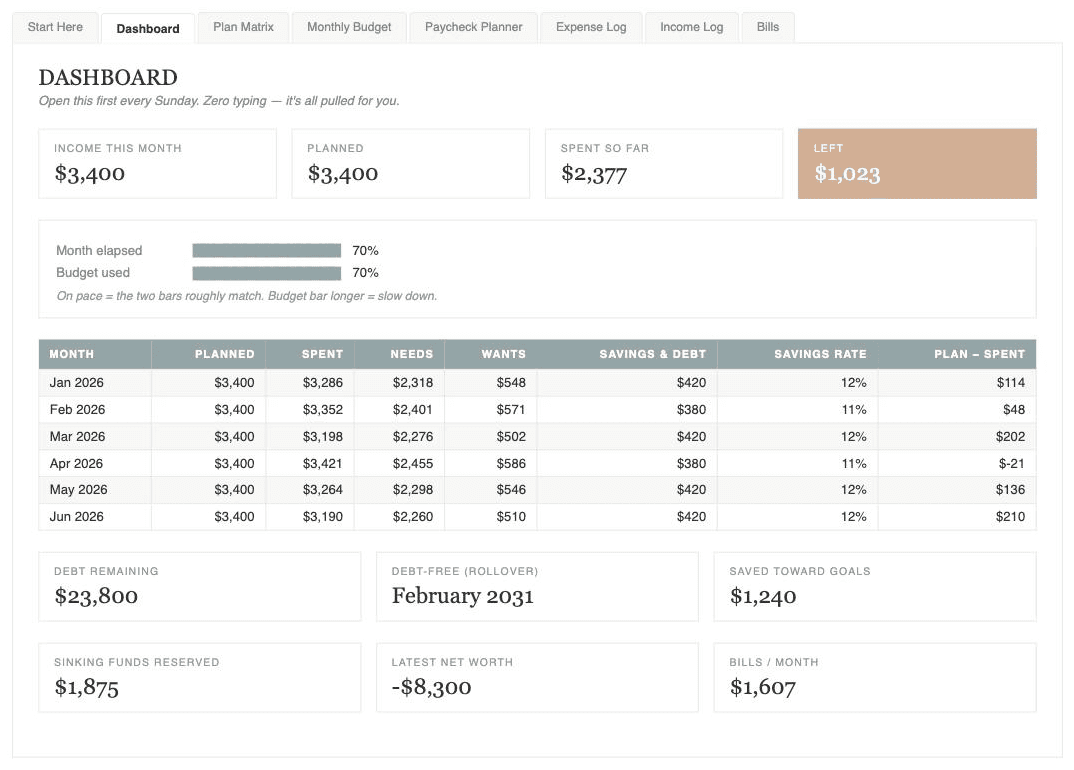
Do not skip the ugly month. A chart that excludes inconvenient data becomes decoration.
Explain the change instead of merely coloring it
Net worth can rise or fall for several different reasons:
- Money added to savings or investments
- Debt principal repaid
- New borrowing
- Investment market movement
- Home or vehicle estimate changes
- Interest, fees or withdrawals
- Large planned expenses
Use a simple change note:
Net worth rose $620: $300 saved, $240 of debt principal repaid and about $80 of investment growth.
This prevents a rising market from being mistaken for excellent budgeting, and a market decline from being mistaken for personal failure.
The principal-versus-payment trap
A $400 loan payment does not always improve net worth by $400. Part may be interest, which is an expense, while the principal portion reduces the liability. Use the actual balance change when updating debt.
The credit-card payment puzzle
Paying a $1,000 credit-card balance from checking reduces cash by $1,000 and debt by $1,000. Net worth is unchanged at the moment of payment because the purchase already reduced net worth when the liability appeared. The benefit is avoiding future interest and freeing cash flow—not a magical $1,000 jump on payment day.
Transfers are not growth
Moving $500 from checking to savings changes the location of the asset, not total assets. Likewise, moving money from one investment account to another should not change net worth.
Common double-counting mistakes
- Adding savings goals and the bank balance. If emergency and vacation funds are categories inside one account, count the account once.
- Counting home equity as an asset while also counting full home value. Use full home value and mortgage debt, or equity alone—not both.
- Counting a vehicle's full value but omitting its loan. Include both sides.
- Adding paycheck income before it reaches an account. Income is not an asset until it is received or legitimately owed as a receivable you track.
- Counting retirement contributions twice. The contribution is already inside the account balance.
- Using credit limits as assets. Available credit is borrowing capacity, not something you own.
- Adding a tax refund before it is confirmed. Wait until the amount is known and receivable or deposited.
- Counting an expected inheritance. It is not your asset until it legally becomes yours.
Couples and shared finances
Choose the view that matches how decisions are made:
- Household statement: all jointly and individually owned assets and all debts for both partners
- Individual statement: only assets and liabilities legally belonging to one person
- Both: one household view plus individual views for transparency or planning
Do not include the full value of a jointly owned asset in two individual statements. If ownership is split, use an agreed ownership percentage and document it.
Partners may bring unequal assets or debt into a relationship. The statement is an inventory, not a verdict about effort or character. Decide together which obligations are shared in practice, but do not rewrite legal ownership in the spreadsheet.
Privacy and account security
A net-worth tracker contains sensitive information even without login credentials.
- Never store passwords, full account numbers or security answers in the sheet
- Use labels such as “Main checking” or the final four digits only
- Protect the device and cloud account with a strong unique password and multifactor authentication
- Limit sharing permissions
- Avoid entering balances on public Wi-Fi if you must log into accounts
- Keep a secure backup or export
- Delete old shared copies after moving the tracker
If an app connects to financial accounts, review what data it accesses, how access can be revoked and whether you are comfortable with that arrangement. Manual monthly entry is slower but reduces how many services hold account access.
What actually moves net worth
The durable levers are not exciting:
- Spend less than you earn and direct the difference
- Build emergency savings
- Pay down high-cost debt with a snowball or avalanche plan
- Capture employer retirement matches when eligible and appropriate
- Avoid borrowing for assets that lose value quickly
- Increase income without increasing every lifestyle category
- Protect against catastrophic losses with appropriate insurance
- Give long-term investments time rather than reacting to every market move
Net worth improvement can be slow while you build stability. A new emergency fund increases assets. Using part of it for a real emergency lowers assets, but may prevent expensive debt. The number fell; the system worked.
How to read a negative net worth
Do not invent an age-based deadline. Education, housing, family obligations, health, geography and starting support differ enormously.
Break the number into a sequence:
- Make every minimum payment on time.
- Build a small emergency buffer.
- Stop high-interest balances from growing.
- Pay down the highest-priority debt.
- Capture available retirement benefits when the budget can support them.
- Review progress by quarter, not mood.
Consumer.gov notes that credit reports list cards, loans and reported balances. Reviewing yours can uncover errors or unknown accounts, but net worth and credit score remain different measures. Net worth asks what you own minus what you owe. Credit history describes how you handle reported borrowing.
A quarterly review that produces action
Every three months, answer:
- Did total liabilities fall?
- Did cash reserves become safer?
- Was the change driven by contributions or market movement?
- Which account changed most, and why?
- Is any asset value stale or unrealistic?
- Is any debt missing?
- What single action would improve the next quarter?
Good actions are specific:
- Increase the weekly emergency transfer from $20 to $30
- Add $100 to the highest-rate card payment
- Review an old retirement account rollover with a qualified professional
- Revalue the vehicle next quarter
- Add the overlooked medical payment plan
“Grow net worth” is not an action. It is the result.
Frequently asked questions
Should I include my home? Yes for total net worth: include a conservative current value and the mortgage balance. Also keep cash and investments visible separately because home equity cannot usually pay an ordinary bill without selling or borrowing.
Should I include my car? Include a conservative resale value and the auto loan. Update the value quarterly or twice a year rather than chasing monthly estimates.
Should retirement accounts count if I cannot access them yet? Yes. You own the account, so include its current value. Keep retirement and liquid cash in separate rows so the total does not hide accessibility.
How often should I update investments? Use the balance on your regular tracking date. Do not check more often just to update net worth; daily market movement is noise for a long-term household statement.
My net worth fell even though I saved. Did I fail? No. Markets, asset estimates, interest or a planned expense may have outweighed the contribution temporarily. Review total debt, cash reserves and the three- or six-month trend.
Is net worth the best measure of financial health? It is one useful measure, not the only one. Cash flow, emergency savings, debt cost, insurance, retirement readiness and financial well-being matter too. The CFPB maintains a separate Financial Well-Being Scale because security and freedom of choice are not captured by a balance sheet alone.
Should I use an app or a spreadsheet? Use the method you will update accurately. Apps automate balances but require account connections and may classify items incorrectly. A spreadsheet requires manual entry but makes assumptions visible and is easy to archive.
Calculate the first honest number
This Sunday, build the account inventory before calculating anything. Gather current balances, choose conservative valuation rules and record the date. Then subtract total liabilities from total assets and save the result without editing it into something more flattering.
Next month, repeat the same method. Explain the largest change and choose one action.
The first number is only a coordinate. The consistent series is the map.







Written by
I fixed my own money with a spreadsheet and a Sunday morning, and now I build the tools I wish I’d had. I manage a dental practice in Greensboro, North Carolina, and I have never once told anyone their problem was the coffee.