15 Side Hustles That Actually Work in 2026 (AI, Automation and Real Money)
By Nora Bennett · July 4, 2026

Most side hustle lists you'll read this year were written in 2019 and reheated. Walk dogs. Babysit. Deliver food. That advice isn't wrong exactly, but it is incomplete for 2026. It ignores the biggest shift in how ordinary people produce and sell work since the smartphone: AI made generic output cheap, and moved more of the value to judgment, distribution and implementation.
Here's what I mean, because it's the basis of this entire post. An AI tool can produce a plausible first draft, mockup or workflow in minutes. That does not make the result accurate, useful or ready for a customer. What remains valuable is knowing what to make and for whom, getting it in front of people who care, checking every important detail, and being the human who makes the thing actually work inside a real business.
That's where the money went. This list follows it.
You do not have to become an engineer to benefit from that shift. A dental office does not care how impressive your prompt was; it cares whether the recall tracker catches overdue patients, whether the booking form works on a phone, and whether someone fixes it when it breaks. The technical floor dropped. The responsibility did not.
How this list is filtered
Every entry passed four tests: startable this weekend (no new degree or long certification path), little or no capital at risk (nothing to stock or gamble), a rate I'll state plainly including the unglamorous ranges, and actually a job, not a funnel (if it pays mainly for recruiting others, or requires you to buy in first, it's in the traps section instead). The rates below are reasonable starting quote ranges, not promises; your market, experience and project scope will move them.
One more rule I applied ruthlessly: if AI can do the whole thing end to end, it isn't a business. Anything where your only contribution is pasting a prompt is already worth close to nothing, because ten thousand people can do it by Thursday. Every hustle below has a human bottleneck that's genuinely hard to remove.
The honest AI reality in 2026
AI is doing more complete tasks than it did a year ago. The 2026 Anthropic Economic Index describes longer, more agentic work sessions rather than simple back-and-forth chats. That makes these services faster to deliver, but it also means the button-pushing part is becoming less valuable every month.
| Service | AI can accelerate | The part a client pays you to own |
|---|---|---|
| Automation | Drafting steps, formulas and code | Requirements, permissions, testing and monitoring |
| Sites and small tools | Layouts, copy and prototypes | Scope, accessibility, security, launch and maintenance |
| Content operations | Transcripts, drafts and variations | Positioning, facts, rights, taste and publishing |
| AI training | Examples and practice exercises | Company policy, privacy, teaching and follow-up |
| Digital products | Research summaries and first drafts | The problem, usability, customer support and distribution |
That last column is the business. If you cannot confidently own it yet, build a demo with fake data and learn before touching a client's live system. Keep your tool budget at $0 until you have a working sample, then set a monthly ceiling before free trials quietly become five subscriptions. AI lowers startup cost; it does not remove revisions, sales calls, software fees or support.
Lane 1: Implementation, the highest-paying lane
Small businesses have heard about AI relentlessly for three years and mostly still don't use it. Not because they're stubborn, but because nobody will sit with them for two hours and make it work inside their specific mess. That gap is the best-paid opportunity on this list, and it barely appears in other side hustle articles.
1. Automation building (Zapier, Make, n8n), $300–1,500 per workflow, $200–600/month retainers. Connect the tools a business already pays for so data stops being retyped by a human. A form submission creates the client record, sends the intake email, adds the calendar hold and files the invoice. Add an AI step to summarize or categorize and it feels like magic to the client. Every plumber, clinic, studio and agency has three of these waiting. This weekend: pick one business you know, map one annoying manual process on paper, build it, show them. The demo is the pitch.
2. Vibe coding small tools and sites (Lovable, v0, Cursor, Replit, Bolt), $500–2,500 per project. The one people underestimate. AI coding tools let a non-engineer ship a real working thing: a booking page, a quote calculator, an internal dashboard, a client portal. Small businesses need these constantly, and agency quotes start at five thousand. The caveats matter here, so read them twice. You are responsible for the thing working: hosting, the domain, a handover document, and what happens when it breaks in March. Charge for maintenance or hand off cleanly, because "I built it with AI" is not a defence when a client's booking form goes down on a Monday. And stay away from payments, medical records and anything regulated until you genuinely know what you're doing. This weekend: rebuild something you already understand, using fake data. A safe, working demo is better proof than a folder of AI certificates.
3. AI setup and training sessions for teams, $75–200 per session, $500–1,500 for a half-day. Sit with a real estate team, a law office, a clinic, and teach them to use AI for their actual work: the specific prompts, where it lies, what they must never paste into it, how to check output. The useful version is narrow and practical; a generic tour of popular tools is already free online. This weekend: write a one-page outline for a two-hour session aimed at one industry you know. Offer it to one business at half price in exchange for a testimonial.
4. AI-assisted bookkeeping and back-office, $25–45/hour, retainers $400–1,200/month. Transaction categorization, invoice chasing, receipt reconciliation, inbox triage. AI can speed up the tedious middle; the client is paying for accuracy and for someone who follows up. Keep the boundary clear: bookkeeping is not tax advice, and sensitive financial data does not belong in a consumer AI account. Sticky, recurring, deeply unsexy income. This weekend: use sample transactions to build a month-end cleanup demo and a checklist. Do not practice for the first time inside a real client's books.
5. Local SEO and Google Business Profile management, $200–600/month per client. Half the small businesses in your town have a rotting profile: wrong hours, no photos, unanswered reviews. Unglamorous, ongoing, and directly tied to their phone ringing, which is what makes it easy to keep getting paid. This weekend: find three local businesses with visibly neglected profiles and send each one a specific, free, useful fix. The audit is the sales pitch.
Lane 2: Attention and content operations
AI can generate content. It cannot decide what's worth saying, hold a consistent voice, or be accountable on Monday morning. So the work moved from making content to running content.
6. Social media management for local businesses, $300–800/month per client. AI can shorten drafting and variation work, but scheduling, replying, approvals and reporting still take human time. Your value is local knowledge, judgment and reliability, not how many posts you can generate before breakfast. This weekend: build a two-week content calendar for one local business, unprompted, and send it.
7. Content repurposing service, $400–1,200/month per client. One podcast episode or long video becomes clips, posts, a newsletter and a blog piece. AI does transcription, cutting and drafting; you supply taste and actually publish. Creators and consultants pay monthly because this is the exact task they always postpone. This weekend: repurpose one episode for a mid-sized creator, free, and send it. It converts more often than you'd think.
8. UGC and short-form video for brands, $100–400 per video. Brands still need real people demonstrating real products. No follower count required: this is production work, not influencing. AI can help with scripts and shot lists, but the useful deliverable is believable footage a brand has permission to use. This weekend: film three spec videos for products you already own, and pitch five brands with them attached.
9. Newsletter and email operations, $300–900/month. Businesses know email is the highest-return channel they own, and almost none of them send anything. Writing, sequencing, list management, reporting. AI drafts; you own the strategy and the send button. This weekend: write one welcome sequence for a local business and show them what it would earn.
Lane 3: Products, slow to start, real ceiling
10. Spreadsheet and digital templates, $7–29 each; $0–500+/month depending on catalog and traffic. My lane, so I'll be blunt: this compounds slowly and most shops earn very little in months one to three. What sells is a real tool for a specific person's real problem, not another minimalist planner page. AI slop flooded this market, which is genuinely good news for anyone building something that works, because the bar for "obviously made by a human who cared" is now very low to clear. The full spreadsheet-skills guide is here.
11. Micro-tools and tiny SaaS, $0 for months, then $200–2,000/month if it lands. The same builders from #2 mean one person can now ship a small paid tool: a niche calculator, a scheduling widget, an industry-specific tracker. Highest ceiling here, longest odds, and you inherit support forever. Only build something you've personally needed, and only after a few paid client projects have taught you what shipping really costs. The practical micro-SaaS guide breaks down founder stories, validation, pricing and a 30-day launch plan.
12. Selling your own stuff, $100–500 in a single weekend. Not a business, but the fastest honest money in this article and the zero-risk audition for flipping. Ten listings, phone photos, done before lunch. Genuinely the first thing to do if you need cash this month rather than this quarter.
Lane 4: Paid by the hour, starting Monday
13. AI model evaluation and data work, $15–40/hour when projects are available. The AI industry pays humans to rate outputs, write reference answers and label data, recruited through specialist platforms. It can be remote and flexible, but it is not dependable income: volume is inconsistent, qualification does not guarantee work, projects vanish overnight, and rates vary by specialty. This weekend: research two established platforms and apply without paying a fee. A legitimate platform pays you; you do not pay it to unlock work.
14. User testing and research studies, $10–60 per test, $50–150 for live interviews. Companies pay to watch real people use their products. Not steady income, and screeners filter heavily, but the effective hourly rate is good and it's done from the couch. This weekend: register on two platforms and take every screener for a fortnight to prime the pipeline.
15. Tutoring, including "how do I use this AI thing", $20–60/hour, more for professional clients. Academic tutoring still pays, but the growth area is teaching adults the tools: the small business owner, the nervous professional, the parent trying to help with homework. You need to be one chapter ahead, not an expert. This weekend: one platform profile, plus messages to three people you already know.
The floor nobody should be ashamed of
If you need money this week, in-person work still pays fastest and AI cannot touch it: cleaning ($25–50/hour), pet sitting, elder errand-running, yard work, moving help. I left these out of the main list because they appear in every article ever written and you already know they exist, not because they're beneath anyone. They're honest work with same-week cash and no learning curve. The lanes above pay better eventually; this floor pays on Saturday.
What things actually pay, side by side
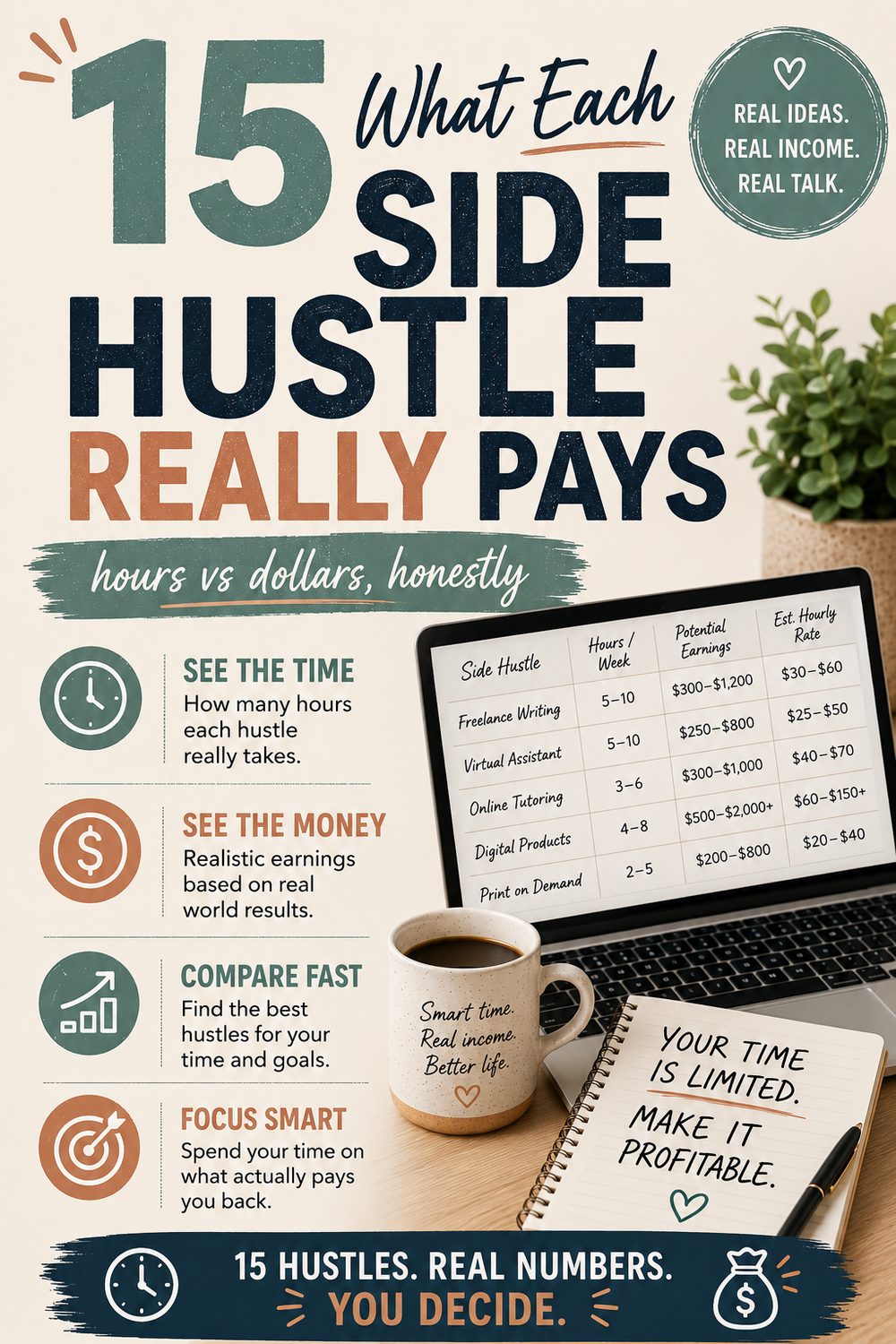
| Hustle | Realistic rate | First dollar | Ceiling |
|---|---|---|---|
| Automation building | $300–1,500/workflow | 2–4 weeks | High |
| Vibe-coded sites and tools | $500–2,500/project | 2–6 weeks | High |
| AI training sessions | $75–200/session | 1–3 weeks | Medium |
| Bookkeeping / back-office | $25–45/hour | 1–2 weeks | Medium |
| Local SEO | $200–600/month | 2–4 weeks | Medium |
| Social media management | $300–800/month/client | 2–4 weeks | Medium |
| Content repurposing | $400–1,200/month/client | 2–4 weeks | Medium |
| UGC video | $100–400/video | 2–6 weeks | Medium |
| Templates and products | $7–29/sale | 1–6 months | High, slow |
| Model evaluation / data work | $15–40/hour | 1–2 weeks | Low |
| In-person services | $20–50/hour | Days | Low |
Two patterns worth noticing. Services pay first; products pay later. And the lanes that combine AI speed with human accountability have the higher ceiling, because the client is not buying access to an AI tool. They're buying someone who will make it work and answer the phone.
How to get the first client in fourteen days
You need enough skill to deliver safely, but another week of tutorials is not always the missing piece. Beginners also stall because they have no specific sample and rely only on crowded job boards.
- Days 1–3: pick one lane and one audience. "Appointment-reminder automation for dental offices" is easier for a buyer to understand than "AI services."
- Days 4–7: build one real thing, free, unrequested. The workflow, the booking page, the content calendar, the profile audit. Not a proposal. The actual artifact.
- Days 8–10: give it to three businesses that fit. Not a pitch, a gift with one sentence: "I built this for you, it's yours either way. If it's useful, I do this properly for [price]."
- Days 11–14: discount deliberately, not indefinitely. Put the normal price and the first-project discount in writing, then adjust the next quote using what you learned about the real scope.
That sequence works because it inverts the normal pitch. You've proven you can deliver before asking for anything, which is exactly what a small business owner who has been burned by an agency needs to see.
The traps, in detail
This category attracts more nonsense than any other, so let me be specific about what will waste your weekend.
- "Faceless AI content" channels and blogs. Mass-produced, interchangeable content is a weak business. YouTube's monetization policy specifically excludes repetitive or mass-produced template content that lacks original value. AI can support a real editorial point of view; it cannot substitute for one.
- AI art and print-on-demand slop. Flooded market, near-zero prices, and marketplaces increasingly require AI disclosure and restrict listings. If your entire product is a prompt output, so is everyone else's.
- Courses about AI side hustles, especially any costing more than the hustle's first month of earnings. The information is free; what's missing is sequencing, which this post just gave you.
- "Prompt packs" as a business. A prompt is a sentence. It has no defensible value, and the next model update makes it obsolete.
- Anything requiring you to buy in first: inventory kits, "founder positions", paid certifications for services nobody asks to see certified. If the product is mainly sold to new recruits rather than customers, the product is you.
- Auto-applying and mass-generated freelance proposals. Platforms detect and penalize it, and clients can smell it. It's the one place AI actively costs you money.
- Passive income claims generally. The only genuinely passive things here are #10 and #11, both requiring months of unpaid work first, and neither passive while you're building.
Rules you actually need to know
Disclose where required. Marketplaces and app stores increasingly require labelling of AI-generated or AI-assisted work, and some clients contractually forbid it. Ask, disclose, put it in writing. Getting delisted over a checkbox is a miserable way to lose a shop.
Never paste client secrets into consumer AI tools. Patient data, customer lists, contracts, anything covered by privacy law. If you handle sensitive information, use tools with the appropriate agreements and settings, or don't handle it at all. This is the mistake that ends businesses rather than merely embarrassing them.
Check the work. AI invents facts, numbers, citations and law with total confidence. You are being paid to be the person who checks. A client who catches an error you didn't will never hire you again, and they'll be right not to.
The boring paperwork paragraph
Side income is taxable income. In the US, the IRS says net self-employment earnings of $400 or more generally require a tax return with Schedule SE, and quarterly estimated payments may apply. A useful starting habit is to open a sinking fund named "Taxes" and move 25% of every payout into it, then use Form 1040-ES or a tax professional to calculate your actual number. Track expenses and any business mileage, keep tool subscriptions as potential business expenses, and log every payout in the planner's Income Log so your variable-income budgeting runs on honest numbers.
Give the money a job before it arrives
Side hustle income that lands in checking evaporates like any other unassigned money. Decide the split before the first payout. A common one: 25% to the taxes fund, 50% at the debt or the emergency fund, 25% yours to enjoy guilt-free, because a hustle with no personal payoff burns out by month two.
Choosing yours
What's your energy? Building alone (1, 2, 11), people-facing (3, 6, 15), or heads-down repetitive (4, 13)? A hustle that fights your temperament loses to your couch by week three.
How fast do you need money? This week: the physical floor, or #12. This month: #4, #13, #15. This quarter: #1, #2, #3, #6. This year: #10, #11.
Floor or ceiling? Hourly work has a high floor and a low ceiling. Implementation work starts slower and climbs much higher, because you can raise rates, add retainers and eventually subcontract. Most people should run one floor hustle for cash while growing one ceiling hustle underneath it.
Frequently asked questions
Do I need to be technical for the AI and automation ones? For #1, #2 and #3: not to start learning or building demos. You need to be comfortable clicking around unfamiliar software, persistent when something breaks, and honest about what you cannot safely deliver yet. What you cannot skip is testing the thing properly before handing it over, especially when it touches private data, payments or a client's daily operations.
Isn't AI going to eat these jobs too? It will eat the parts that are pure production, and it already has. What it doesn't do is show up accountable, understand one specific business's mess, take responsibility when something breaks, or maintain a relationship. Every hustle in the top three lanes is deliberately built around that gap. Hedge anyway: build client relationships, not platform dependence.
How much can I realistically earn? For the service lanes at 5–10 hours a week, $200–800 a month is the honest common range within a few months, with implementation work climbing as your rates rise. That's enough to transform a debt payoff or fund an emergency account in a season. Anyone promising $5k a month by Thursday is selling you a course.
What tools should I actually learn first? One AI assistant used daily until it's second nature, one automation platform (Zapier or Make to start, n8n when you want more control), and one AI builder (Lovable, v0, Replit or Cursor) if you're going the vibe-coding route. That's it. Tools churn constantly; the transferable skill is decomposing a business problem into steps, and that survives every tool change.
Will side income affect my benefits or taxes badly? Taxes are handled by the 25% rule above. Benefits: if you receive income-tested support, extra earnings can affect eligibility thresholds, so check your programs' limits before ramping up rather than after.
This weekend, then
Pick one lane, one audience, and build one real thing for free before Sunday night. Not a proposal, not a plan. The actual artifact. The technical barrier that used to sit between you and this work has genuinely collapsed; what's left is choosing something specific and following through, and those were always the real barriers anyway.
The spending side of your money now has a system. As of this weekend, the income side has one too.





Written by
I fixed my own money with a spreadsheet and a Sunday morning, and now I build the tools I wish I’d had. I manage a dental practice in Greensboro, North Carolina, and I have never once told anyone their problem was the coffee.