Paycheck Budgeting: How to Budget by Paycheck (Biweekly Guide)
By Nora Bennett · July 12, 2026

Here's a quiet mismatch that breaks a lot of budgets: nearly every budgeting guide assumes monthly money, but most people are paid biweekly, twenty-six checks a year that refuse to line up with the calendar. If you've ever had a perfectly good monthly budget fall apart because rent was due on the 1st and payday was the 15th, the problem wasn't you. It was the units. Budgeting by paycheck fixes it: instead of one monthly plan your paychecks don't match, each check gets its own small plan, its own bills, its own savings, its own spending money, before it arrives.
Why monthly budgets break on biweekly pay
A monthly budget answers "can I afford this, this month?" But your money doesn't arrive monthly. It arrives in two (occasionally three) chunks, and your bills don't politely wait for the average. They cluster: rent and the car payment near the 1st, utilities mid-month, subscriptions wherever they feel like it.
So you can be completely fine on average and still overdraw on the 9th: right after check one paid the rent cluster and right before check two arrives. Timing problems masquerade as money problems, and they generate overdraft fees, credit card bridging, and the persistent feeling of being broke on a decent income.
Paycheck budgeting dissolves the problem by matching the plan to the money's actual rhythm: every check knows its jobs before it lands.
Marcus fixes HVAC systems, so our second income swings about $900 between a quiet March and a brutal August. Budgeting by paycheck is the only thing that ever made that livable: we plan against his lowest realistic check and treat the summer overage as a lump with a job already assigned to it.
The core mechanic: every check gets a plan
For each paycheck, answer four questions, in this order:
- Which bills does this check cover? (The ones due before the next check.)
- What does it send to savings and debt? (Split your monthly amounts across checks.)
- What's its share of flexible spending, groceries, gas, fun, until next payday?
- What stays behind as buffer? (Your checking floor: more on this below.)
When those four answers use up the whole check, it lands with its assignments waiting, money flows through the plan, and the space between paydays stops being a mystery. It's zero-based budgeting at paycheck scale: every dollar of every check, employed.
The worked example: $1,569 per check
Using this site's standard $3,400-a-month earner: paid biweekly, each check is $3,400 × 12 ÷ 26 = $1,569 (memorize the ×12÷26 move. It converts any monthly number to its true biweekly share). Their bills, sorted by due day, split naturally into two clusters:
Check 1 (lands the 1st), covers bills due the 1st–14th:
| Job | Amount |
|---|---|
| Rent (due 1st) | $1,250 |
| Streaming bundle (due 8th) | $22 |
| Car insurance set-aside (due 5th, quarterly ÷ 3) | $120 |
| Groceries & gas until next check | $130 |
| Buffer stays in checking | $47 |
| Check spoken for | $1,569 ✓ |
Check 2 (lands the 15th), covers bills due the 15th–31st:
| Job | Amount |
|---|---|
| Electricity (due 15th) | $120 |
| Internet + phone (due 20th) | $95 |
| Car payment (due 20th) | $300 |
| Debt minimums | $160 |
| Savings & sinking funds | $390 |
| Groceries, gas & fun until next payday | $504 |
| Check spoken for | $1,569 ✓ |
Notice the asymmetry: check 1 is nearly all rent, check 2 carries the savings and the fun. That's normal and fine. Checks don't need to be fair to each other; they need to cover what's actually due on their watch.
The two "extra" paychecks (the best part)
Two checks a month × 12 months = 24 checks. But biweekly pay delivers 26. Twice a year, a month contains a third paycheck that your monthly bills have no claim on, roughly $3,138 a year in our example that the routine never touches.
That money is only a windfall if you treat it like one before it arrives. Left undesignated, three-paycheck months absorb into lifestyle without a trace (ask anyone who can't remember theirs). Decide now: the classic moves are a starter emergency fund in one shot, a serious debt payoff strike, or fully funding your December sinking fund in July. Check your pay dates, mark the two bonus months on the calendar, and give those checks their jobs months in advance.
Three timing problems and their fixes
Rent is due the 1st, but the mid-month check is the one that's flush. The permanent fix is getting one check ahead: build a buffer equal to your rent cluster (use a three-paycheck month to do it painlessly), and from then on, each check pays next period's bills instead of racing this period's due dates. Timing stress disappears entirely.
A bill lands right on the boundary. Most billers will move your due date with one phone call. It's among the highest-value calls in personal finance. Cluster your bills deliberately: big fixed stuff after check 1, everything else after check 2.
The checks aren't equal (variable hours, overtime). Budget from your guaranteed minimum check, and pre-assign any overage to a catch-up list: savings first, then the thinnest category of the month. Never build the baseline plan on your best-case check.
Where the planner does this automatically
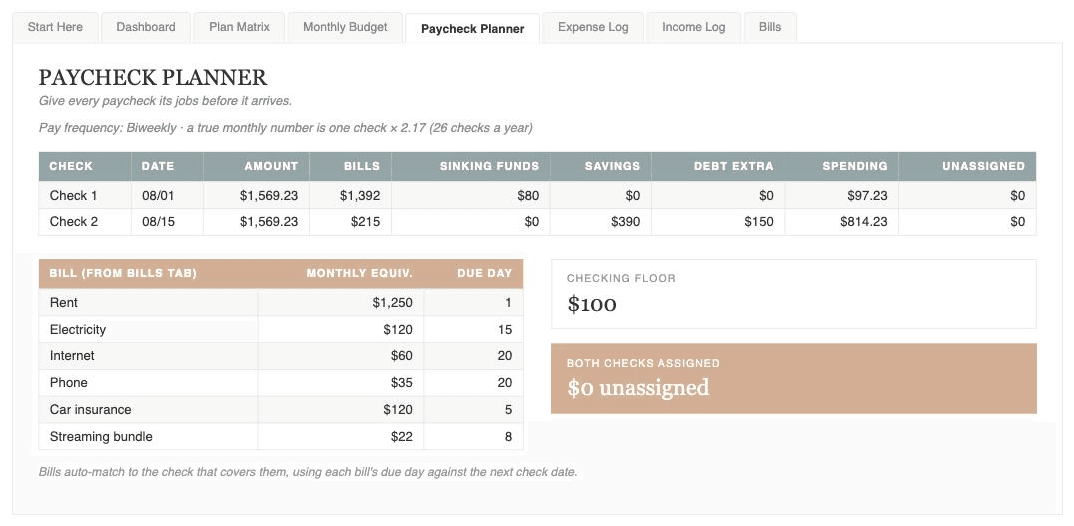
The free Sunday Budget planner has a Paycheck Planner tab built for exactly this workflow. Set your pay frequency to biweekly on the Start Here tab and it computes each check's amount with the ×12÷26 math done right; enter your check dates and it auto-matches your bills to the correct check using each bill's due day (pulled from the Bills tab); then you assign savings, spending, and buffer until each check's Unassigned cell hits $0 and turns green. There's even a checking-floor setting so no check ever gets assigned below your comfort line.
Frequently asked questions
I'm paid weekly: does this still work? Even better: four small plans a month instead of two, each covering one week of bills and spending. The math move becomes ×12÷52, and the planner's frequency setting handles it.
What's the difference between biweekly and semi-monthly? Biweekly = every other week = 26 checks, drifting dates, two bonus months. Semi-monthly = fixed dates (1st and 15th) = 24 checks, no bonus months, but perfectly predictable bill mapping. Both use paycheck budgeting; only the bonus-check strategy differs.
Should couples with different pay schedules merge this? List all checks from both people on one calendar, then map the household bills to whichever check is best positioned. The unit stops being "his check / her check" and becomes "the next money in": the budgeting-together ground rules still apply.
Do I still need a monthly budget at all? Keep a light one as the outer frame: monthly is still the honest unit for planning categories and the 50/30/20 split. The paycheck plans are how the monthly intentions actually get executed in real time.
Map your next check this Sunday
Pull up your bills, sort them by due day, and split them across your next two checks: then open the planner's Paycheck tab and let it do the matching for you. Two planned paychecks from now, the week-before-payday dread quietly stops being a thing; two bonus paychecks from now, you'll have money with a job that past-you assigned on purpose.




Written by
I fixed my own money with a spreadsheet and a Sunday morning, and now I build the tools I wish I’d had. I manage a dental practice in Greensboro, North Carolina, and I have never once told anyone their problem was the coffee.


