The 50/30/20 Budget Rule Explained + Calculator
By Nora Bennett · July 2, 2026 · Updated August 6, 2026

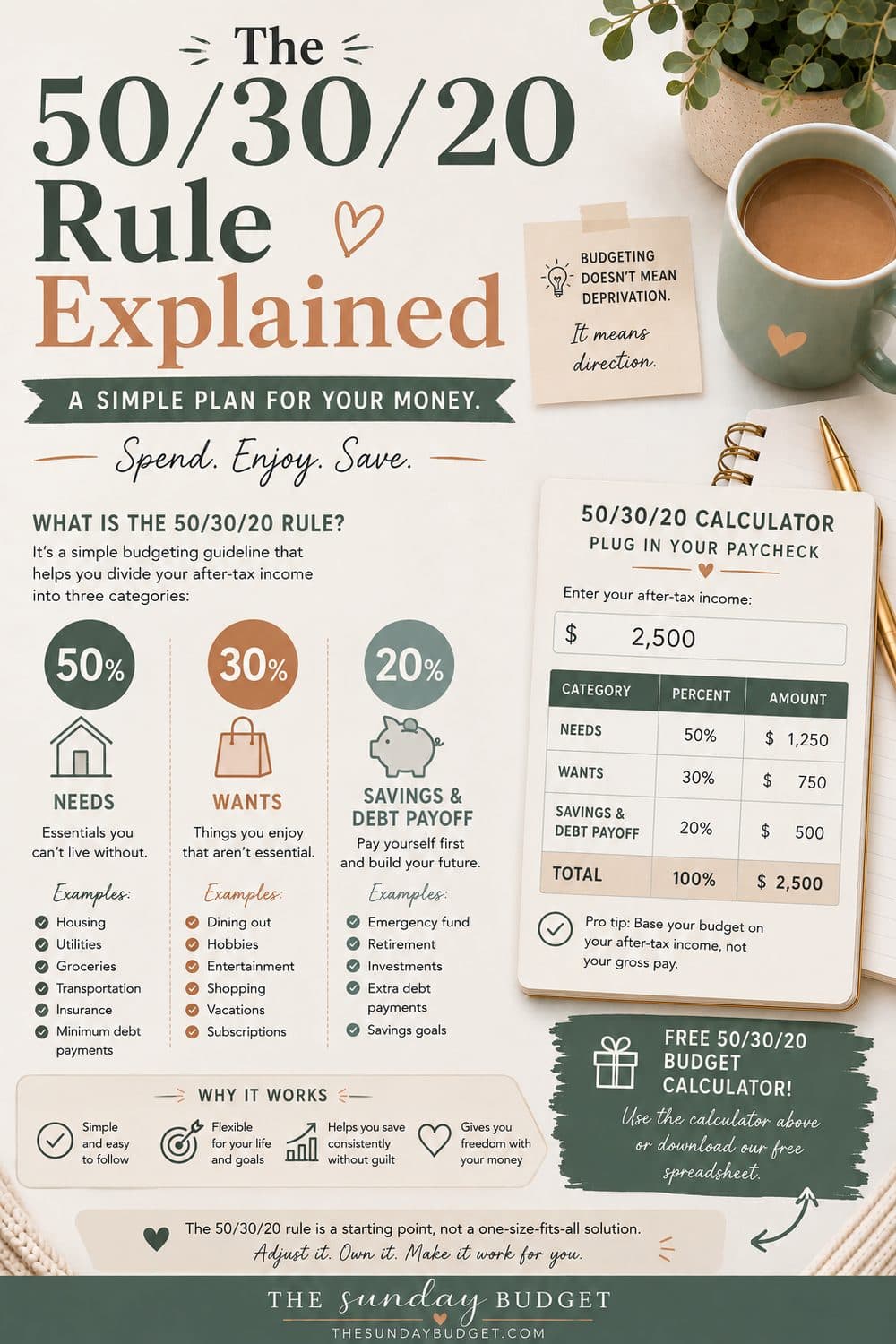
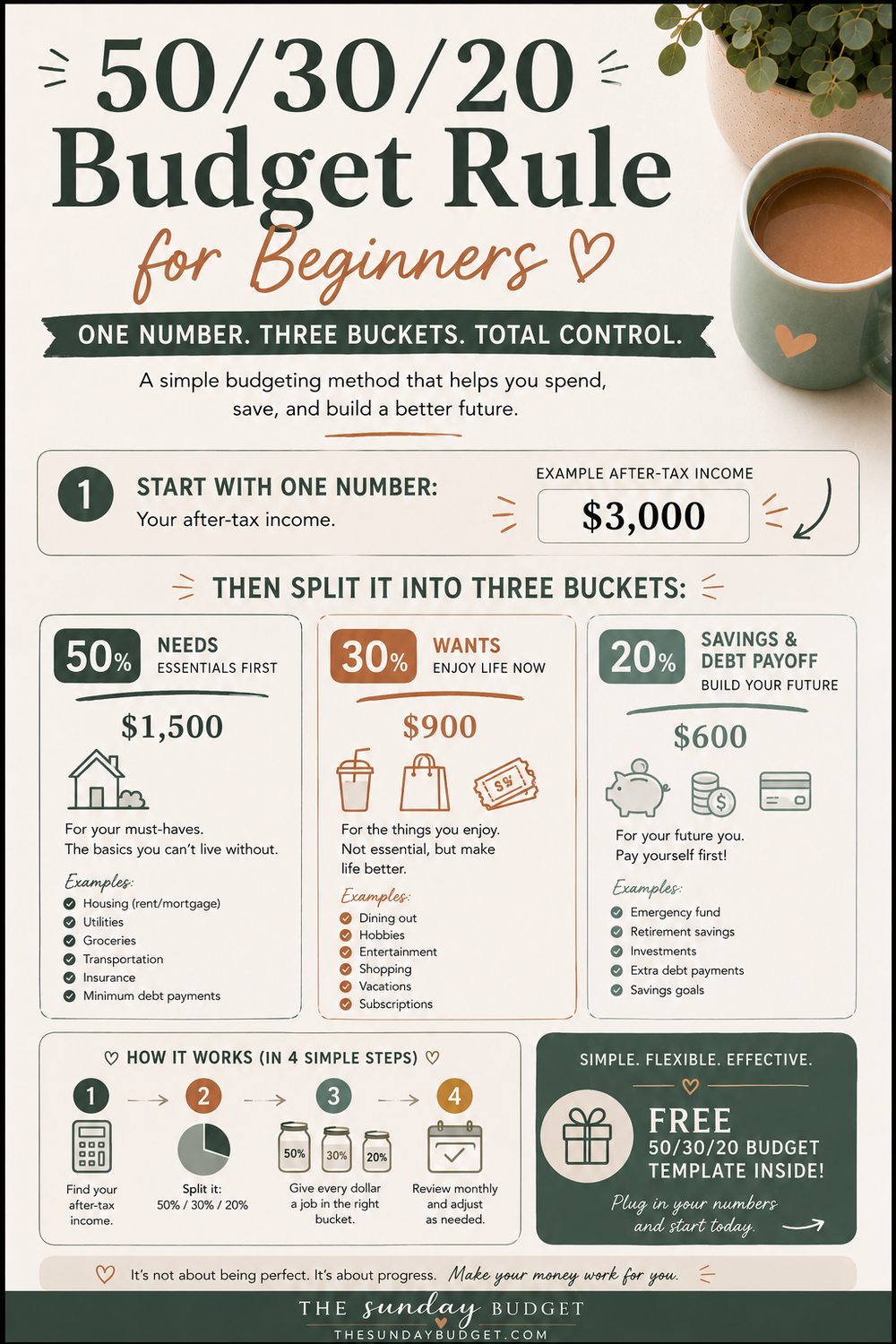
The 50/30/20 budget rule divides monthly net income into three broad groups:
- 50% for needs
- 30% for wants
- 20% for savings and extra debt payoff
It is useful because three totals can reveal the shape of a budget quickly. It is limited because real expenses do not always fit clean labels, payroll deductions complicate “net income,” and a household cannot lower rent simply because a ratio says it should.
Treat 50/30/20 as a diagnostic framework, not a financial eligibility test. The percentages help you ask better questions; they do not decide whether a necessary expense is allowed.
The 50/30/20 formula
Start with monthly net income and multiply:
Needs target = monthly net income × 0.50
Wants target = monthly net income × 0.30
Savings and extra debt target = monthly net income × 0.20
For $3,400 of monthly net income:
| Bucket | Calculation | Target |
|---|---|---|
| Needs | $3,400 × 0.50 | $1,700 |
| Wants | $3,400 × 0.30 | $1,020 |
| Savings and extra debt | $3,400 × 0.20 | $680 |
| Total | $3,400 |
The Consumer Financial Protection Bureau teaches 50/30/20 as one example of a budget rule, using monthly net income and categories for needs, wants, and savings. Its teaching materials also acknowledge that category answers can vary when the reasoning is defensible. Review the CFPB's 50/30/20 budgeting activity and worksheet.
This guide calls the final bucket “savings and extra debt” because both direct current income toward future financial capacity. Required minimum debt payments remain needs; payments above the required amount go in the 20% bucket.
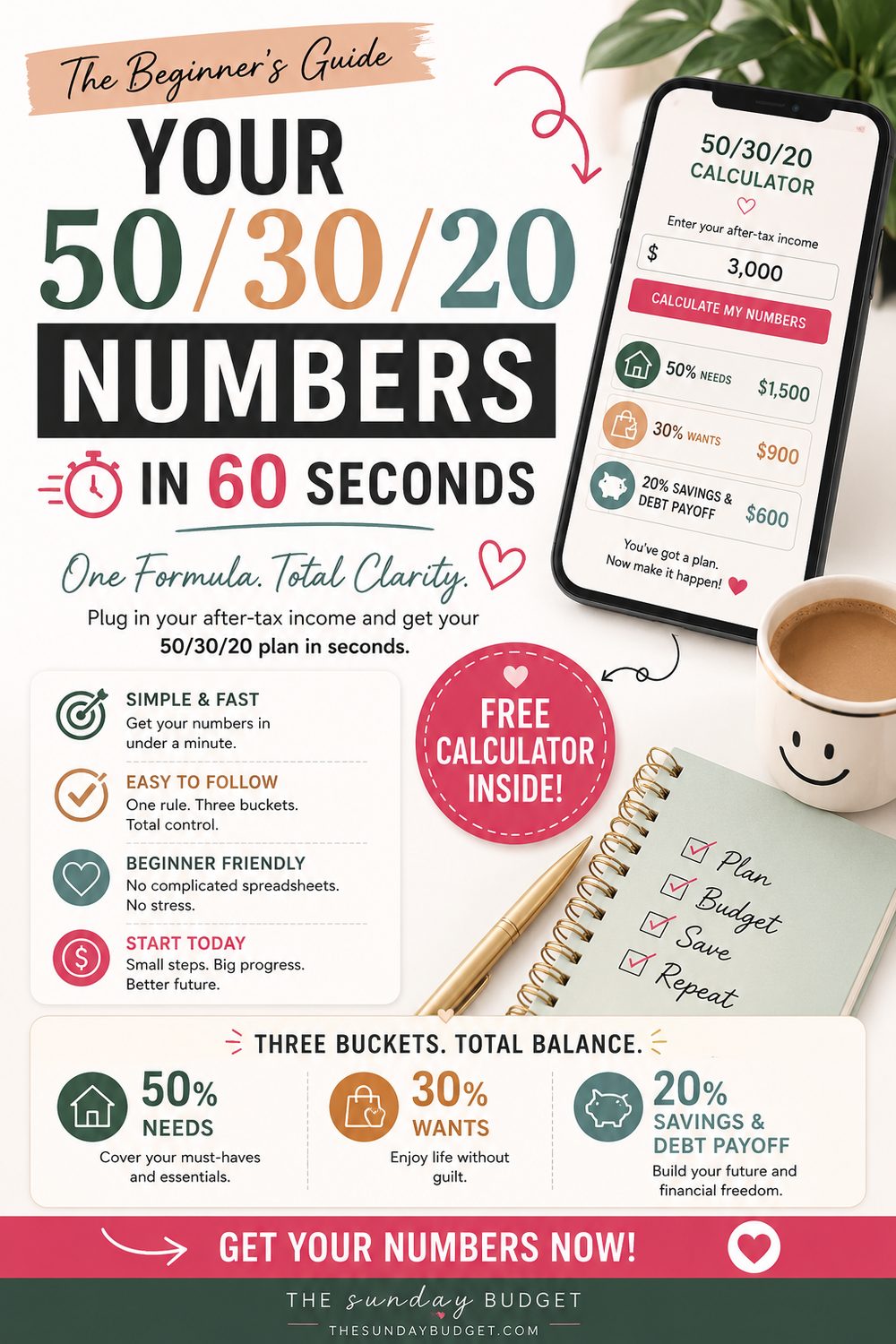
Calculate your 50/30/20 targets
Enter the net amount for one pay period and choose the frequency. The calculator converts it to a monthly average and applies the ratios.
Your 50/30/20 numbers
rent, groceries, bills, minimum debt payments
eating out, hobbies, fun money — guilt-free
emergency fund, retirement, extra debt payments
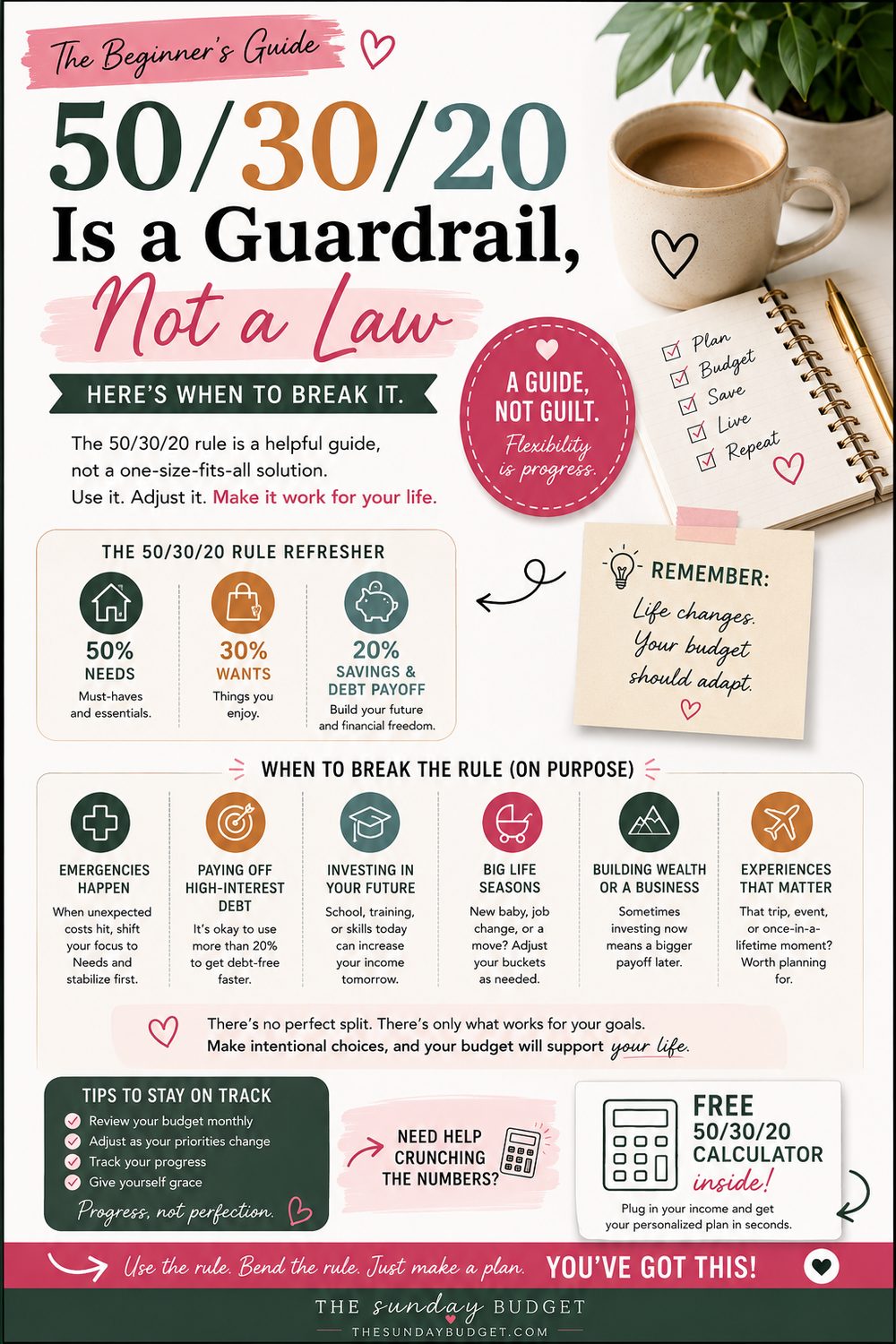
Guardrails, not laws — see below for when (and how) to bend them.
Quick-reference table
| Monthly take-home | Needs: 50% | Wants: 30% | Savings/debt: 20% |
|---|---|---|---|
| $2,000 | $1,000 | $600 | $400 |
| $2,500 | $1,250 | $750 | $500 |
| $3,000 | $1,500 | $900 | $600 |
| $3,400 | $1,700 | $1,020 | $680 |
| $4,000 | $2,000 | $1,200 | $800 |
| $5,000 | $2,500 | $1,500 | $1,000 |
| $6,000 | $3,000 | $1,800 | $1,200 |
Biweekly and weekly income warning
The calculator uses annual averaging:
- biweekly check × 26 ÷ 12; or
- weekly check × 52 ÷ 12.
That is useful for comparing ratios across a year. It does not mean the average amount lands in every calendar month. A biweekly worker normally receives two checks in most months and three in two months. Use the exact checks arriving in each month for bill timing and the annual average for long-term ratio analysis.
The beginner budgeting guide explains how to combine monthly targets with a paycheck-level cash-flow calendar.
What income should you use?
“Net income” sounds obvious until a pay stub includes taxes, health insurance, retirement contributions, an HSA, union dues, and other deductions.
Choose one convention and use it consistently.
Option 1: deposited-cash method
Use the amount that lands in checking after all payroll deductions. This is the simplest number for a cash budget and the number the calculator above expects.
Under this method:
- the three targets apply only to deposited cash;
- payroll retirement contributions sit outside the calculation; and
- the resulting 20% target does not describe total household saving if money is already saved through payroll.
This is useful for answering: How should the cash reaching my account be divided?
Option 2: all-in after-tax method
Start with take-home cash and add back elective payroll deductions you want represented inside the categories. Then classify those deductions.
For example, if $3,400 reaches checking and $300 of employee retirement contributions were deducted first:
| Item | Amount |
|---|---|
| Deposited take-home | $3,400 |
| Employee retirement contribution added back | $300 |
| Income used for ratio analysis | $3,700 |
The retirement contribution is then included in the 20% total rather than disappearing from the analysis.
Do not add a payroll deduction back to income and forget to include it in a bucket. That inflates the denominator without recording where the money went.
Employer retirement matches generally should not be treated as spendable income for a monthly cash budget. Paycheck deductions and tax treatment vary, so use the pay statement and plan documents rather than assuming every deduction works the same way. Consumer.gov's paycheck guide explains common tax and benefit deductions.
What belongs in the 50% needs bucket?
A need is an expense necessary to maintain basic living, health, required obligations, or the ability to earn income.
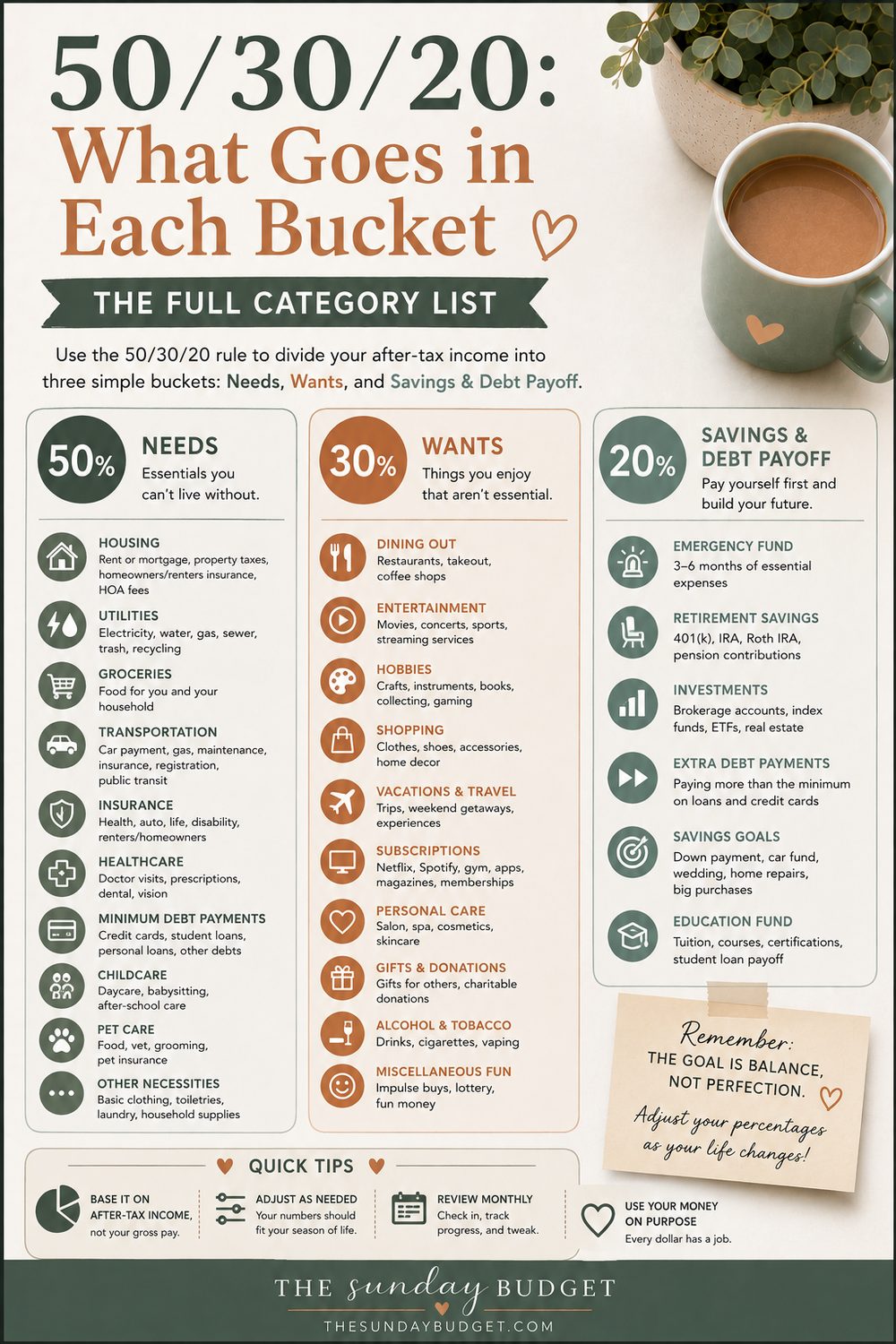
Common needs include:
- rent or mortgage;
- basic utilities;
- necessary groceries and household supplies;
- essential transportation;
- required insurance;
- medication and necessary health care;
- childcare required for work;
- minimum debt payments;
- court-ordered or legal obligations; and
- basic phone or internet access needed for work, school, health, or essential communication.
Price matters as well as purpose
An expense can contain both a need and a want.
A phone may be necessary, while the premium device payment or expanded entertainment package is optional. Transportation may be necessary, while part of the cost difference between two workable vehicles is a want.
You do not need to split every mixed bill to the cent. Use a reasonable, repeatable rule. If classification work becomes harder than the decision it supports, keep the whole bill in the more conservative category and note the optional portion when looking for reductions.
What belongs in the 30% wants bucket?
Wants improve comfort, convenience, recreation, or personal preference but can usually be reduced or delayed without immediate harm.
Examples include:
- restaurants and delivery beyond necessary food access;
- entertainment subscriptions;
- leisure travel;
- hobbies and recreational equipment;
- optional upgrades;
- nonessential clothing purchases;
- premium versions of otherwise necessary services;
- gifts beyond required commitments; and
- convenience spending chosen over a workable lower-cost alternative.
The wants category is not a list of bad choices. It creates a planned limit for spending that makes life enjoyable. The useful question is not “Do I deserve this?” It is “Does this fit alongside current needs and future goals?”
What belongs in the 20% future-goals bucket?
This guide includes:
- emergency-fund contributions;
- retirement contributions made from the income denominator;
- long-term investment contributions;
- a home-deposit or other long-term savings goal;
- extra debt payments above required minimums; and
- cash intentionally building future financial capacity.
Do not count investment growth, an employer match, a credit-card limit, or a transfer between two of your accounts as a current income contribution.
Minimum versus extra debt payments
Suppose a card requires $80 and you pay $230:
- $80 required minimum: needs;
- $150 extra principal payment: future goals.
This separation shows the cost of staying current and the additional amount chosen to accelerate payoff. Use a debt snowball or debt avalanche to direct the extra payment.
Where sinking funds belong
A sinking fund is a storage method, not automatically a savings category. Classify the future expense the fund will pay.
| Sinking fund | 50/30/20 category | Reason |
|---|---|---|
| Annual car insurance | Needs | Required insurance paid later |
| Essential car maintenance | Needs | Protects necessary transport |
| Holiday gifts | Wants | Planned discretionary spending |
| Vacation | Wants | Planned leisure spending |
| House down payment | Future goals | Builds toward a long-term asset purchase |
| Extra debt payoff reserve | Future goals | Intended for principal beyond minimums |
If $100 moves to a holiday sinking fund this month, the cash is saved temporarily, but its purpose is future discretionary spending. Counting every sinking fund in the 20% bucket can make the plan appear to build more long-term savings than it does.
Read Sinking Funds Explained for target formulas, account options, and category priorities.
Difficult expenses: need or want?
Some categories depend on context. Use purpose, minimum workable cost, and consequence.
| Expense | Usually a need when | Usually a want when |
|---|---|---|
| Internet | Required for work, school, health access, or essential communication | Paying for speed or bundles beyond the requirement |
| Phone | Basic reliable access is necessary | Premium device or service tier is optional |
| Car | No workable lower-cost transport supports essential travel | Upgrade or second vehicle is primarily preference |
| Childcare | Required to work, study, or obtain necessary care | Optional convenience beyond the household's chosen baseline |
| Clothing | Replacing basic, work, school, or weather-appropriate items | Fashion purchases beyond current need |
| Education | Required for a current job or essential credential | Optional course primarily for recreation or enrichment |
| Giving | A binding commitment in the household's values or obligations | Flexible discretionary giving that can be changed |
| Medical | Necessary treatment, medication, or access | Elective service chosen primarily for preference |
Reasonable people can classify the same expense differently because consequences differ. Write down the rule and apply it consistently enough for month-to-month comparison.
A complete $3,400 example
Suppose $3,400 reaches checking each month and no retirement contribution occurs before deposit. The targets are $1,700 needs, $1,020 wants, and $680 savings or extra debt.
Actual assignments are:
Needs
| Need | Amount |
|---|---|
| Rent | $1,250 |
| Utilities | $180 |
| Basic phone | $45 |
| Vehicle payment and insurance | $420 |
| Groceries | $380 |
| Minimum debt payments | $160 |
| Needs total | $2,435 |
Wants
| Want | Amount |
|---|---|
| Restaurants | $180 |
| Streaming | $35 |
| Optional clothing | $60 |
| Hobbies | $75 |
| Travel sinking fund | $100 |
| Wants total | $450 |
Savings and extra debt
| Future goal | Amount |
|---|---|
| Emergency savings | $150 |
| Extra debt payment | $250 |
| IRA contribution | $115 |
| Future-goals total | $515 |
The full plan totals $3,400. Its actual ratios are:
| Bucket | Actual | Share | 50/30/20 target | Difference |
|---|---|---|---|---|
| Needs | $2,435 | 71.6% | $1,700 | $735 over |
| Wants | $450 | 13.2% | $1,020 | $570 under |
| Future goals | $515 | 15.1% | $680 | $165 under |
Rounding makes the displayed percentages total 99.9%.
The plan is balanced even though it does not match 50/30/20. The framework reveals two facts:
- needs consume most of the budget; and
- low wants partially protect savings and extra debt payoff.
The useful next question is not how to relabel $735. It is whether any large need can safely change over time and whether income can increase.
Use the reverse calculation
The standard calculation starts with income. The reverse calculation starts with current needs.
Net income required for needs to equal 50% = current needs ÷ 0.50
For $2,435 of needs:
$2,435 ÷ 0.50 = $4,870 monthly net income
At the current $3,400 income, the exact 50% target is $1,700, creating a $735 gap. That gap could theoretically close through lower need costs, higher income, or both.
This is not a demand to earn $4,870 or cut $735 immediately. It quantifies the distance so changes can be evaluated honestly.
What to do when needs exceed 50%
1. Verify the classification and denominator
Check for duplicate transfers, extra debt payments inside needs, discretionary sinking funds classified as needs, or payroll contributions omitted from an all-in calculation.
Do not solve the ratio by calling a necessary expense a want.
2. Protect current high-consequence expenses
Housing, basic food, utilities, medication, essential transport, required insurance, and current minimum payments take priority over reaching a model percentage.
If the household cannot cover current bills, use a survival budget and contact billers or support services before focusing on ratios.
3. Examine large costs before tiny purchases
Housing, transport, childcare, insurance, and debt minimums often determine the needs ratio. Possible changes may involve refinancing risk, moving costs, contract terms, coverage needs, family logistics, or job access. Compare the full consequence rather than cutting solely for a percentage.
4. Set a current ratio and a target direction
If the present mix is 72/13/15, record it. A next-stage goal might be to prevent needs from rising, increase the future-goals amount by $25, or direct a future debt payoff into savings.
Do not copy a replacement ratio from someone else's budget. Build it from the dollars that can actually move.
5. Review income as well as spending
Cost reductions have limits. Additional hours, a role change, benefits, assistance, or carefully chosen side income may have more impact than repeated cuts to an already small wants bucket.
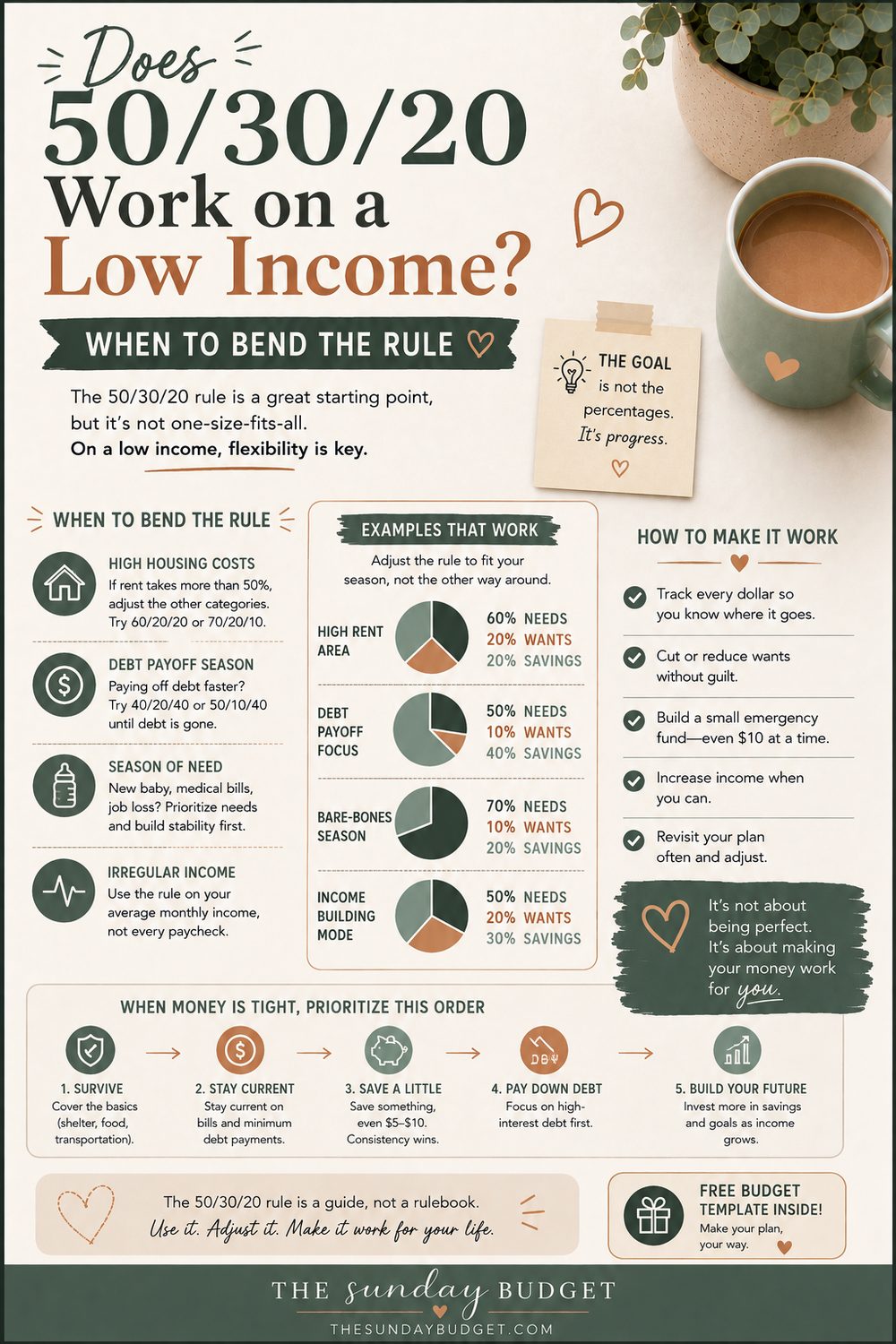
Other times to adapt the rule
Irregular or seasonal income
Apply the ratio to a conservative baseline or to annual net income, then maintain a cash-flow plan for low months. Do not commit to 30% wants based on an annual average when the money has not arrived.
Aggressive debt payoff
Minimums remain needs. Extra payoff goes in future goals. You can reduce wants and raise the future-goals share for a defined period, but first keep essentials current and protect against predictable expenses that would create replacement debt.
Very low required expenses
Thirty percent is a ceiling or guide, not a requirement to spend. If needs and wants are below their targets, direct the difference to priorities such as retirement, reserves, debt, or another goal.
High medical, care, or family-support costs
The categories may be necessary even when they push needs far above 50%. Use the framework to see the pressure, not to deny the obligation.
Large payroll contributions
Use the all-in method if you want retirement or other elective deductions represented. Otherwise use deposited cash for the budget and report payroll saving separately.
50/30/20 and zero-based budgeting can work together
The systems answer different questions:
- 50/30/20: How is the budget distributed across broad priorities?
- Zero-based budgeting: What specific job does every available dollar have?
A zero-based plan can contain dozens of categories and still roll up to three ratios. Build category-level assignments first, then total needs, wants, and future goals as a diagnostic.
| Method | Strength | Limitation |
|---|---|---|
| 50/30/20 | Fast high-level comparison | Does not manage due dates or detailed categories |
| Zero-based | Precise assignment of available money | More maintenance and still needs cash-flow timing |
| Paycheck budget | Matches bills to deposits | Can obscure the monthly and annual picture |
Read Zero-Based Budgeting and Paycheck Budgeting to add the detail this framework intentionally omits.
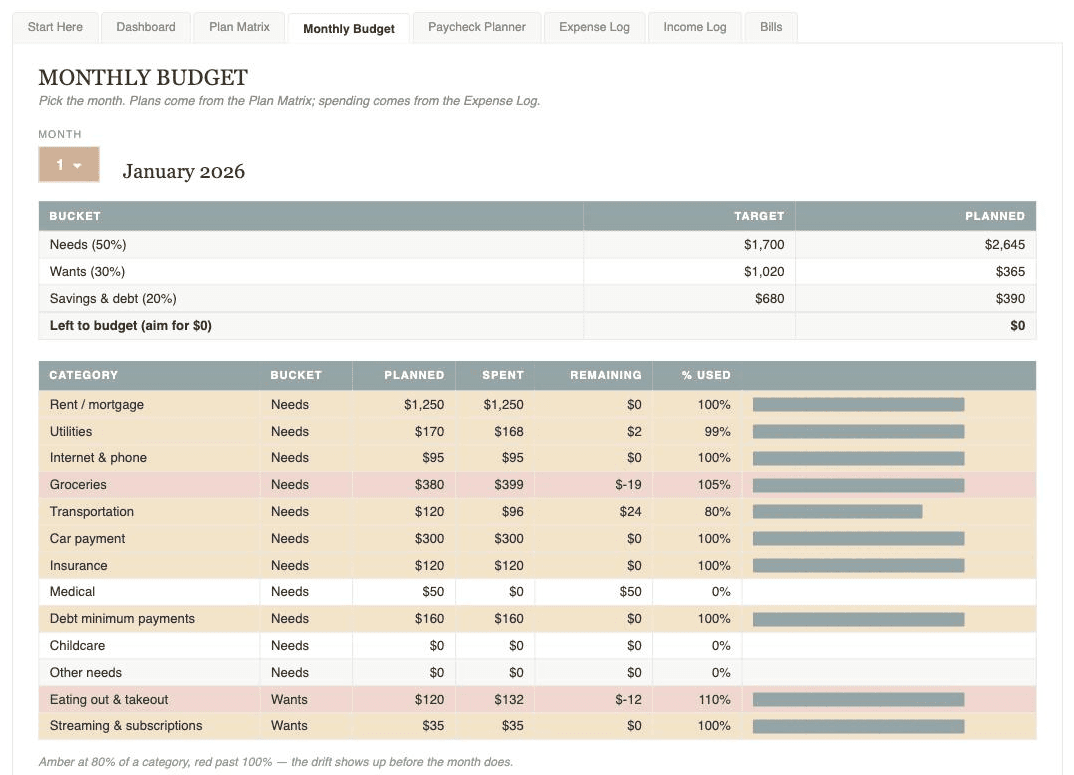
The free Sunday Budget planner tracks planned and actual category amounts. Use the category detail for weekly decisions and the three broad totals for a monthly diagnostic.
A monthly 50/30/20 review
At month-end:
- Confirm the income denominator used.
- Total actual needs, wants, and future-goal contributions.
- Calculate each share: bucket total ÷ income × 100.
- Review misclassified or duplicated transfers.
- Identify the largest dollar variance, not only the largest percentage.
- Choose one change for the next month.
Compare several months before drawing conclusions. A medical bill, annual premium, or three-paycheck month can distort one period. Sinking funds should reduce those spikes when classified by their eventual purpose.
Common 50/30/20 mistakes
Treating 30% wants as a spending target
It is not necessary to spend the full amount. Unused room can support another priority.
Counting all payroll deductions and then using only deposited income
Decide whether the analysis is cash-only or all-in. Mixing conventions creates misleading ratios.
Putting every sinking fund in savings
Classify the expense the money will eventually pay.
Counting minimum debt payments twice
Required minimums belong in needs. Only the amount above them belongs in future goals.
Using the annual biweekly average for cash flow
The annual average is useful for ratios, but bills need the actual checks arriving that month.
Relabeling instead of changing the plan
Moving an expense from needs to wants changes the report, not the bank balance.
Ignoring timing
The framework says nothing about whether rent clears before payday. Pair it with a bill calendar.
Frequently asked questions
Is 50/30/20 based on gross or net income?
Use monthly net income. For a simple cash budget, use the amount deposited after deductions. For an all-in analysis, add selected elective payroll deductions back and classify them consistently.
Are taxes included in the 50% needs bucket?
Not when the ratio starts with income after taxes. Taxes have already been removed from the denominator. If self-employment income is received before tax payments, reserve the tax obligation before treating the remainder as spendable net income; use current tax guidance or a qualified professional for the amount.
Does retirement count toward the 20%?
Employee retirement contributions can count when they come from the income denominator. If you add a payroll contribution back to income for an all-in analysis, include it in the 20% total. Do not count the same contribution twice.
Does an employer match count?
An employer match increases retirement assets but is generally not spendable monthly income contributed from the household's net-pay denominator. Track it separately rather than using it to make the cash budget appear to meet 20%.
Is a mortgage payment a need or savings?
The required mortgage payment is normally a housing need. Extra principal beyond the required payment can be treated as a future-goals contribution. Do not count the principal portion of the required payment in both categories.
What if my needs are 70%?
Record the real ratio, confirm the categories, protect current essentials, and identify which large dollar amounts can change safely over time. Use the lower wants and future-goals percentages as information, not evidence of personal failure.
Should the 20% go to savings or debt first?
That depends on payment status, emergency reserves, interest rates, employer retirement benefits, and upcoming expenses. Stay current, protect essential cash needs, capture any employer benefit you have deliberately decided is appropriate, and compare the cost of debt with the need for liquidity. The emergency-fund guide and debt-method comparison can help build the sequence.
Is 50/30/20 good for irregular income?
It is useful as an annual or baseline diagnostic. It is not enough for timing. Build the monthly budget from dependable income and use a cash-flow calendar for actual deposits.
Can couples use the rule?
Yes. Agree on the income denominator, shared versus individual expenses, and classification rules before comparing percentages. Separate-account and joint-account households can both use one combined ratio report for shared finances.
Use the rule as a dashboard
Calculate the three targets, then classify the last month's real transactions. Do not stop at whether the percentages passed or failed.
Ask:
- Which bucket creates the most pressure in dollars?
- Is the income denominator consistent?
- Are required and extra debt payments separated?
- Are sinking funds classified by purpose?
- Does the monthly cash-flow calendar still work?
- What is one realistic change for next month?
The 50/30/20 rule is most useful as a dashboard above a real budget. It can show direction quickly, while the category plan, bill calendar, and weekly review do the work of keeping the month operational.

Written by
I fixed my own money with a spreadsheet and a Sunday morning, and now I build the tools I wish I’d had. I manage a dental practice in Greensboro, North Carolina, and I have never once told anyone their problem was the coffee.


