Debt Snowball vs Debt Avalanche: Which Is Faster?
By Nora Bennett · June 25, 2026 · Updated August 6, 2026

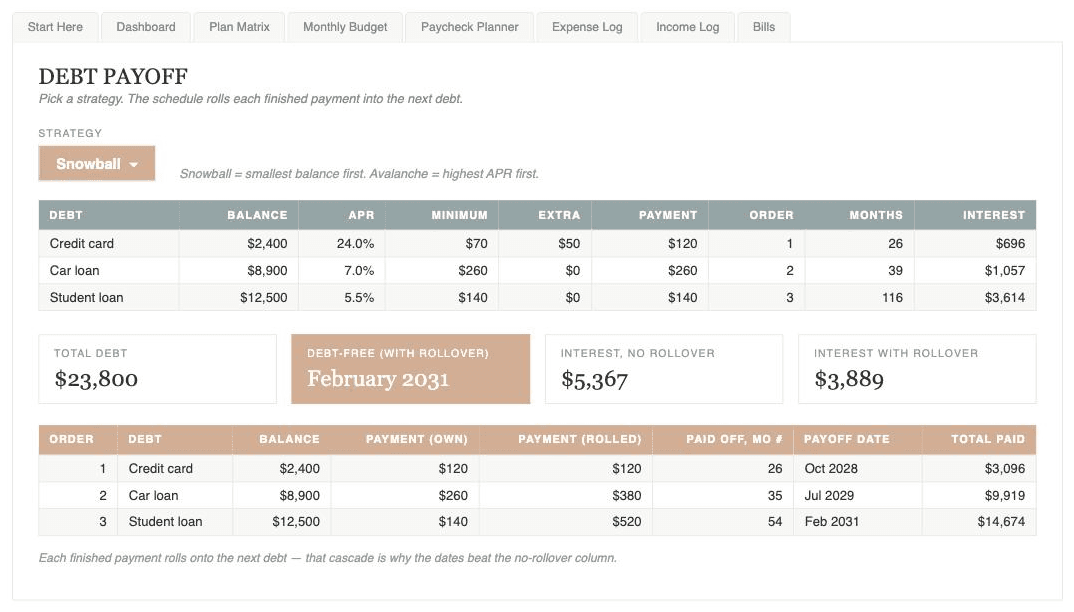
The debt snowball and debt avalanche are almost the same system. Both make the required payment on every included debt, direct all extra money to one target, and roll the finished payment into the next debt.
The only difference is the target order:
- Debt snowball: smallest balance first.
- Debt avalanche: highest interest rate first.
That difference affects interest cost, the timing of the first paid-off account, and how long a person may wait for a visible win. The avalanche is mathematically cheaper when all other assumptions are equal. The snowball can produce faster account closures, which some people find easier to maintain.
The correct choice is not a personality quiz. It depends on your rates, balances, minimum payments, account status, and what has caused previous payoff attempts to stop.
This comparison is for debts that are current and appropriate for accelerated payoff. If housing, utilities, food, medication, required insurance, or transport to work is at risk, stabilize those first. Secured debt, tax or court debt, payday or title loans, federal student loans, medical bills, and collection accounts may need special handling before either sorting method is used. The low-income debt-payoff guide explains those branches.
Quick answer: snowball or avalanche?
| Choose | When it is usually the better fit |
|---|---|
| Debt snowball | You need an early account closure, have several small balances, or repeatedly lose momentum before the first payoff |
| Debt avalanche | Minimizing interest is the priority, the rate gaps are large, or you can stay engaged during a longer first target |
| Hybrid | One quick payoff would free a meaningful minimum, but the remaining high-rate debt is too costly to ignore |
| Neither yet | Required payments do not fit, essentials are unstable, debts are in collections or legal action, or special repayment options have not been reviewed |
If both methods finish in nearly the same month and cost nearly the same amount, choose the order that is easiest to execute. If the avalanche saves a substantial amount, decide whether an early snowball win is worth that specific cost—not an imagined cost.
How the debt snowball works
List included debts from smallest current balance to largest current balance. Ignore interest rates when choosing the target.
Each month:
- Make the required payment on every debt.
- Send the full extra payment to the smallest balance.
- When that balance reaches zero, add its former payment to the next-smallest debt.
- Continue until every included debt is paid.
Snowball strengths
- The first account may close sooner.
- Fewer accounts can mean fewer due dates and minimums to manage.
- Visible progress can make a long plan feel active.
- A freed minimum increases the payment available for the next target.
Snowball tradeoffs
- A high-rate balance may continue accruing interest while a cheaper balance is targeted.
- The extra interest can be significant when rate gaps or balances are large.
- “Smallest balance” should not override urgent legal, secured, or essential consequences.
How the debt avalanche works
List included debts from highest APR to lowest APR. The balance size does not determine the target.
Each month:
- Make the required payment on every debt.
- Send the full extra payment to the highest-rate debt.
- When that debt reaches zero, add its former payment to the next-highest-rate debt.
- Continue until every included debt is paid.
Avalanche strengths
- It minimizes interest when the balances, payments, rates, and timing are otherwise identical.
- It removes the most expensive balance first.
- The benefit grows when one APR is far above the others.
Avalanche tradeoffs
- The first target may be large and take a long time to close.
- Progress is less visible if motivation depends on reducing the number of accounts.
- A mathematically optimal projection is not useful if the plan repeatedly stops.
The engine both methods share
The target order gets most of the attention, but three shared behaviors create most of the payoff acceleration.
1. Concentrate the extra payment
After making required payments, send the extra to one target. Splitting $150 across five accounts may reduce every balance slightly, but it delays closing an account and freeing its minimum.
Research published in the Journal of Consumer Research examined concentrated versus dispersed repayment. Across a field study and experiments, concentrated repayment tended to increase motivation, with the strongest effect when payments produced a large proportional reduction in a small account. That supports the motivational logic behind visible progress, but it does not prove that snowball is financially better for every borrower.
Read the research as evidence that how progress feels can affect behavior, not as permission to ignore large interest differences or urgent debt consequences.
2. Keep the total debt payment steady
Suppose required payments total $395 and the budget provides $150 extra. The debt budget is $545 a month.
When a $35 minimum disappears, continue paying $545 total. The target now receives that $35 plus the original $150 extra. This rollover is what makes later debts fall faster.
3. Prevent replacement debt
A payoff plan can show falling balances while new spending quietly returns to another card. Protect current essentials, build a small buffer, and create sinking funds for predictable expenses before choosing an aggressive extra payment.
The fastest projection is not the fastest real plan if it sends the next repair back onto credit.
A head-to-head comparison with reproducible math
Consider three debts totaling $13,700:
| Debt | Balance | APR | Required payment |
|---|---|---|---|
| Store card | $1,200 | 9% | $35 |
| Credit card | $4,500 | 24% | $110 |
| Car loan | $8,000 | 6.5% | $250 |
| Total | $13,700 | $395 |
The budget adds $150 extra, so the total debt payment remains $545 a month.
Assumptions used
To make the comparison reproducible, this example assumes:
- interest is estimated monthly as balance × APR ÷ 12;
- interest is added before that month's payment;
- rates and required payments remain constant;
- there are no new charges, late fees, penalties, promotions, or payment holidays;
- there is no prepayment penalty;
- the full $545 is paid every month; and
- each completed payment rolls to the next target immediately.
Real credit cards often calculate interest using an average daily balance, and real minimums may change. Loan amortization and payment-allocation rules also vary. Use this example to compare methods, not as a lender payoff quote.
Results
| Result | Debt snowball | Debt avalanche |
|---|---|---|
| Payoff order | Store card → credit card → car | Credit card → store card → car |
| First account paid | Month 7 | Month 22 |
| Second account paid | Month 25 | Month 24 |
| Debt-free | Month 30 | Month 30 |
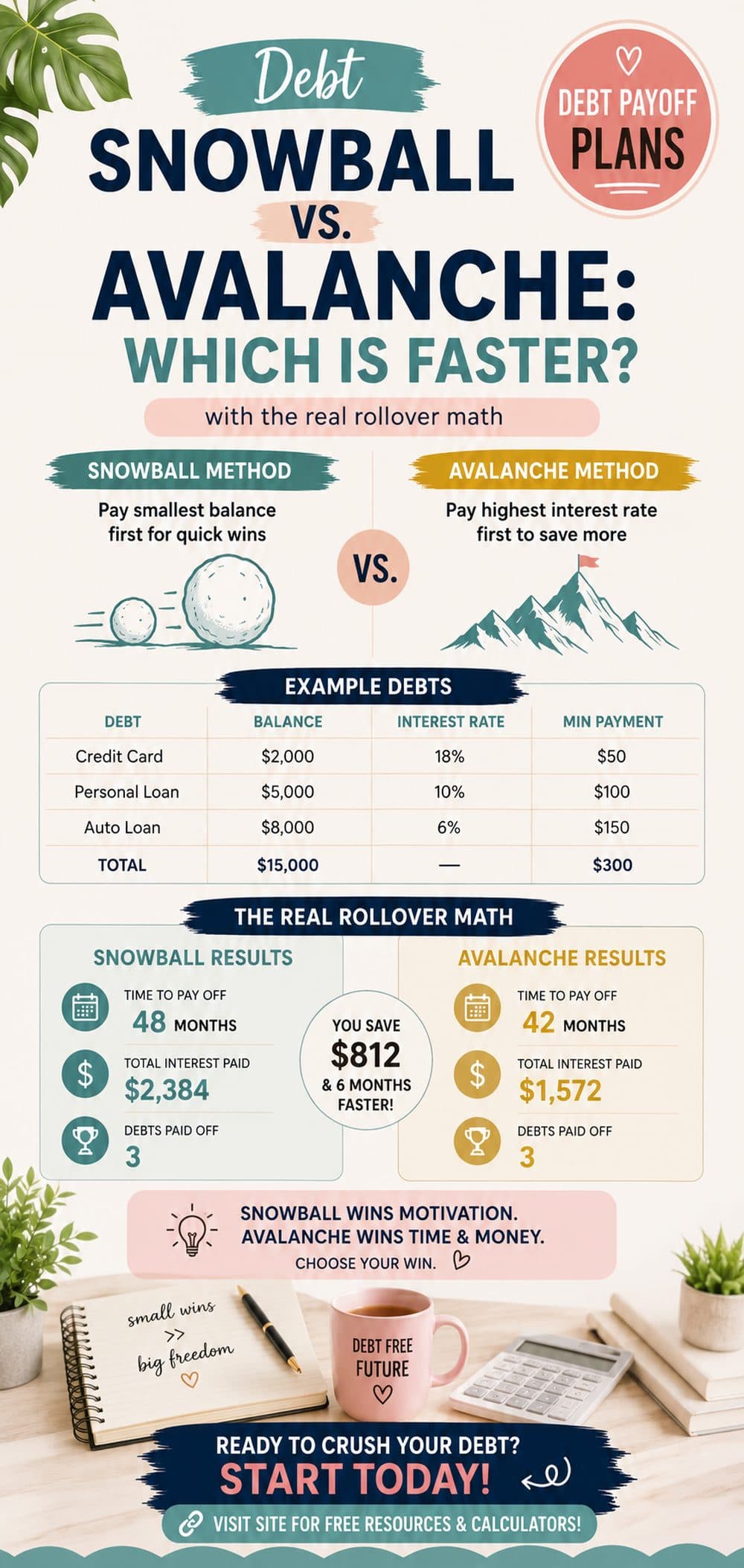
| Estimated interest | $2,284 | $2,000 |
In this example:
- The avalanche saves an estimated $284.
- The snowball closes the first account 15 months earlier.
- Both finish during month 30 because the same $545 reaches the same debts over a relatively short period.
The methods can finish in the same month and still have different interest costs because more of the avalanche payment reduces the 24% balance earlier.
Correcting the “minimum payments only” comparison
If each debt receives only the listed fixed payment and finished payments are not rolled forward, the final debt in this simplified model lasts about 87 months and total estimated interest is roughly $5,971.
That is much slower than either focused method:
| Plan | Estimated debt-free month | Estimated interest |
|---|---|---|
| Fixed listed payments only, no rollover | 87 | $5,971 |
| Snowball with $150 extra and rollover | 30 | $2,284 |
| Avalanche with $150 extra and rollover | 30 | $2,000 |
Actual card minimums often decline as balances fall, which can make minimum-only repayment last even longer. The statement's minimum-payment warning is the better source for a specific card.
The main conclusion is not that order never matters. It is that a stable extra payment and full rollover matter more than arguing over an order that never gets implemented.
When the avalanche advantage becomes larger
The $284 difference belongs to this example only. Avalanche savings generally grow when:
- the highest APR is much higher than the others;
- the highest-rate balance is large;
- the monthly extra is small relative to the balances;
- payoff will take many years; or
- a promotional rate is about to end.
Imagine a 34% card beside a 7% installment loan. Paying the installment loan first may carry a much larger interest cost than the $284 difference above. Run both schedules with your actual rates before deciding the price of a snowball win is “small.”
When the snowball advantage becomes more useful
The snowball may be especially useful when:
- one or two balances can be cleared within the first few months;
- each small payoff frees a meaningful minimum;
- the household has many accounts and due dates;
- previous plans stopped because no account ever seemed to close; or
- rates are similar enough that the cost difference is modest.
The advantage is practical, not magical. Closing a small account does not create new money unless its payment is rolled forward.
A decision scorecard
Answer these questions using your own inventory.
| Question | Points toward snowball | Points toward avalanche |
|---|---|---|
| How soon would the first target disappear? | Small debt closes within a few months | High-rate debt also closes soon |
| How large is the APR gap? | Rates are close | One rate is much higher |
| What stopped previous plans? | Lack of visible wins or too many accounts | No behavioral issue; interest cost is the concern |
| How much minimum payment would be freed? | A quick payoff releases a useful amount | Small payoff releases very little |
| How long is the full plan? | Short enough that cost difference is small | Long horizon magnifies interest differences |
| Are there special consequences? | Neither method decides this | Neither method decides this |
Then calculate both versions. Compare:
- first payoff date;
- final payoff date;
- total estimated interest;
- number of accounts remaining after 6 and 12 months; and
- whether the monthly payment is genuinely sustainable.
Do not decide from method labels alone. Decide from the difference produced by your numbers.
Three hybrid strategies
You do not need to follow either method with perfect purity.
1. One-win hybrid
Pay off one small balance that can disappear quickly, then reorder the rest by APR.
This works best when the first payoff is fast and frees a useful payment. Calculate the additional interest created by the detour.
2. Rate-floor hybrid
Put debts above a chosen APR threshold in avalanche order, then snowball the lower-rate group.
The threshold is not universal. Choose it after looking at the actual rate gaps and payoff timeline.
3. Deadline hybrid
Move a promotional or deferred-interest balance forward when its deadline creates a material risk. Confirm the exact terms: a 0% promotional APR and a deferred-interest offer are not always the same.
A deferred-interest promotion may charge interest back to the purchase date if the balance is not paid under the offer's terms. Read the agreement rather than assuming “no interest” means the same thing on every account.
When neither method should control the next payment
Snowball and avalanche are sorting tools, not complete financial triage systems.
Essentials or secured debt are in danger
If rent, utilities, required insurance, work transport, or a secured loan is at immediate risk, protect the household and contact the provider. A high-rate credit card should not receive an extra payment that causes a car repossession or utility disconnection.
Required payments do not fit
If the budget cannot make required payments, call creditors about hardship options and consider qualified nonprofit credit counseling. A payoff method cannot fix an unaffordable required-payment structure.
A debt is in collections
Verify the collector, original creditor, amount, dates, and validation notice before paying. Old debt can involve state-specific legal time limits. Get any agreement in writing and seek local legal advice when needed.
A medical bill may qualify for assistance
Ask a nonprofit hospital for its financial-assistance policy, application, and itemized bill before treating the listed balance as final.
Federal student loans have current program options
Use StudentAid.gov and the official servicer to compare current repayment options. Refinancing a federal loan into a private loan can permanently remove federal protections.
Tax, court, or family obligations change the decision
Legal consequences and relationships are not captured by APR. Get advice appropriate to the obligation and jurisdiction.
How to run either method step by step
Step 1: Stabilize the budget
Protect essentials, make required payments, and choose a starter buffer. If new borrowing is still covering normal expenses, address that gap before setting an aggressive extra amount.
Step 2: Build the debt inventory
Record balance, APR, required payment, due date, status, collateral, promotional deadline, and current owner.
Step 3: Remove special-case debts from the simple sort
Create a separate action plan for secured, legal, tax, collection, medical, payday, title, and federal student-loan situations.
Step 4: Choose the repeatable debt budget
Add required payments and the extra amount supported by an ordinary month.
Use three levels:
- Floor month: required payments only.
- Normal month: required payments plus the repeatable extra.
- Strong month: normal payment plus a planned share of extra income.
Step 5: Model snowball and avalanche
Use the same total payment and start date for both. If one projection quietly assumes more money, the comparison is invalid.
Step 6: Choose the order and automate carefully
Automate only amounts the account can support reliably. Low balances and irregular income may make manual payday payments safer than rigid automatic extras.
Step 7: Redirect the rollover immediately
When a debt reaches zero, update the next payment before the freed cash blends into everyday spending.
Step 8: Review monthly, not obsessively
Use each new statement to record:
- ending balance;
- interest charged;
- fees;
- payment received;
- next due date; and
- whether the projected order still makes sense.
Recalculate after a rate change, new hardship plan, balance transfer, large payment, or major income change.
Balance transfers: compare the whole offer
A balance transfer can change the avalanche order by reducing a high APR temporarily. It does not reduce the principal by itself.
The CFPB notes that issuers may charge a transfer fee even on a 0% offer and that promotional rates last for a limited period.
Before transferring, record:
- transfer fee;
- promotional APR;
- promotion end date;
- APR after the promotion;
- credit limit and amount eligible to transfer;
- required minimum;
- treatment of new purchases; and
- whether the old account will remain open.
Estimate the break-even point
Use a rough comparison:
Transfer fee ÷ approximate monthly interest saved = break-even months
If a $3,000 transfer costs $120 and saves about $55 a month at first, the simple break-even is a little over two months. Savings decline as the balance falls, so model the full offer rather than relying only on this estimate.
Avoid new purchases on the transfer card unless you understand exactly how interest and payments will be applied.
Should you close a paid-off card?
It depends.
The CFPB explains that closing a card can increase credit utilization and may lower a credit score, but closing can still be sensible when an annual fee, poor terms, fraud-monitoring burden, or temptation to borrow outweighs that effect.
Use this checklist:
- Does the account charge an annual fee?
- Is it one of the older accounts?
- Will closing it sharply reduce total available credit?
- Can it remain open without carrying a balance?
- Will you monitor statements for fraud and unexpected charges?
- Is keeping it open likely to restart unaffordable spending?
Do not keep a balance or pay interest merely to build credit. If the account remains open, lock or store the card safely and monitor it.
Seven mistakes that distort the comparison
- Using different total payments. Both methods must receive the same monthly amount.
- Ignoring changing minimums. Decide whether the model holds payments constant or follows each issuer's formula.
- Forgetting fees and promotions. A fee or expiring rate can change the correct order.
- Treating every debt as ordinary unsecured debt. Collateral and legal consequences matter.
- Spreading extra money across every account. This weakens the concentration and delays rollovers.
- Letting a finished payment disappear. The total debt budget should stay steady unless the household needs a deliberate pause.
- Choosing an extra amount from the best month. A plan that requires perfect income will repeatedly break.
Frequently asked questions
Is the avalanche always faster?
It always minimizes interest or ties under identical assumptions, but it does not always finish in an earlier month. The example in this guide finishes in month 30 under both methods because the total monthly payment is the same.
Is the snowball supported by research?
Research supports the idea that concentrated repayments and visible proportional progress can increase motivation. It does not establish that every person should ignore interest rates. Use the finding to design feedback and milestones, then calculate the financial tradeoff.
How much should I save before starting?
There is no universal amount. Protect current essentials and build enough initial cushion to reduce the chance that a common small expense returns to credit. Then balance buffer growth with the cost and consequence of the debt.
What if my highest-rate debt is also the smallest?
Both methods choose the same first target. Continue until the methods disagree, then compare the remaining schedules.
Should I capture an employer retirement match before extra debt payments?
Review the match formula, vesting rules, debt cost, immediate household stability, and any consequences of reducing contributions. A match can be valuable, but a blanket rule cannot account for imminent eviction, unaffordable payday debt, or other urgent risks. Use plan documents and qualified advice for the tradeoff.
Can I switch methods later?
Yes. Switching after new information or a planned milestone is reasonable. Constantly switching because another balance looks emotionally urgent can slow progress. Set a review date or rule, such as “one snowball win, then avalanche.”
What happens during a bad month?
Use the floor payment level. Protect essentials and make required or agreed payments. Resume the normal extra when the budget recovers. A planned pause is different from abandoning the system.
The practical decision
Run both methods with the same debts and payment. If the avalanche saves a large amount, use it unless there is a strong reason not to. If the difference is modest and an early account closure would materially improve follow-through, the snowball or a one-win hybrid may be worth the calculated cost.
Then stop debating the labels. Make the first payment, roll every finished payment forward, and review the schedule after each statement. The method that wins is the one that remains mathematically honest and operational long enough to reach zero.






Written by
I fixed my own money with a spreadsheet and a Sunday morning, and now I build the tools I wish I’d had. I manage a dental practice in Greensboro, North Carolina, and I have never once told anyone their problem was the coffee.