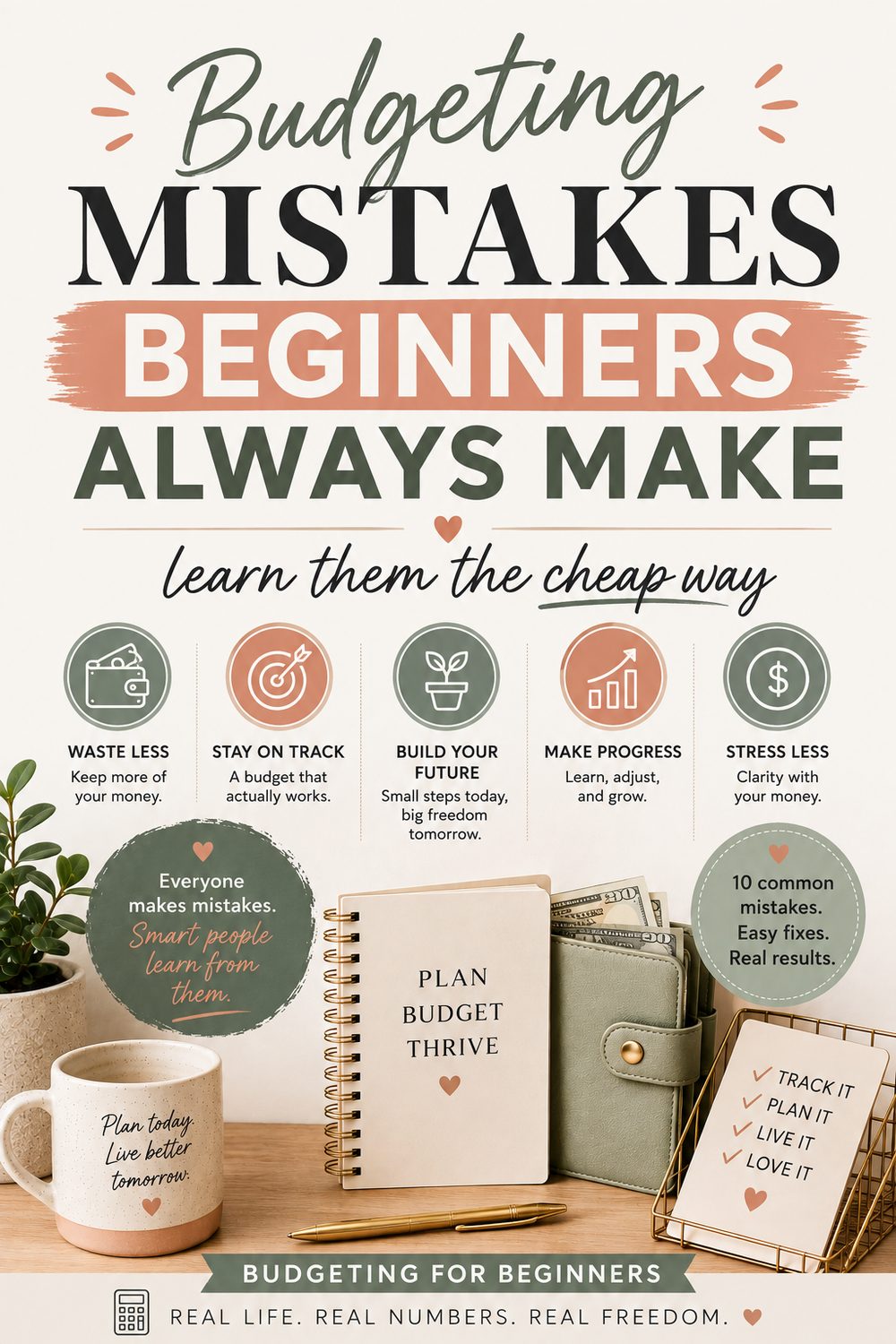
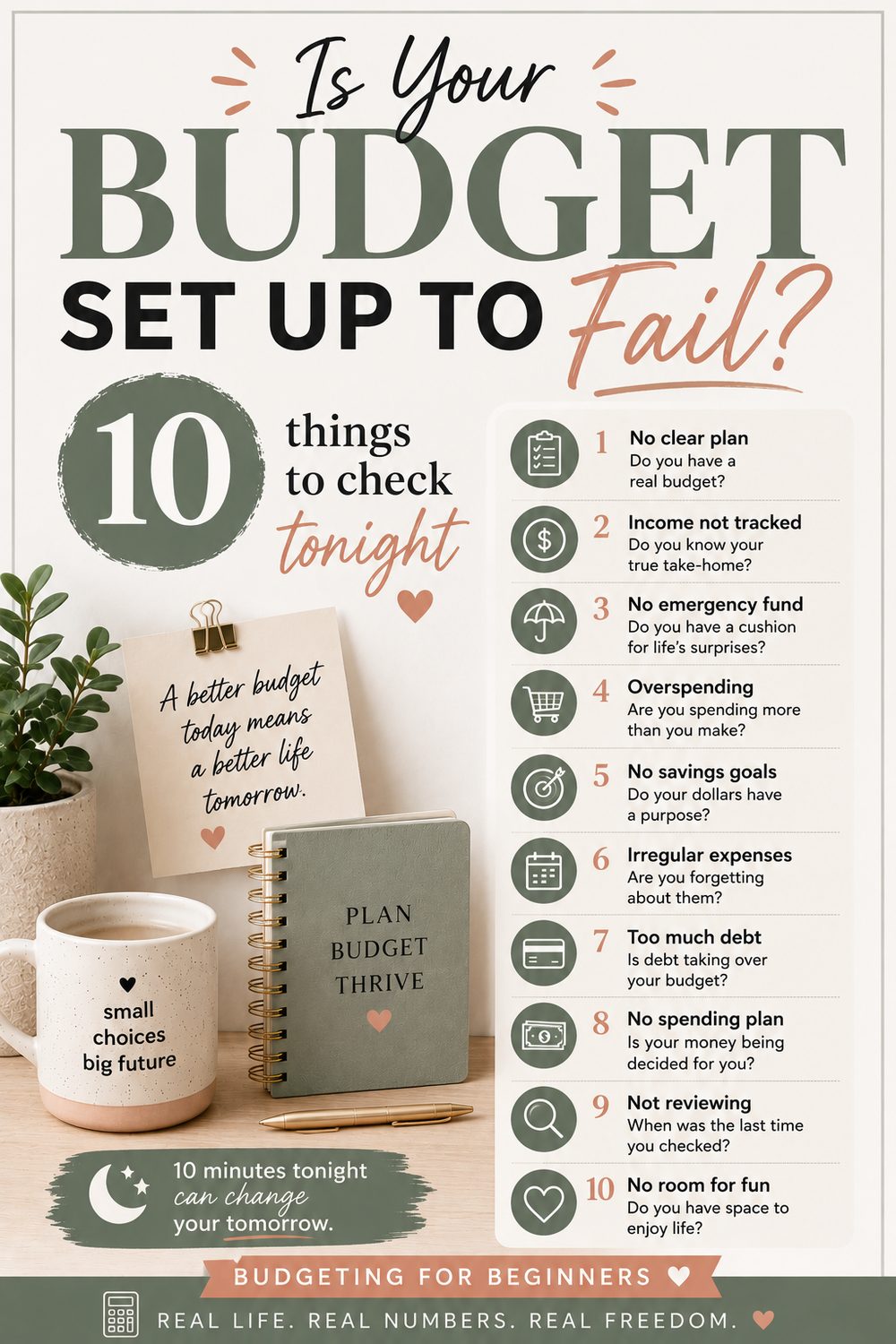
10 Budgeting Mistakes That Keep You Broke
By Nora Bennett · July 11, 2026

A budget can fail even when every formula is correct.
The problem is usually not that you cannot add. It is that the plan uses money that never reaches your account, ignores when bills are due, guesses at real spending, or leaves no room for ordinary life. Then the numbers break and the person using them gets blamed.
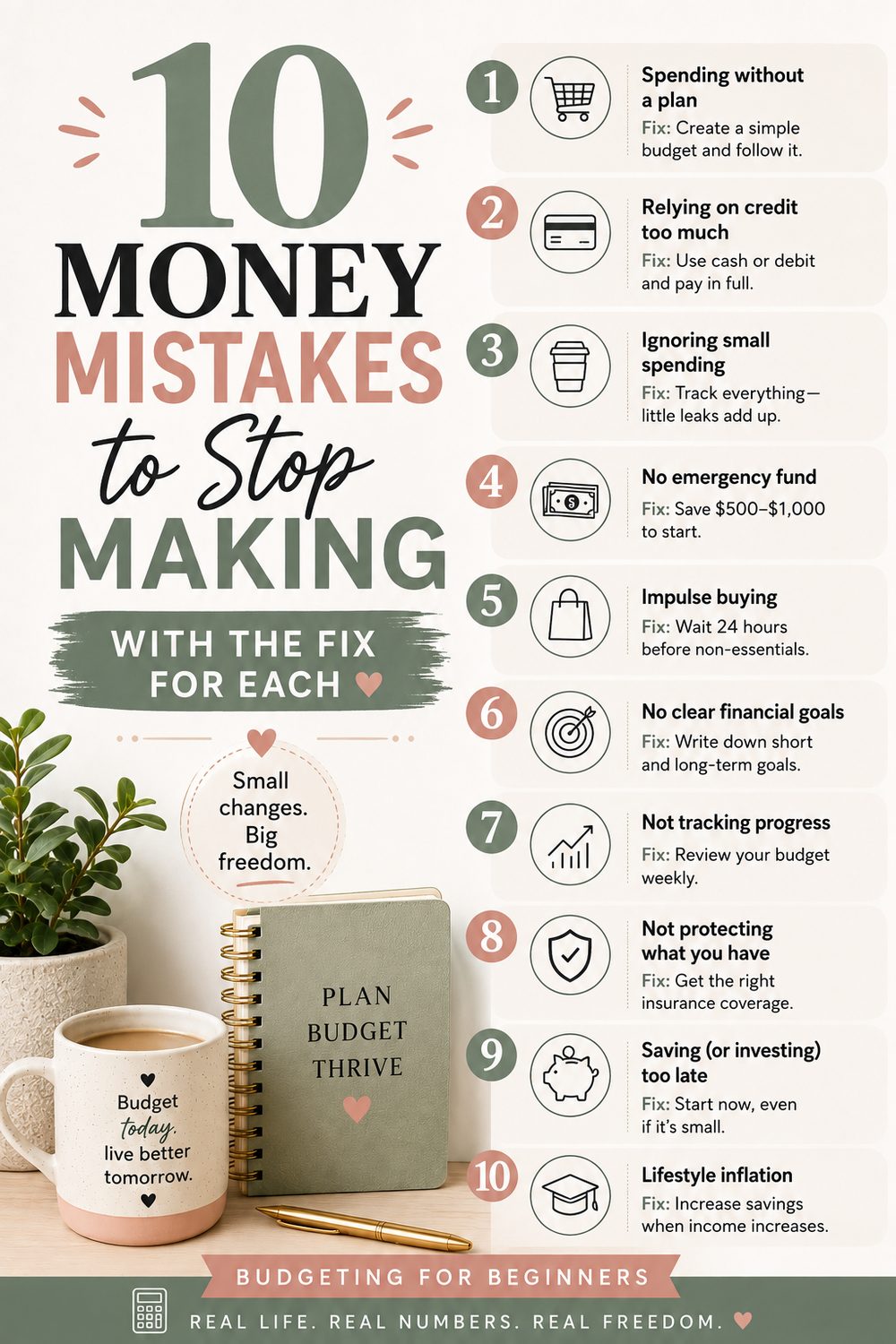
These ten budgeting mistakes can keep cash flow unstable, but none of them is a character flaw. Each one has a visible symptom, a likely cause, and a practical repair. You do not need to fix all ten this weekend. Find the mistake that is costing you the most, repair it, and let the next month provide better data.
A two-minute budget diagnosis
Before reading the full list, answer these questions:
- Does the income in your budget equal the deposits that actually reach your account?
- Are your grocery, fuel, and household numbers based on recent transactions?
- Can you see every bill due before your next payday?
- Are annual and irregular expenses getting monthly contributions?
- Is there a small buffer for normal variation?
- Do you review the plan before the month is over?
Every “no” points to one of the mistakes below.
1. Budgeting gross income instead of spendable income
The mistake: Building the plan from salary or gross pay rather than the amount available after taxes, benefits, retirement contributions, garnishments, and other payroll deductions.
The symptom: Your categories fit neatly on paper, but checking runs short even when you stay close to the plan.
Why it happens: Gross salary is easy to remember. Net pay changes when benefits, withholding, overtime, or unpaid time changes.
The fix for regular income: Look at the last two or three ordinary pay deposits. Exclude bonuses and unusually high overtime. Use the normal deposit amount multiplied by the number of checks expected in the budget period.
If you are paid every two weeks, build a normal month around two paychecks. Treat the two months that contain a third paycheck as separate planning opportunities—not as income silently spread across every month.
The fix for irregular income: Consumer.gov suggests using a longer history when income does not arrive monthly. Add a representative period of income and divide it into a monthly estimate. For budgeting, a cautious version is even safer: use the lower end of recent ordinary months for core commitments, then assign income above that baseline after it arrives. See the full Consumer.gov budgeting method.
Do not include a tax refund, bonus, commission, freelance invoice, or support payment before you reasonably expect it to clear.
2. Writing an aspirational budget instead of a factual one
The mistake: Entering what you believe a responsible person should spend rather than what your household currently spends.
The symptom: Groceries, transport, or household supplies exceed the budget by the middle of the month, every month.
Why it happens: A lower number feels like progress. But typing $400 into the grocery category does not change a recent $650 pattern.
The fix: Build a 30- to 90-day baseline.
- Export or review checking and credit-card transactions.
- Remove transfers and credit-card payments so purchases are not counted twice.
- Group actual spending into broad categories.
- Divide irregular but necessary costs across the months they cover.
- Use those averages as the first draft.
Then choose one or two categories to reduce. Test a modest change with a specific action: one fewer takeout order, a written grocery list, or a lower-cost phone plan. Do not slash five categories and call the difference savings before the month happens.
A factual budget is not permission to keep every habit forever. It is a reliable starting point for changing one.
3. Planning the month but ignoring paycheck timing
The mistake: Your monthly income is technically enough, but too many bills leave before the paycheck that is supposed to cover them.
The symptom: You are short in the first half of the month and comfortable in the second, or you repeatedly use overdraft protection while the monthly budget says you are fine.
Why it happens: A monthly total hides timing. Rent due on the first cannot be paid by income arriving on the fifteenth.
The fix: Add a bill calendar or paycheck plan. The CFPB recommends listing each bill, amount, and due date, then checking the calendar weekly. Its bill-calendar guidance is simple: know what is owed and when it leaves.
For each paycheck, write:
- starting checking balance;
- income arriving before the next payday;
- bills due before the next payday;
- groceries, transport, and other essentials needed during that period;
- planned savings or debt payments; and
- the balance that must remain until the next deposit.
If one pay period is negative, the problem may be timing rather than total spending. Ask providers whether a due date can be changed, split a large monthly obligation across paychecks by setting aside part early, or hold more of the previous paycheck for the next cycle.
The paycheck budgeting guide walks through the full setup.
4. Forgetting non-monthly and irregular expenses
The mistake: Planning only for bills that arrive every month.
The symptom: Car insurance, school costs, holidays, annual subscriptions, maintenance, and professional fees repeatedly become “emergencies.”
Why it happens: Monthly budgeting screens make annual costs easy to overlook, and an expense without an exact date can feel optional until it arrives.
The fix: Build an irregular-expense inventory from the previous 12 months. Review statements, email receipts, your calendar, and insurance documents. Include:
- annual and semiannual insurance;
- vehicle registration, service, and tires;
- home or renter maintenance;
- medical deductibles and routine care;
- school, work, and professional costs;
- birthdays and holidays;
- annual memberships and subscriptions;
- pet care; and
- travel you already know you will take.
Estimate the next cost, subtract anything already saved, and divide by the months or paychecks remaining. That contribution becomes a sinking fund.
Example: a $720 insurance premium due in nine months needs $80 a month. The bill is still large, but it is no longer a surprise.
Do not confuse a sinking fund with an emergency fund. Sinking funds prepare for expected costs. Emergency savings protect against unplanned, necessary, time-sensitive shocks.
5. Saving “whatever is left” or automating too much
This mistake has two opposite versions.
Version A: You intend to save what remains at the end of the month, but optional spending absorbs the unassigned money first.
Version B: You automate an ambitious transfer without checking bill timing, then incur an overdraft or move the money back.
The fix: Choose a safe, specific transfer based on cash flow.
Automatic saving can be effective, and the CFPB describes recurring transfers as one way to build consistency. It also warns that poorly timed transfers can cause overdraft fees when checking is too low. Review the CFPB's automatic-saving considerations before scheduling one.
Use this order:
- Cover essentials and bills due before the next paycheck.
- Make required minimum debt payments.
- Leave a realistic checking cushion.
- Transfer an amount you can keep saved.
- Increase it after two successful pay cycles.
For irregular income, transfer a percentage when each payment clears instead of promising a fixed amount on a date when income may not arrive.
Saving $20 repeatedly is more useful than moving $100 to savings and $100 back every month.
6. Removing every enjoyable expense
The mistake: Cutting all restaurants, hobbies, entertainment, personal spending, and convenience costs to prove the budget is serious.
The symptom: The plan works briefly, then one stressful week triggers spending that feels uncontrolled or secret.
Why it happens: Extreme cuts create dramatic totals and can feel decisive. They also ignore the fact that a budget must operate during ordinary human life.
The fix: Include a defined amount of flexible spending after essentials and minimum obligations. Call it fun money, personal spending, or lifestyle—whatever makes the job clear.
The amount is not automatically 30% of income. The 50/30/20 framework is a useful starting point, not a rule every household can meet. If money is tight, the category may be small or temporarily paused. The goal is to make the tradeoff visible rather than pretending it will never occur.
For shared finances, give each partner a clear amount that can be spent without approval. That prevents every coffee or hobby purchase from becoming a budget meeting while protecting joint priorities.
7. Starting with a system too complicated to maintain
The mistake: Creating dozens of categories, multiple accounts, daily tracking rules, an envelope system, and a new app all at once.
The symptom: Setup takes hours, transactions pile up uncategorized, and you stop opening the budget.
Why it happens: Detail looks like control. Sometimes it is only administrative work.
The fix: Start with the minimum detail needed to make decisions.
A first-month budget can use seven groups:
- Income
- Housing and utilities
- Food and household
- Transport
- Health, insurance, and dependents
- Debt and savings
- Flexible spending
Split a category only when the extra information would change a decision. For example, separate groceries from restaurants if you want to reduce restaurant spending. Do not create six grocery subcategories merely because the software allows it.
Use one primary system for the plan. Your bank, card apps, and receipts can supply evidence, but they do not each need a separate budget.
8. Tracking spending without making decisions
The mistake: Reviewing charts that show where money went but never setting category amounts before spending.
The symptom: You know last month's totals in impressive detail, yet the same categories exceed an undefined limit again.
Why it happens: Tracking feels productive and apps make it effortless. But tracking is a record; budgeting is a decision.
The fix: Give every category a planned amount before the period begins, then compare actual spending with that decision while there is still time to adjust.
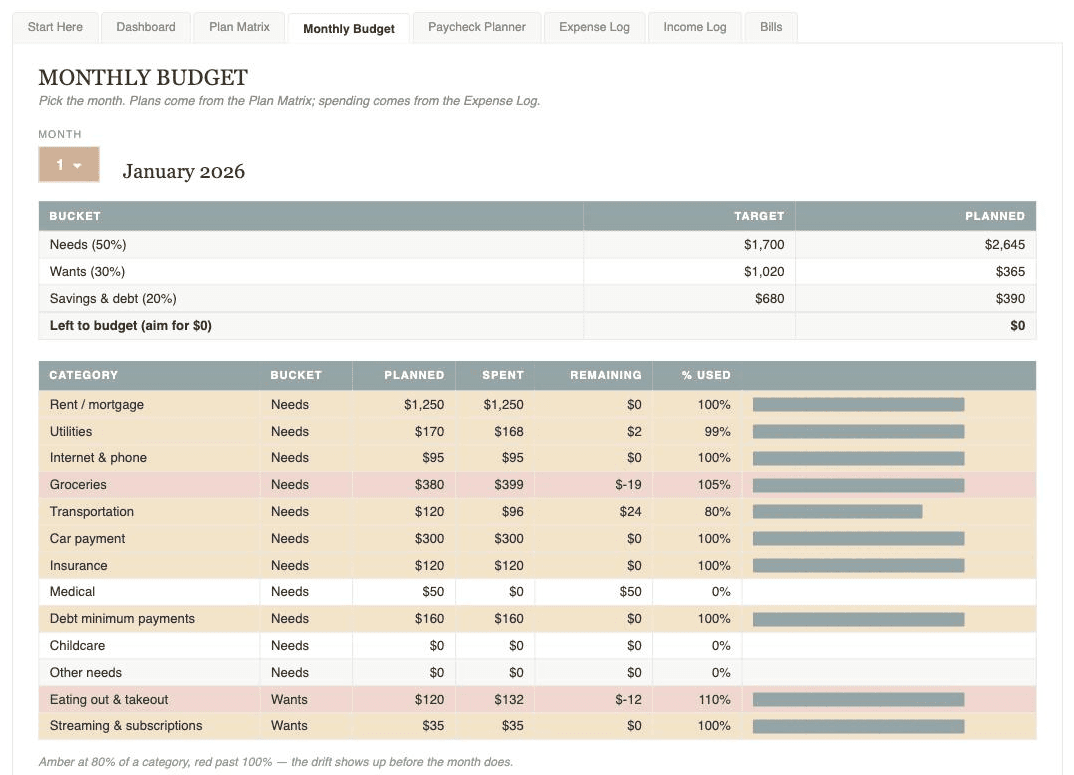
Run a ten-minute weekly review:
- confirm recent transactions;
- compare actual spending with the plan;
- check bills due before the next review;
- move money between categories deliberately if needed; and
- record one adjustment for the coming week.
An app, spreadsheet, notebook, or envelope system can all work. The best tool is the simplest one you will consult before the money is gone. The apps versus spreadsheets versus paper guide can help you choose.
9. Giving every dollar a job but leaving no margin
The mistake: Assigning the budget down to zero without accounting for normal price changes, forgotten small costs, or transactions that settle at unexpected times.
The symptom: A $12 school request or higher utility bill forces you to take money from rent, savings, or a credit card.
Why it happens: “Every dollar has a job” is sometimes interpreted as “every dollar must be committed to an exact bill.” A buffer is also a job.
The fix: Add a small budget buffer and a separate checking cushion.
- A budget buffer is a category for minor, irregular costs during the month.
- A checking cushion is money left in the account to reduce timing errors and overdrafts.
- An emergency fund is separate savings for larger, genuinely unplanned needs.
Do not use the buffer as a hidden excuse to overspend. Give it an amount, track what uses it, and reduce or redirect it if it consistently remains untouched.
If you regularly pay overdraft fees, review low-balance alerts, automatic payment dates, and your institution's overdraft settings. The CFPB explains that transaction timing may not appear in the order expected and lists ways to reduce overdraft risk.
10. Treating one bad week as proof the budget failed
The mistake: Exceeding one category, declaring the month ruined, and waiting for the next month—or next January—to start again.
The symptom: One $60 overage becomes several weeks of unplanned spending.
Why it happens: A budget is treated as a test of discipline rather than a plan that changes when reality changes.
The fix: Use a mid-month repair, not a restart.
- Stop and enter the transactions.
- Calculate the exact overage.
- Protect housing, essentials, minimum payments, and required bills first.
- Reduce another flexible category by the amount you can absorb.
- If the month cannot absorb it, lower a nonessential goal or revise the plan honestly.
- Ask whether the original category was unrealistic or the event was unusual.
If groceries exceed the plan because prices or household needs changed, next month's baseline may need to rise. If the overage came from an avoidable pattern, choose a specific control for next week. Data should change the design—not become evidence that you are “bad with money.”
What if your budget is negative before optional spending?
Sometimes the problem is not a budgeting mistake. Essential expenses and minimum obligations may exceed reliable income.
When that happens, do not keep shrinking categories that are already unrealistic. Use a triage budget:
- List reliable income and its arrival dates.
- Prioritize housing, essential utilities, food, medicine, transport needed for income, required insurance, and essential dependent care.
- Contact lenders and providers before a missed payment to ask about hardship options, due-date changes, or payment plans.
- Check public benefits, tax credits, workplace benefits, and community assistance for which you may qualify.
- Pause lower-priority subscriptions and goals temporarily.
- Identify the smallest sustainable income increase or major-cost reduction available.
Avoid pretending a negative budget can be repaired by making the grocery number impossible. The low-income budgeting guide provides a more detailed order of operations.
A 30-day budget repair plan
Do not rebuild everything in one evening. Use one month to create a budget based on evidence.
Days 1–3: Build the factual starting point
- Collect recent pay records, bank statements, card statements, and bills.
- Record net income and every income date.
- List fixed bills with amounts and due dates.
- Total the last 30 to 90 days of variable spending.
Days 4–7: Find the structural gaps
- Add annual and irregular expenses.
- Check whether the first or second half of the month goes negative.
- Identify subscriptions and automatic payments.
- Choose a realistic checking cushion.
Week 2: Make only three changes
- Correct one unrealistic category.
- Reduce one expense with a specific action.
- Schedule one safe savings or debt transfer.
Week 3: Test the cash-flow timing
- Check the account before each automatic payment.
- Compare each category with the amount remaining.
- Move money between categories deliberately rather than ignoring an overage.
Week 4: Write the next version
- Keep the category amounts that worked.
- Adjust those that repeatedly missed.
- Turn one predictable annual cost into a sinking fund.
- Choose the next single improvement.
At the end of 30 days, success is not a perfect plan. Success is knowing what arrived, what left, what is due next, and which decision you will change.
Frequently asked questions
Which mistake should I fix first?
Fix the one creating fees, missed essentials, or new high-cost debt. That is often incorrect income, cash-flow timing, or missing irregular bills. If the plan is stable but savings are not growing, address the savings system next.
Is using a budgeting app a mistake?
No. An app can reduce transaction-entry work and make patterns visible. It becomes a problem only when automatic categorization replaces planning and review. Decide the category limits first, then use the app to compare reality with the decision.
How many categories should a budget have?
There is no correct number. Use enough categories to support decisions and no more than you can review consistently. Start broad and split categories only when the distinction changes what you will do.
Should my budget equal zero?
Income minus planned spending, saving, and debt payments can equal zero in a zero-based budget. That does not mean your checking balance must be zero. A checking cushion and budget buffer are valid assignments.
How often should I check the budget?
Weekly is frequent enough for many households to catch drift while there is still time to adjust. Also check before large purchases and before automatic withdrawals if cash flow is tight.
Fix one mistake this Sunday
Open your latest statement and find one piece of evidence: the actual deposit, the real grocery total, the next bill date, or the annual cost you forgot. Correct that number in your plan.
Then schedule a ten-minute review for next week. A durable budget is not a document you finish. It is a small decision system you keep improving with real information.


Written by
I fixed my own money with a spreadsheet and a Sunday morning, and now I build the tools I wish I’d had. I manage a dental practice in Greensboro, North Carolina, and I have never once told anyone their problem was the coffee.


