How to Pay Off Debt Fast on a Low Income (Realistic Plan)
By Nora Bennett · July 19, 2026

Paying off debt quickly on a low income is not about finding hundreds of dollars that do not exist. It is about stopping avoidable damage, choosing the correct debt to target, lowering costs where possible, and making sure every extra payment produces lasting progress instead of creating a new emergency next week.
“Fast” must be measured against your real starting point. If a plan clears $4,000 in 18 months instead of keeping the household in revolving debt for several years, that is meaningful speed—even if it does not make a dramatic social-media headline.
This guide begins before the first extra payment. You will stabilize essential bills, identify which debts need special handling, calculate a repeatable payoff amount, and decide where occasional extra money should go.
Urgent situations come before payoff speed. If rent, utilities, food, medication, transport to work, insurance, or personal safety is at risk, use the low-income budgeting guide first. If you have received a lawsuit, garnishment notice, repossession warning, foreclosure notice, tax levy, or court document, deadlines may apply. Contact qualified local legal aid, a housing counselor, or an attorney instead of relying only on a general payoff method.
Step 1: Pass the stabilization test
An extra debt payment is useful only if it stays paid. Before attacking a balance, check four conditions.
1. Current essentials are funded
Housing, basic utilities, food, medication, work transport, required insurance, childcare needed for work, and court-ordered obligations come before accelerated unsecured debt payoff.
This is not permission to ignore creditors. It is a way to prevent a credit-card payment from causing eviction, disconnection, loss of transportation, or another high-cost crisis.
2. Required payments fit—or creditors have been contacted
List every minimum or agreed payment due this month. If they do not fit after essentials, the problem is not payoff motivation. The payment structure is unaffordable.
Contact creditors before due dates and ask about hardship options, lower payments, fee relief, due-date changes, or a structured plan. No option is guaranteed, and each may affect interest, account access, credit reporting, or payoff time. Ask for the full terms in writing.
3. New borrowing has stopped when safely possible
If groceries, fuel, or medication still go onto a card every month, paying extra to that card may only create the appearance of progress. Fix the recurring budget gap—or reduce it as far as possible—before setting an aggressive target.
4. A small shock absorber exists
The first buffer does not need to be a universal $1,000. It should cover a small expense that commonly sends the household back to credit: a prescription, transport problem, school request, or timing error.
A useful starting sequence is:
- a small checking-account cushion;
- one common surprise expense;
- one week of essential variable spending; and
- a larger starter emergency fund over time.
Do not build the buffer with money needed for this month's essentials or court-required payments. The goal is to reduce new debt, not create a different shortage.
Step 2: Build a complete debt inventory
You cannot choose a payoff order from balances alone. Create one row for every debt with these columns:
| Information | Why it matters |
|---|---|
| Creditor or current owner | Tells you who must receive payment or answer questions |
| Debt type | Secured, unsecured, medical, student, tax, court-ordered, or collection debt may need different treatment |
| Current balance | Measures the amount still owed |
| Interest rate or fee structure | Shows how quickly the balance may grow |
| Minimum or agreed payment | Determines the monthly amount needed to remain on plan |
| Due date | Allows paycheck mapping and prevents timing mistakes |
| Status | Current, late, charged off, in collections, or subject to legal action |
| Collateral or consequence | A car, home, utility service, license, or legal obligation may change priority |
| Promotional-rate end date | A deferred-interest or promotional balance can become more expensive later |
| Contact and last agreement | Creates a record of calls, names, dates, and written terms |
Use current statements and account portals. For U.S. credit accounts, review your reports through AnnualCreditReport.com, the federally authorized source. A credit report may not contain every debt, so compare it with mail, medical bills, tax records, court documents, and your bank history.
Do not estimate the APR when the document is available
Find the purchase APR, cash-advance APR, penalty rate, and promotional terms on the statement or agreement. A card can have more than one rate.
For a rough estimate of one month's interest:
Balance × annual percentage rate ÷ 12 = approximate monthly interest
Example: a $1,000 balance at 24% APR produces roughly $20 of interest in a simple monthly estimate.
Actual card interest usually depends on average daily balance, daily periodic rates, transaction timing, fees, and payment allocation. Use the statement's interest charge for the most reliable recent number.
Step 3: Classify debts before ranking them
The highest APR is not automatically the first payment in every situation. First identify debts with special consequences or options.
| Debt situation | First action | Why |
|---|---|---|
| Housing, vehicle, or other secured debt is late | Contact the servicer and qualified local help immediately | Missed payments may threaten an essential asset or housing |
| Court-ordered, tax, or government debt | Get advice specific to the agency and local law | Collection powers and legal consequences can differ |
| Payday or title loan | Review cost, due date, debit authorization, and lawful repayment options quickly | Short terms, fees, and collateral can create urgent risk |
| Federal student loan | Check the current account and StudentAid.gov Loan Simulator | Repayment and relief options can differ from private debt and are changing |
| Nonprofit-hospital bill | Request the hospital's financial-assistance policy before assuming the full balance is fixed | Eligible patients may qualify for free or discounted care |
| Collection account | Verify the collector, debt, amount, and legal status before paying or sharing sensitive information | The debt may be incorrect, already paid, duplicated, or subject to state-specific rules |
| Current unsecured debt | Compare APR, balance, minimum, and payoff method | This is where avalanche or snowball ordering usually applies |
Secured debt needs consequence-based decisions
A credit card at a high rate may cost more interest, but a late car payment may threaten transport needed for work. Do not let a payoff spreadsheet override the consequence of losing an essential asset.
Contact the lender early. Ask about the amount required to become current, hardship options, extensions, fees, and how each choice changes the loan. Extending a loan can lower a payment while increasing total interest, so compare both monthly relief and total cost.
Federal and private student loans are different
Federal student loans may have repayment plans, deferment, forbearance, forgiveness, rehabilitation, or consolidation rules that do not apply to private loans. Federal Student Aid states that its Loan Simulator can compare estimated payments, total paid, payoff dates, and current plan eligibility.
Because federal programs are changing, use StudentAid.gov and your official servicer rather than an old blog's list of plan names. Ask how any change affects interest, forgiveness progress, loan term, and total cost.
Private-loan options depend on the contract and lender. Contact the lender directly and get any modification in writing.
Medical debt may have an assistance step before payoff
In the U.S., tax-exempt hospitals must maintain a written financial-assistance policy. The IRS explains that these policies include eligibility criteria and the application method for free or discounted medically necessary care.
Ask the hospital—not only a collection agency—for:
- the financial-assistance policy and plain-language summary;
- the application form and deadline;
- an itemized bill;
- confirmation of which providers are covered by the policy;
- a pause on collection activity while a complete application is reviewed; and
- an interest-free payment plan if a balance remains.
Do not assume every medical provider or bill is covered. The hospital's policy may exclude independent physicians or other providers.
Verify collection debts before making a payment
The CFPB's current debt-collection rule requires validation information about the debt and explains a consumer's dispute rights. Review the CFPB validation-notice guidance promptly.
Before paying:
- Confirm the collector's identity using independently verified contact information.
- Compare the original creditor, account, balance, and dates with your records.
- Review the validation notice and dispute deadline.
- Learn the rules where you live, especially for older debts.
- Get any payment plan or settlement terms in writing before sending money.
Do not make a token payment on an old debt merely to stop a call. In some places, a payment or acknowledgment may affect legal time limits. A qualified local consumer-law attorney or legal-aid organization can explain the rule that applies to your debt.
Step 4: Choose the payoff method
Once urgent and special-case debts have a plan, rank current unsecured debts.
Debt avalanche
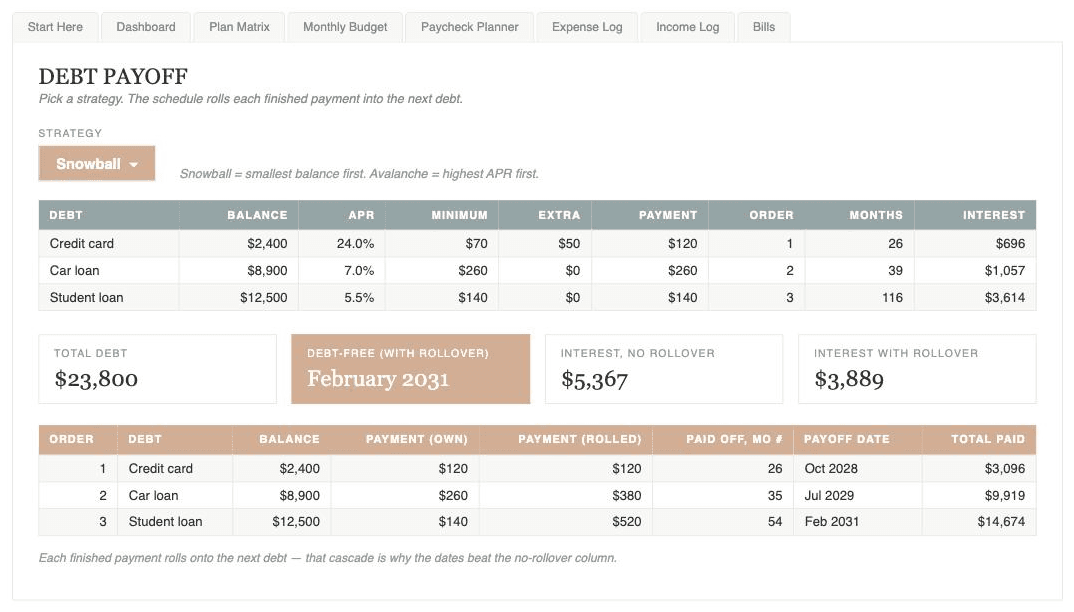
Pay minimums on all included debts and direct every extra dollar to the highest interest rate. When that debt is gone, roll its full payment to the next-highest rate.
Best for: reducing interest cost when you can maintain the sequence.
Tradeoff: the first balance may take longer to disappear.
Debt snowball
Pay minimums on all included debts and target the smallest balance first, regardless of rate. Roll the freed payment to the next-smallest balance.
Best for: creating early wins and reducing the number of due dates.
Tradeoff: it can cost more interest than the avalanche.
A practical hybrid
Use a hybrid when one very small balance can be cleared quickly and its minimum meaningfully increases the next payment. After that quick win, switch to the highest APR.
Example: paying off a $120 balance that frees a $30 minimum may improve cash flow. Paying off a $120 low-rate balance that frees only $5 while a much larger debt accrues extreme fees may be less useful.
The snowball-versus-avalanche comparison explains both methods in more detail. The best method is one you can follow without missing protected bills or taking on replacement debt.
Step 5: Set a repeatable payment amount
Do not choose an extra payment from your best month. Choose it from the normal budget after essentials, minimums, irregular bills, and a starter buffer.
Use this equation:
Debt attack amount = total minimum payments + reliable monthly extra
If minimums total $190 and the budget can safely add $60, keep sending $250 total each month. As debts disappear, do not reduce the $250 unless the household needs a temporary pause.
Use three payment levels
Create a plan that can survive different months:
- Floor month: required or agreed payments only.
- Normal month: minimums plus the repeatable extra.
- Strong month: normal payment plus a pre-decided portion of extra income.
This removes the idea that a minimum-only month destroyed the plan. It was already built into the system.
Map the payment to paychecks
If paid twice monthly, the $250 may be easier as $125 from each check. If due dates cluster, reserve part of the prior paycheck rather than waiting for the check immediately before the due date.
Use a separate Bills balance, spreadsheet allocation, or bank bucket so money assigned to debt is not mistaken for spending money.
Step 6: Ask creditors to reduce the cost
An APR reduction, waived fee, or affordable hardship plan can matter as much as a small extra payment. Call before the account is deeply delinquent when possible.
Use this script:
“I want to keep paying this account, but the current payment or interest rate is not sustainable on my income. What hardship plans, reduced-rate options, fee waivers, fixed-payment programs, or due-date changes are available? Please explain the monthly payment, interest rate, fees, program length, effect on card access and credit reporting, and what happens when the program ends.”
Record:
- the representative's name and department;
- date and time;
- offered payment and interest rate;
- program start and end dates;
- fees waived or added;
- whether the account will close or freeze;
- effect on past-due status and credit reporting; and
- confirmation number or written agreement.
Do not accept a “lower payment” without asking whether the loan term or total cost increases. Immediate affordability may still be the right priority, but the tradeoff should be visible.
A worked $4,200 payoff example
Consider four debts that are current and have already passed the special-case review:
| Debt | Balance | APR | Minimum |
|---|---|---|---|
| Store card | $800 | 31.99% | $35 |
| Credit card | $1,600 | 24.99% | $55 |
| Personal loan | $1,200 | 12% | $60 |
| Hospital payment plan | $600 | 0% | $40 |
| Total | $4,200 | $190 |
The household can safely add $60 a month, making the total debt budget $250. It uses the avalanche and has a $500 lump sum in month four after protecting current bills and the starter buffer.
The order
- Store card at 31.99%
- Credit card at 24.99%
- Personal loan at 12%
- Hospital plan at 0%
What happens
- Months 1–3: all minimums are paid; the remaining payment targets the store card.
- Month 4: the $500 lump finishes the store card.
- Months 5–16: the former store-card payment rolls to the credit card until it is gone.
- The hospital plan reaches zero under its normal schedule.
- The freed payments finish the personal loan in month 18.
Using a simplified monthly-interest model, the debts finish in about 18 months with roughly $543 of interest. The same $250 monthly budget without the $500 lump takes about 20 months and roughly $728 of interest. Keeping only the original $190 total payment takes about 29 months and roughly $1,193 of interest.
These are illustrations, not lender payoff quotes. Actual results vary because credit cards may use daily compounding and changing minimums, loans may have fees or prepayment rules, and payments can be applied differently. Use current statements or a lender payoff amount for exact planning.
The key lesson is not “find $500.” It is that three levers work together:
- a repeatable monthly extra;
- payment rollover when a balance closes; and
- occasional extra money applied to the current target.
Step 7: Use lump sums without creating the next emergency
A tax refund, third paycheck, overtime month, rebate, gift, or sale can accelerate debt. But sending every lump to a card is not automatically wise.
Use this order:
- Catch up protected essentials and required payments.
- Reserve taxes if the income is not fully withheld.
- Fund bills due before the next reliable income.
- Refill the starter buffer.
- Cover a known near-term expense that would otherwise return to debt.
- Send the planned remainder to the current payoff target.
Decide the percentage before the money arrives
For example, a household might direct 60% of a windfall to debt, 25% to an upcoming car repair fund, and 15% to a planned family need. The correct split depends on what would otherwise become new debt.
Tax refunds vary and are not guaranteed. U.S. readers can check current eligibility for the Earned Income Tax Credit and other credits through the IRS, but should not build monthly bills around a refund that has not arrived.
When consolidation helps—and when it does not
Consolidation replaces multiple debts with one new debt. It may help if:
- the new APR is meaningfully lower after all fees;
- the payment fits without an extremely long term;
- the total cost is lower or the affordability tradeoff is intentional;
- promotional rates and expiration dates are understood;
- there is no valuable protection lost by refinancing; and
- paid-off accounts will not immediately be used to rebuild the balances.
Compare:
| Question | Why it matters |
|---|---|
| What is the APR, not only the monthly payment? | A lower payment can hide a longer and more expensive loan |
| What origination or transfer fees apply? | Fees reduce or erase interest savings |
| Is the rate fixed or variable? | A variable rate can rise later |
| How long is the new term? | More months can increase total interest |
| Is collateral required? | Turning unsecured debt into secured debt can increase risk |
| Which protections disappear? | Refinancing federal student loans or other protected debt can remove options |
Do not refinance federal student loans into a private loan without understanding the permanent loss of federal repayment and forgiveness protections.
Credit counseling, debt settlement, and bankruptcy
If minimum payments remain unaffordable after the budget and creditor calls, a normal payoff method may not be the right tool.
Nonprofit credit counseling
The CFPB explains that credit counseling organizations are usually nonprofits that can review the budget and may organize a debt management plan. Under a plan, the consumer makes one payment to the counseling organization, which pays participating creditors.
Ask about:
- setup and monthly fees;
- which creditors participate;
- the required payment and program length;
- interest or fee concessions;
- what happens if a payment is missed;
- whether accounts close; and
- how payments and account status will be reported.
Use the CFPB's credit-counseling explanation to compare the service with consolidation or settlement.
Debt settlement
Debt settlement is not the same as a debt management plan. The CFPB warns that settlement companies may charge expensive fees and commonly encourage consumers to stop paying creditors, which can add late fees, penalty interest, collection activity, lawsuits, and credit damage. Forgiven debt may also have tax consequences.
The FTC states that covered for-profit debt-relief services sold by telephone cannot charge a fee before meeting specific results and payment conditions. Treat upfront-fee demands, guaranteed results, pressure, and claims of a secret government program as warning signs.
Read the CFPB's debt-relief risks before signing.
Bankruptcy advice
When the debt is impossible to repay, income is being garnished, lawsuits are escalating, or essential life cannot stabilize, a consultation with a qualified bankruptcy attorney or legal-aid organization can explain legal options. Learning the options does not commit you to filing.
Do not drain protected retirement funds, surrender essential assets, or make unusual payments to relatives without qualified advice. Bankruptcy and creditor laws are fact-specific.
A 90-day debt-payoff launch plan
Days 1–7: Stabilize
- Fund immediate essentials.
- List every required payment and due date.
- Pause extra payments until the inventory is complete.
- Create the first buffer target.
- Respond promptly to lawsuits, repossession, foreclosure, or government notices.
Days 8–14: Verify
- Gather statements and contracts.
- Review credit reports.
- Confirm balances, APRs, promotional terms, and account status.
- Request validation information for collection debts.
- Ask hospitals about financial assistance.
- Check current federal student-loan options through StudentAid.gov.
Days 15–30: Negotiate and choose
- Call unaffordable creditors.
- Compare hardship terms in writing.
- Choose avalanche, snowball, or hybrid.
- Set floor, normal, and strong-month payment levels.
- Map payments to paychecks.
Month 2: Make the system repeatable
- Automate only payments the account can safely support.
- Track the target balance after each statement.
- Direct normal extra money to one debt.
- Build one small sinking fund for the expense most likely to create new debt.
Month 3: Review the evidence
- Compare balances with the starting inventory.
- Confirm interest and fees are moving in the expected direction.
- Revisit hardship plans or due dates that did not help.
- Decide the job of any upcoming lump sum.
- Seek nonprofit counseling or legal advice if the numbers still cannot work.
Frequently asked questions
Should I save or pay off debt first on a low income?
Fund immediate essentials and create a small shock absorber first. Then pay high-cost debt aggressively while gradually building protection against the expenses most likely to return to credit. The exact split depends on the debt's cost and consequences.
Should I close a card after paying it off?
Consider annual fees, temptation, account age, available credit, fraud monitoring, and whether the card has useful protections. Closing an account can affect credit utilization and history, but keeping a card open is not helpful if it repeatedly creates unaffordable debt. There is no universal answer.
Should a tax refund go entirely to debt?
Not if current essentials are behind or a predictable expense will immediately go back onto the card. Decide the split before the refund arrives: catch-up needs, taxes if applicable, buffer, known expenses, then the current debt target.
What if collectors keep calling?
Review the CFPB debt-collection resources and validation notice. Keep records of calls and letters. Do not let call frequency decide payment priority, and do not ignore court papers. Get local legal help when rights, deadlines, or old debt are uncertain.
Is a balance transfer worth it?
Only after comparing the transfer fee, promotional APR, expiration date, post-promotion APR, required payment, and the amount that can realistically be repaid during the offer. A transfer moves debt; it does not eliminate it.
What if I can only add $10 a month?
Use it if current essentials and the starter buffer remain safe. Also pursue the non-payment levers: hardship rates, fee waivers, hospital assistance, benefits, due-date changes, and reliable extra income. Ten dollars plus a lower APR can be more effective than a larger payment at an unchanged high rate.
How do I stay motivated during a long payoff?
Track more than the total balance. Record debts closed, interest reduced, fees avoided, months without new borrowing, buffer growth, and each payment rolled forward. A minimum-only month is not failure when it protects the household and prevents new debt.
Start with one accurate page
This Sunday, do not make a dramatic payment. Build one accurate debt inventory, circle any debt with urgent legal or asset consequences, choose the first buffer target, and identify the account that receives the normal extra after stabilization.
Then make the first planned payment—not the largest emotionally possible payment. A debt plan becomes fast when it can survive real life long enough for rollover payments, lower costs, and occasional lump sums to compound in your favor.




Written by
I fixed my own money with a spreadsheet and a Sunday morning, and now I build the tools I wish I’d had. I manage a dental practice in Greensboro, North Carolina, and I have never once told anyone their problem was the coffee.