30-Day Money Saving Challenge (Free Printable)
By Nora Bennett · June 28, 2026 · Updated August 5, 2026

A money saving challenge works for one simple reason: it turns "I should save more", a fog with no edges, into a daily game with a visible finish line. This 30-day money saving challenge is built for normal budgets and real lives: one small action per day, a grace rule for missed days, and no escalating "$100 day" nonsense that quietly assumes you're rich by week four. Most people finish somewhere between $150 and $400 saved, and, more valuable, with two or three habits that keep paying after the month ends.
The rules (there are only five)
- One action per day. Each day has a small job. Some save cash directly, some build the machinery that saves cash forever.
- Skip days happen; streaks forgive. Miss a day, double up tomorrow. A missed Tuesday never killed a challenge; quitting over a missed Tuesday kills them all.
- Move every dollar you save. When an action saves money, transfer that amount to savings the same day, even $4. Savings you can see is the fuel.
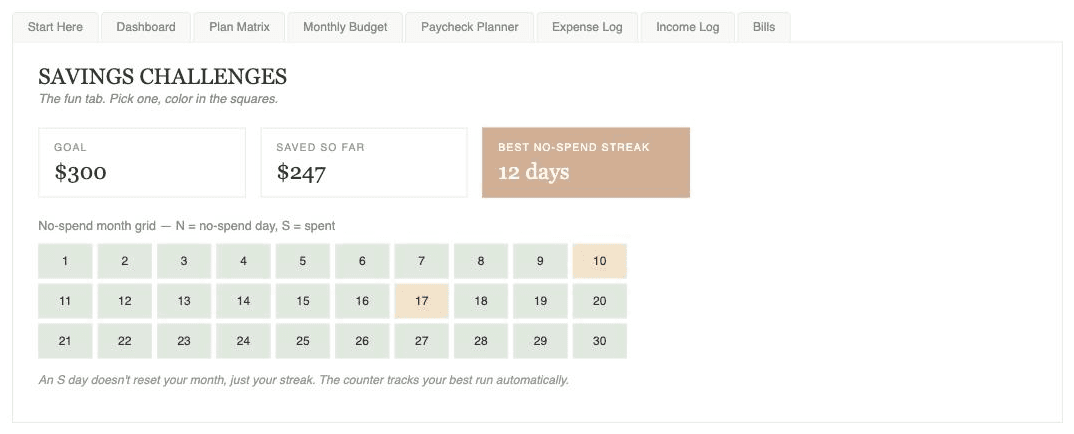
- Track it visibly. Color a square, tick a box. The free planner has a Challenges tab with a 30-day grid, a goal bar, and a running total that fills as you go.
- No misery purchases required. Nothing on this list asks you to be cold, hungry, or joyless. Deprivation challenges end in a revenge-spend; this one doesn't.
Week 1: Awareness (days 1–7)
The cheapest money you'll ever save is money you were spending unconsciously.
- Set your goal. Pick a number for the month ($200? $300?) and write it on the tracker. Vague challenges produce vague results.
- Find your leaks. Read your last month's statement line by line. Highlight everything you'd forgotten you paid for. (This is consistently people's most profitable day.)
- Cancel one subscription you highlighted yesterday. Move its monthly cost to savings.
- Do a no-spend day. Nothing but true essentials for 24 hours. Notice which urges show up and when.
- Unsubscribe from five marketing emails. You can't impulse-buy what never reaches you.
- Make a "want it" list. Everything you're tempted to buy goes on a list with a 30-day timer instead of in a cart. Most wants expire quietly.
- Sunday reset: total up week one, color your squares, and transfer what you saved. Read how the weekly check-in works if it's new to you.
Week 2, Quick wins (days 8–14)
- Pantry-only dinner. Cook from what you already own. The average pantry is hiding a week of meals.
- Pack lunch/coffee for the day and bank the difference, actually transfer it.
- Price-check one regular purchase. Store brand vs name brand on something you buy weekly. Switch if the taste test ties.
- Sell one thing. The exercise bike, the unused lens, the coat with tags on. List it today, not perfectly, done beats optimized.
- Free-fun day. Swap one paid plan for a free one (library, park, that hike you keep mentioning). Bank the difference.
- Batch your errands into one trip. Less fuel, fewer "while I'm here" purchases.
- Sunday reset: total, color, transfer. Halfway.
Week 3: Bigger levers (days 15–21)
One phone call this week is worth more than a month of skipped lattes.
- Call your biggest bill. Internet, phone, insurance: ask for current promotions or a loyalty rate. Scripts feel awkward for ten minutes; discounts last a year.
- Re-quote your insurance online (15 minutes). Switching or matching quotes routinely saves $100–$400 a year.
- Audit your subscriptions properly. All of them, in one list, with yearly costs. The planner's Bills tab computes the yearly damage automatically. Cancel the bottom two.
- Plan next week's meals around what's on sale. Meal planning is the single biggest controllable saving for most households.
- Negotiate or automate one debt. Ask a card issuer for a rate reduction, or set up the extra-payment automation from the debt payoff guide.
- The 24-hour rule, formalized: anything non-essential over $25 now waits a day, permanently. Write it somewhere you'll see it.
- Sunday reset: total, color, transfer.
Week 4: Lock it in (days 22–30)
Savings that depend on willpower evaporate. This week converts the month into machinery.
- Automate a weekly transfer, even $10: from checking to savings, scheduled for payday.
- Start your first sinking fund for the expense that most recently ambushed you.
- Set up account nicknames. "Savings" becomes "Emergency fund" or "December." Named money is money you don't spend.
- Do one more no-spend day and compare it to day 4. It's easier now. That's the habit forming.
- Prep-cook once for the week. Future-you orders less takeout when dinner is already half-made.
- Review your want-it list from day 6. Buy anything still genuinely wanted, guilt-free. Delete the rest and bank their cost.
- Write down your three best wins of the month. You'll want them for the next FAQ.
- Set next month's system: keep the automated transfer, the 24-hour rule, and your best two habits. Drop the rest without guilt.
- Final Sunday reset: grand total, color the last square, and celebrate with something small and deliberate, the anti-deprivation clause applies to finishing, too.
How much will you actually save?
Honest ranges from the actions above, for a typical month:
| Effort level | Realistic total |
|---|---|
| Light (the daily actions, no phone calls) | $100 – $180 |
| Solid (actions + one bill call + meal planning) | $200 – $350 |
| Go-getter (all of it, plus selling something decent) | $400+ |
The bigger prize is the residue: an automated transfer, a sinking fund, a 24-hour rule, and a want-it list keep producing every month after the challenge ends.
Track it as you go
The free Sunday Budget planner includes a Challenges tab with this exact 30-day grid, type what you saved each day and watch the goal bar fill, plus a 52-week challenge and a no-spend month tracker for when you're ready for round two. The download also includes a printable Sunday-reset checklist if you like coloring squares on paper (respect).
Frequently asked questions
What if I'm on a very tight budget? Skip the spend-to-save days and lean on the structural ones: canceling, unsubscribing, bill calls, automation. A challenge that saves $60 on a tight month is a bigger win, proportionally, than $400 on a comfortable one.
Can I do this with a partner? It's better with one: shared tracker, shared total, and days 15–17 (the phone calls) split two ways. Just agree up front that missed days get grace; the challenge shouldn't produce arguments as a side effect.
Do I have to start on the 1st? No. Day 1 is whatever day you start; the tracker doesn't care what the calendar says. (Starting on a Sunday does feel right around here, though.)
What do I do with the money afterward? Give it a job immediately: starter emergency fund, a sinking fund, or a debt payment via snowball or avalanche. Unassigned savings has a way of wandering back into checking.
Start this Sunday
Pick your goal number, grab the planner so the tracker's ready, and let day 1 be this Sunday. Thirty small actions from now, you'll have a few hundred dollars that didn't exist, and the quiet machinery that keeps making more.




Written by
I fixed my own money with a spreadsheet and a Sunday morning, and now I build the tools I wish I’d had. I manage a dental practice in Greensboro, North Carolina, and I have never once told anyone their problem was the coffee.