How to Budget on a Low Income (Without the Usual Nonsense)
By Nora Bennett · July 16, 2026

Budgeting on a low income is not simply normal budgeting with smaller numbers. When there is little margin, one late paycheck, prescription, school expense, or higher utility bill can disrupt the entire month.
That does not mean you are bad with money. It means the plan has less room to absorb ordinary life.
A budget cannot turn insufficient income into sufficient income. What it can do is help you protect the bills with the most serious consequences, match expenses to the right paycheck, avoid some preventable fees, identify the exact size of the gap, and make better use of assistance or additional income.
This guide does not assume you can save 20% of your income, cancel ten subscriptions, or solve the problem by skipping coffee. It starts with the money and obligations you actually have.
If you may lose housing, utilities, food, medication, transportation to work, or personal safety, treat that as an immediate support problem—not a budgeting exercise. In the United States, 211 connects people with local housing, utility, food, and health resources. Outside the U.S., search for your local government benefits portal, housing service, food-support network, or community advice line.
First, identify which problem you have
Before changing categories, compare reliable monthly income with essential monthly expenses.
| Situation | What the numbers show | First priority |
|---|---|---|
| Timing problem | Monthly income covers essentials, but due dates do not match paydays | Build a bill calendar and change due dates where possible |
| Tight but balanced | Essentials fit, but almost nothing remains | Protect a small buffer and reduce recurring costs |
| Temporary shortfall | A lost shift, repair, illness, or seasonal bill makes this month negative | Use short-term triage, provider calls, and assistance |
| Structural gap | Normal essential expenses exceed normal income month after month | Combine expense changes, benefits, debt relief options, and income changes |
These situations need different solutions. A bill calendar can fix a timing problem. It cannot fix a recurring $400 income gap. Naming the gap prevents endless small cuts that never address the real issue.
Calculate the gap
Use this simple equation:
Reliable monthly income − essential monthly expenses = monthly margin or shortfall
Include take-home pay, reliable benefits, regular support, and other income you can reasonably expect. Do not count a hoped-for bonus, overtime that is rarely available, a tax refund that has not arrived, or money you would need to borrow.
If income varies, build the first version of the budget around a conservative baseline. Use the lowest ordinary month from the last three to six months, excluding a month when work stopped entirely because of an unusual event. The irregular-income section explains how to handle better months.
Step 1: Build a survival budget before a lifestyle budget
A survival budget is the version used when money is extremely tight. It protects health, housing, income, and legal obligations before optional spending or accelerated debt payoff.
There is no universal list that works for every household. The consequence of missing a payment matters more than which company is calling most often. The CFPB's prioritizing bills tool recommends weighing risks such as eviction, utility disconnection, repossession, loss of insurance, loss of employment, and legal consequences.
Use this decision order:
1. Protect housing and basic utilities
This generally includes:
- rent, mortgage, or required housing payment;
- electricity, heating fuel, water, and sanitation;
- urgent housing-related costs that prevent displacement; and
- essential phone or internet service when required for work, school, health care, or benefits access.
If housing is already late, contact the landlord, mortgage servicer, utility provider, or a housing counselor before promising money elsewhere. U.S. readers can find a participating agency through HUD housing counseling. HUD states that foreclosure, eviction, and homeless counseling are free; other counseling fees must be disclosed and may be waived when unaffordable.
2. Protect the ability to earn income
This can include:
- fuel, public transport, or a necessary car payment;
- required car insurance;
- childcare needed for work;
- a basic phone plan;
- required uniforms, tools, licenses, or work fees; and
- medication or treatment necessary to keep working safely.
A payment that appears smaller on paper may have a larger consequence if missing it prevents the next paycheck.
3. Protect food, health, and essential care
Fund realistic groceries, medication, basic household supplies, and necessary care. Do not create a food budget that only works if nobody gets hungry or prices never change.
Separate essential care from optional personal spending. Prescriptions, menstrual products, diapers, mobility supplies, and necessary medical transport are not “miscellaneous.” Give them visible categories.
4. Protect insurance and court-ordered obligations
The priority depends on local law and the consequence of missing payment. Car insurance may be required to drive legally. Health, renters, or home insurance can protect the household from a much larger loss. Court-ordered obligations can carry legal consequences.
When uncertain, do not rely on a generic internet ranking. Contact a qualified local housing counselor, legal-aid service, benefits adviser, or credit counselor who can consider your actual contracts and local rules.
5. Then address minimum debt payments and lower-consequence bills
Debt still matters, but sending extra money to a credit card while rent or electricity is at risk usually increases the household's immediate danger. Pay required minimums when the budget allows. If it does not, contact the lender or servicer before the due date and ask what hardship options exist.
Do not send extra debt payments until the current month is stable and a small buffer exists. The debt payoff guide begins after that foundation.
A complete low-income budget example
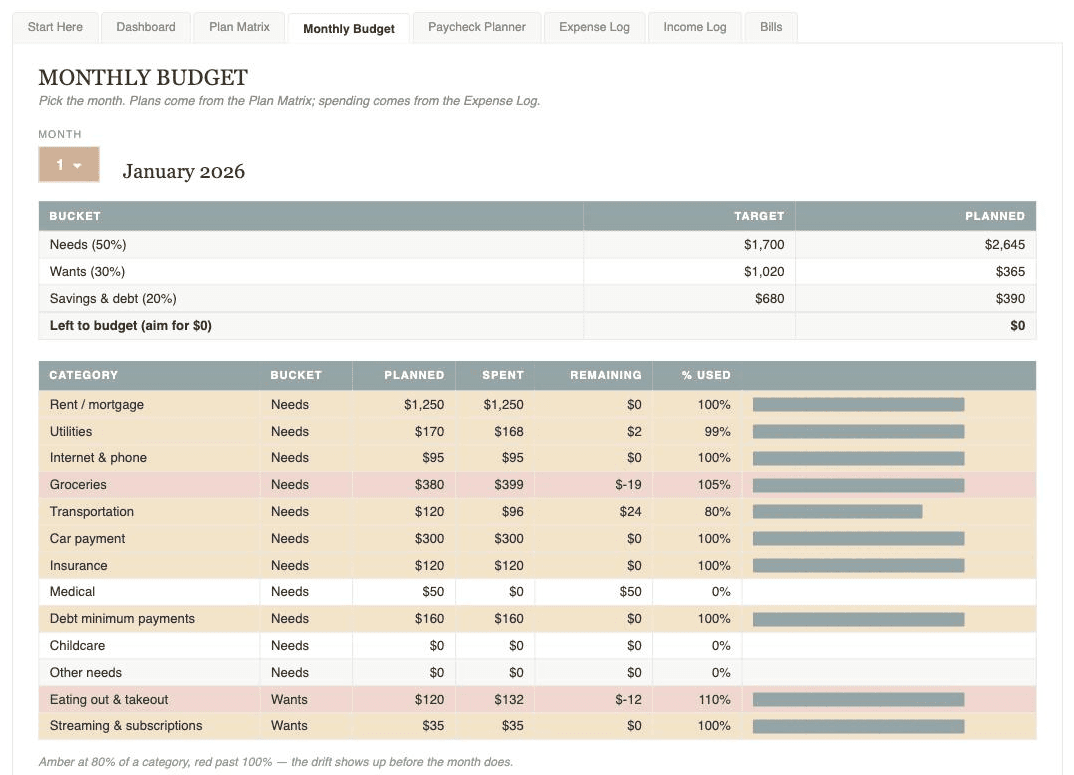
Here is a sample for a household with $2,450 in reliable monthly take-home income. These are teaching numbers, not recommended amounts. Replace every line with local prices and your household's actual needs.
| Category | Monthly amount | Reason |
|---|---|---|
| Rent | $1,150 | Keeps housing current |
| Essential utilities | $190 | Electricity, water, and heating allocation |
| Groceries | $360 | Realistic food plan for this example household |
| Work transportation | $230 | Transit, fuel, or necessary transport costs |
| Medication and health | $70 | Protected health spending |
| Basic phone and internet | $95 | Work and household access |
| Required insurance | $110 | Coverage needed in this example |
| Minimum debt payments | $135 | Contractual minimums |
| Household essentials | $65 | Toiletries, laundry, and basic supplies |
| Starter buffer | $45 | Small protection from timing errors |
| Total | $2,450 | Every dollar assigned |
This budget balances, but it is fragile. There is no room for clothing replacement, car repair, school costs, gifts, or an annual fee. That is useful information. It shows that the next goal is not a dramatic savings rate; it is to create a little margin and add sinking funds one at a time.
If the same household earns only $2,250, the budget has a $200 structural gap. Cutting the $45 buffer still leaves a $155 gap and makes future setbacks more expensive. The solution must include one or more larger changes: assistance, a lower recurring bill, a housing or transport change when feasible, debt-payment relief, or additional reliable income.
Step 2: Map bills to paychecks
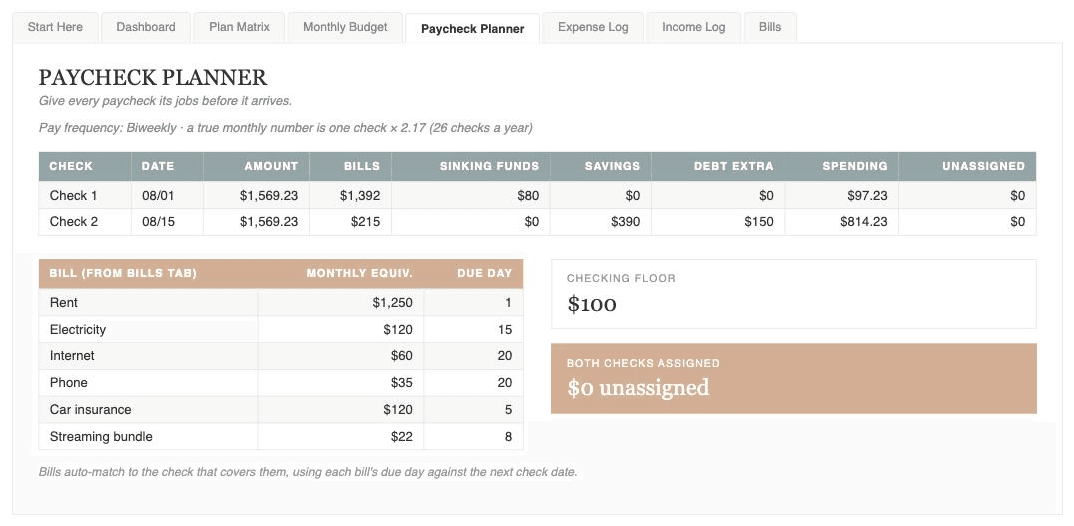
A monthly budget can be mathematically correct and still overdraw the account if most bills are due before the second paycheck.
Create a bill calendar with five columns:
| Bill | Due date | Amount | Paycheck that funds it | Action needed |
|---|---|---|---|---|
| Rent | 1st | $1,150 | Half from each paycheck | Hold first half separately |
| Electricity | 6th | $95 estimated | Paycheck 2 from prior month | Ask about level billing |
| Phone | 12th | $55 | Paycheck 1 | Check lower-cost plan |
| Car insurance | 18th | $110 | Paycheck 1 | Keep current |
| Credit card minimum | 25th | $45 | Paycheck 2 | Ask about due-date change |
The “paycheck that funds it” is not always the paycheck immediately before the due date. Rent due on the first may need to be funded partly by the last paycheck of the previous month.
Use a bills holding space
When possible, separate bill money from everyday spending. Options include:
- a second no-fee checking account used only for bills;
- a savings subaccount or bank “bucket” labeled Bills;
- a spreadsheet balance showing money already reserved; or
- physical envelopes for a few cash expenses, while required electronic bills remain in the bank.
The account balance is not the same as the amount available to spend. Subtract every amount already reserved for a bill.
Ask to change due dates
Some creditors and service providers allow a due-date change. Others may split a monthly payment or offer level billing. Ask before the account is late, and confirm whether the change affects the current billing cycle.
Use this script:
“My payment dates do not line up with my income dates. Do you offer a due-date change, split payment, level billing, or another option that would keep the account current? Please explain any fee or effect on this month's payment before making the change.”
Step 3: Use a shortfall plan when everything does not fit
When the current month is negative, do not pay whichever company contacts you first. Work through the consequences.
The 24-hour shortfall checklist
- Write down cash available now and income arriving before the next payday.
- List every bill due before then, including food, transport, medication, and childcare.
- Mark any payment connected to housing, utilities, work access, insurance, or a legal obligation.
- Pause optional transfers, extra debt payments, and nonessential autopays.
- Call affected providers before their due dates.
- Apply for relevant assistance instead of waiting until service is disconnected or eviction is filed.
- Record every agreement, representative name, confirmation number, and new date.
A provider hardship script
“I am dealing with a temporary income shortfall. I can pay $___ on ___, but I cannot make the full scheduled payment. What hardship plans, payment arrangements, due-date changes, fee waivers, or lower-cost options are available? Will this affect service, interest, credit reporting, or my account status? Please send the agreement in writing.”
Do not agree to a payment you already know the budget cannot support. Ask for the full cost and consequences of each option.
A bank-fee script
“This fee created a hardship, and I am reviewing my account settings to prevent another one. Can you waive this fee as a courtesy? Please also explain my overdraft settings, low-balance alerts, and whether recurring payments can still create overdraft or returned-payment fees.”
A waiver is not guaranteed. The purpose of the call is both to request help and to understand how the account behaves.
A medical-bill script
“I cannot afford this balance under the current terms. Do you offer financial assistance, charity care, an income-based discount, an interest-free payment plan, or an itemized bill review? What documents are required, and will collections pause while the application is reviewed?”
Keep copies of forms and note application deadlines.
Step 4: Stop preventable fees and timing losses
Tight budgets are vulnerable to small timing errors. Focus on systems rather than willpower.
Review overdraft settings
In the U.S., the CFPB explains that a bank generally cannot charge an overdraft fee for a one-time debit-card or ATM transaction unless the customer opted in. Checks and recurring electronic payments can be treated differently. Review the current CFPB overdraft guidance and ask your bank how its specific account works.
Practical protections include:
- low-balance and transaction alerts;
- declining optional debit-card overdraft coverage if appropriate;
- keeping a list of every automatic payment and its processing window;
- unlinking nonessential subscriptions from the bill account;
- asking the bank whether a no-overdraft or lower-fee account is available; and
- checking the available balance before, not after, a purchase.
Opting out does not make every returned payment consequence disappear. A declined bill may still trigger a merchant fee or service issue, which is why the bill calendar matters.
Review recurring charges by annual cost
A $12 monthly charge is $144 a year. That does not automatically make it wasteful, but the annual number makes the tradeoff easier to judge.
For each recurring bill, choose one action:
- keep because it protects health, income, safety, or meaningful quality of life;
- move to a cheaper plan;
- negotiate;
- share legally within the provider's terms;
- pause temporarily; or
- cancel.
Do not spend hours reducing a category by $3 while ignoring a $70 monthly service that no longer fits.
Step 5: Build a buffer in stages
The first savings goal is not a perfect emergency fund. It is a small amount that keeps the next timing error from becoming a fee or new debt.
Use stages that match your reality:
- Transaction cushion: enough to prevent a small timing mistake from taking the account below zero.
- One common surprise: enough for a prescription copay, transport problem, school request, or another expense that repeatedly disrupts the month.
- One week of essential spending: food, transport, medication, and other immediate needs.
- Starter emergency fund: a larger target based on the household's most likely urgent expense.
Five dollars is not too small if it is the amount the budget can repeat. But do not transfer savings and then borrow for groceries. A buffer only helps when the current essentials are also funded.
Keep the buffer separate from the everyday spending balance when possible. If used, refill it gradually instead of treating the withdrawal as failure.
Step 6: Claim support that changes the math
Assistance is an income strategy. If a program covers part of food, health care, childcare, housing, or utilities, it creates room for the rest of the budget.
For U.S. readers, start with official sources:
| Need | Starting point | What it can help locate |
|---|---|---|
| Local urgent support | 211 | Housing, utilities, food, health, and community programs |
| Government benefits | USA.gov Benefit Finder | Food, health, housing, utilities, unemployment, disability, and family programs |
| Housing problems | HUD housing counseling | Rental, eviction, mortgage, foreclosure, and housing guidance |
| Tax credits | IRS EITC information | Eligibility tools for the Earned Income Tax Credit and related filing information |
Eligibility rules, funding, and waitlists change. Use official program pages and do not pay someone who promises guaranteed approval.
Also check:
- employer benefits and employee-assistance programs;
- school meal, transport, device, and activity support;
- hospital financial-assistance policies;
- utility hardship or level-payment programs;
- local food cooperatives or food banks;
- childcare subsidies;
- prescription-assistance resources; and
- free tax preparation from qualified local programs.
Outside the U.S., use the same categories but replace the links with official national and local services where you live.
Step 7: Handle debt without sacrificing this month's essentials
When income is low, aggressive debt payoff can backfire if it empties the account and forces the next emergency onto the same card.
Use this sequence:
- Protect immediate essentials and high-consequence obligations.
- Pay affordable required minimums when possible.
- Contact lenders early when a minimum is unaffordable.
- Build a small buffer.
- Then choose a focused payoff method for extra money.
Ask lenders about hardship plans, lower payments, temporary interest changes, or due-date adjustments. Get the terms in writing and ask how the option affects interest, fees, account status, credit reporting, and the payoff timeline.
Be careful with payday and title loans
Fast access does not mean affordable repayment. The CFPB's payday-loan guidance warns that fees can make a short loan difficult to repay from an already tight next paycheck. Before borrowing, ask the creditor about a payment plan, check employer or community emergency assistance, and compare less expensive bank or credit-union options if available.
If you already have a payday loan, do not ignore it. Review the contract, stop repeated electronic withdrawals only through lawful procedures, ask about repayment options, and seek qualified local advice when needed.
How to budget with irregular income
Variable income needs two budgets, not one optimistic average.
Create a floor budget
The floor budget uses conservative expected income and contains only the priorities discussed above. It answers: “What can this household safely commit to even in a lower month?”
Create a better-month order
Decide where additional income goes before it arrives. For example:
- Catch up any protected essential that is behind.
- Fund bills due before the next expected income.
- Refill the transaction cushion.
- Add to the next known irregular expense.
- Pay extra toward priority debt.
- Include a small planned quality-of-life amount.
This prevents a strong week from feeling like permanent income.
Hold back tax money when required
If you are self-employed or taxes are not fully withheld, gross income is not spendable income. Keep the tax allocation separate and use guidance appropriate to your country and business structure.
What to cut—and what to protect
The best cut is one that improves the monthly math without creating a larger cost later.
Review first
- unused or low-value subscriptions;
- a phone, internet, or insurance plan that can be safely re-quoted;
- convenience spending that does not meaningfully improve the week;
- bank and service fees;
- duplicate memberships;
- frequent small purchases made because planning systems are missing; and
- recurring bills that could qualify for assistance or a lower tier.
Protect carefully
- sufficient food;
- medication and necessary health care;
- safe housing and utilities;
- transport and childcare needed for income;
- legally required insurance;
- accessibility needs;
- essential communication; and
- a small amount of realistic, planned personal spending when the budget permits it.
A plan that removes every source of relief may look strict but often becomes impossible to maintain. The amount can be small; the point is to make it deliberate.
A 30-day low-income budget reset
Week 1: See the whole month
- Calculate reliable income.
- List all essential expenses and due dates.
- Identify whether the problem is timing, a temporary shortfall, or a structural gap.
- Stop nonessential extra debt payments until essentials are stable.
Week 2: Make the calls
- Request due-date changes where they would help.
- Ask utilities, phone, internet, insurers, medical providers, and lenders about hardship or lower-cost options.
- Review overdraft settings and turn on alerts.
- Save written confirmations.
Week 3: Apply and compare
- Check benefits and local assistance.
- Review tax-credit eligibility and free filing help.
- Re-quote one large recurring bill without reducing necessary coverage.
- Research one realistic income improvement with a clear hourly return.
Week 4: Build the repeatable system
- Map the next month's bills to paychecks.
- Move the first affordable amount into the buffer.
- Add one irregular expense as a sinking fund.
- Schedule a ten-minute weekly review.
The goal after 30 days is not a perfect budget. It is a plan that shows what is due, what is protected, what is short, and what action comes next.
Frequently asked questions
Should I use the 50/30/20 rule on a low income?
Not as a pass-or-fail test. Essential needs may take far more than 50% of take-home pay. The categories can still prompt useful questions, but the percentages should not override housing, food, health, safety, or local costs. Read the 50/30/20 guide as a flexible framework, not a requirement.
Should I save while I am behind on bills?
Protect immediate essentials first. After that, a very small cushion can be useful because it reduces the chance that the next small surprise creates another missed payment. The correct amount depends on what is behind, the consequences, and whether the transfer would leave current food, medication, or transport unfunded.
What if income does not cover rent and food?
That is an urgent shortfall, not evidence that the budget needs more categories. Prioritize immediate safety, housing, utilities, food, medication, and income access. Contact providers and local assistance before due dates where possible. U.S. readers can start with 211 and HUD housing counseling; use official local equivalents elsewhere.
Is cash budgeting better when money is tight?
Cash can create a clear limit for one or two variable categories, but do not withdraw rent, utility, or emergency money merely to use a binder. A digital or hybrid system may be safer. The cash envelope guide explains the tradeoffs.
How often should I check the budget?
Weekly is usually enough for maintenance, but check before a purchase when the balance is close to a bill amount. During a shortfall, review whenever income arrives or a provider changes an agreement.
What if my partner will not follow the budget?
Start with shared facts rather than blame: reliable income, protected bills, due dates, and the size of the gap. Agree first on what must remain safe. Separate personal spending amounts can reduce conflict, but hiding debt, income, or purchases requires a different conversation than choosing categories.
Your one-page Sunday checklist
This week, do only these five things:
- Write reliable income at the top of the page.
- List every bill due before the next two paydays.
- Circle housing, utilities, food, health, work access, insurance, and legal obligations.
- Make one call that could prevent a fee, disconnection, missed payment, or unaffordable plan.
- Put the smallest sustainable amount into a named buffer after current essentials are covered.
Then repeat next Sunday. A low-income budget succeeds when it protects the household, makes the next decision clearer, and shows when the numbers require outside help or a larger change. It does not need to resemble anyone else's percentages to be a real plan.

Written by
I fixed my own money with a spreadsheet and a Sunday morning, and now I build the tools I wish I’d had. I manage a dental practice in Greensboro, North Carolina, and I have never once told anyone their problem was the coffee.


