No-Spend Month: Rules, Tips, and a Free Tracker
By Nora Bennett · July 25, 2026

A no-spend month is not thirty-one days of spending zero dollars. Rent still exists. Children continue needing things at astonishing speed. Cars remain emotionally committed to making a new noise just after payday.
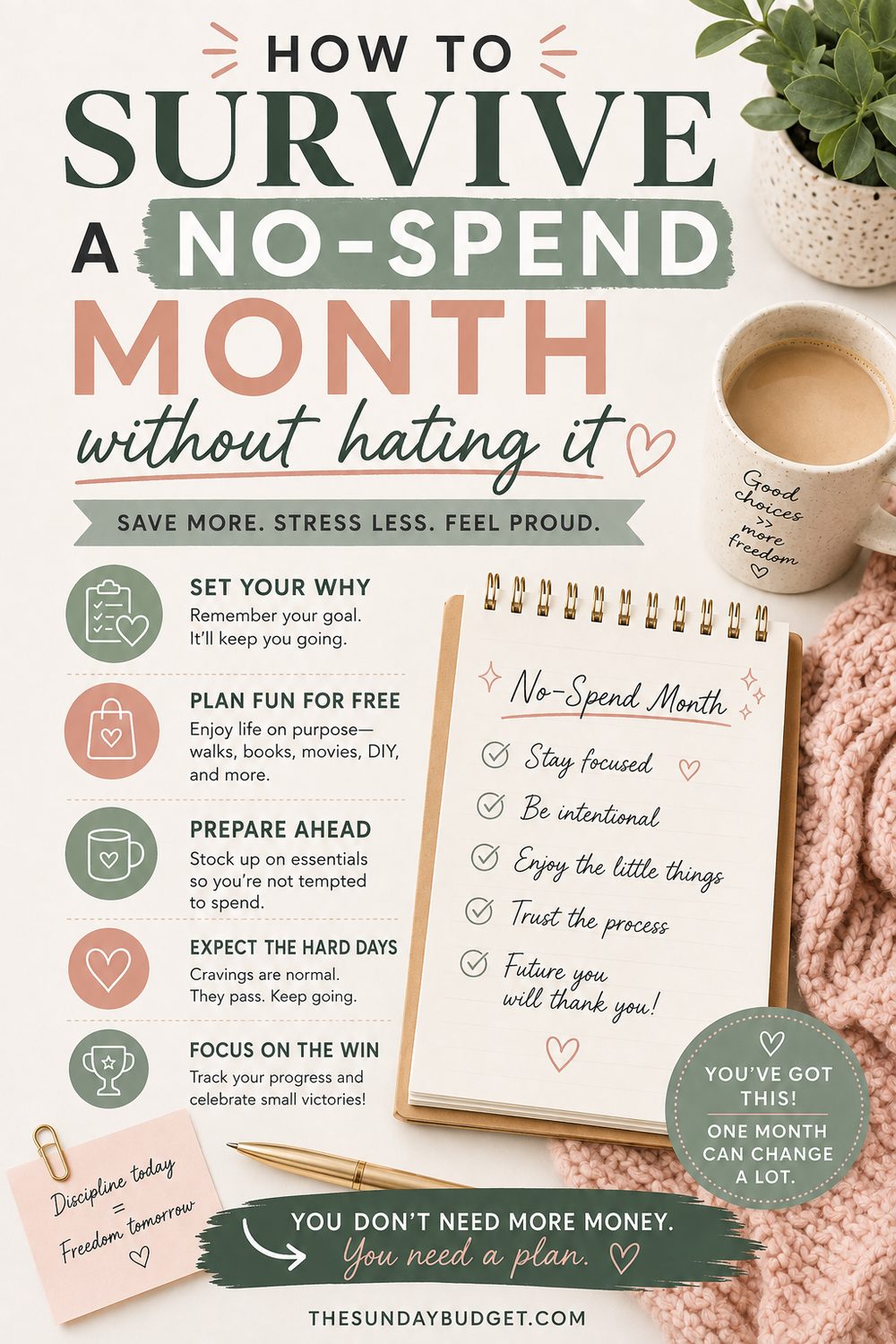
A useful no-spend month is a temporary pause on chosen discretionary spending. You keep paying for needs, obligations and anything that protects your health or income. You pause the categories that have become automatic, then watch what happens when every “small” purchase has to wait.
The money saved matters. The better result is evidence: which expenses were habits, which purchases solved a real problem, which free alternatives you genuinely preferred and which category needs a permanent place in your budget.
This guide gives you the complete system: how to choose the right version, write rules that survive real life, prepare the household, track actual savings, recover from a spending day and re-enter normal life without refunding the whole challenge in one weekend.
What a no-spend month is—and is not
A no-spend month is a short financial experiment with three purposes:
- Interrupt autopilot spending. You create enough friction to notice the purchase before it happens.
- Free cash for one named goal. The money goes somewhere specific instead of dissolving back into checking.
- Collect better budget data. You learn which lower-spending choices are sustainable after the challenge.
It is not:
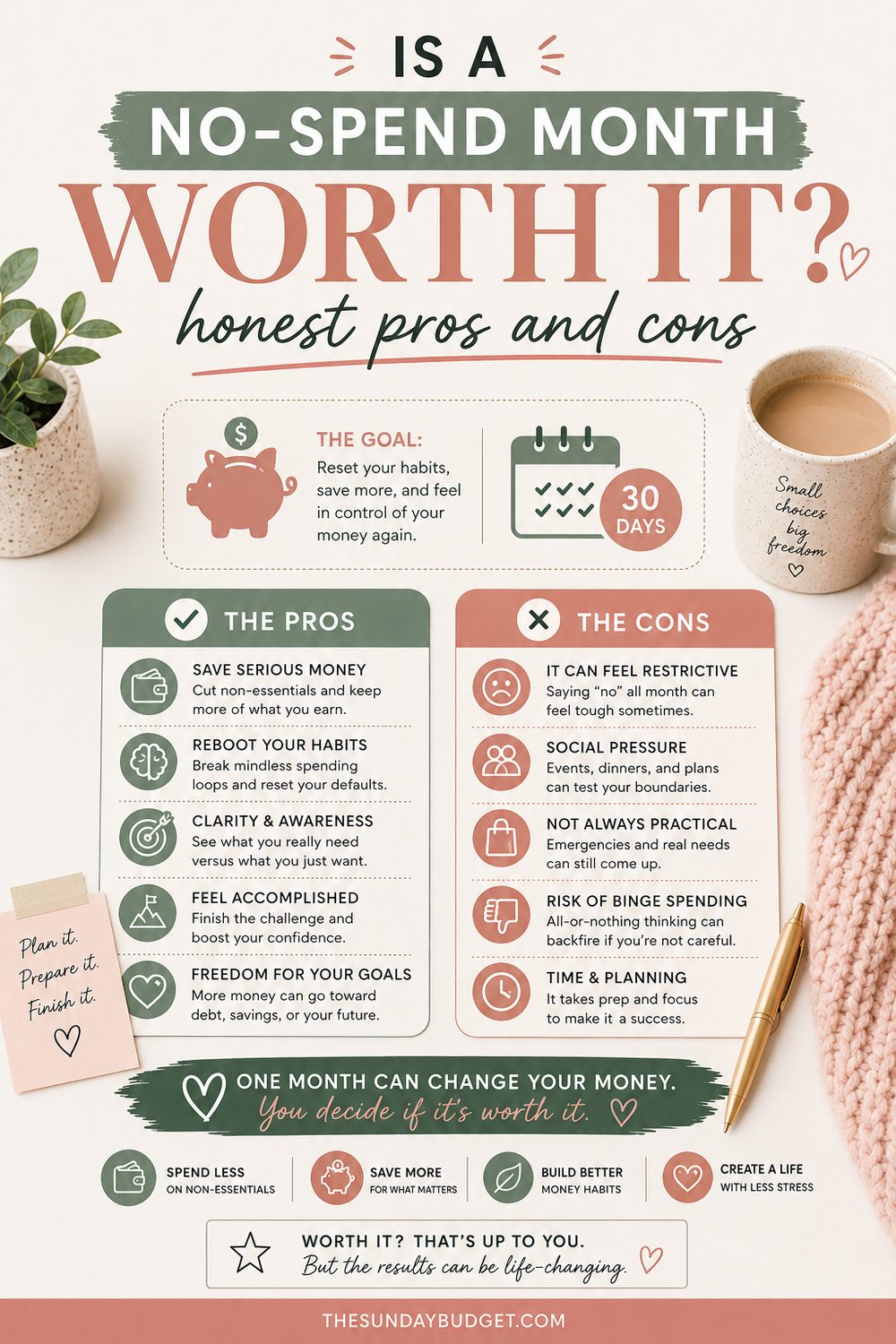
- A punishment for having spent money
- A competition to report the lowest number online
- A reason to skip medication, adequate food, transportation or necessary repairs
- A replacement for more income when essentials already exceed income
- A month-long shopping delay followed by a day-32 spree
If your budget is already stripped to essentials, a full no-spend month may create stress without finding much money. Use the one-category version later in this guide, or focus on bills, benefits, income and debt support instead. A challenge cannot coupon its way out of an income gap.
Choose your version before choosing the month
The strictest version is not automatically the best one. Pick the smallest challenge that will expose a real habit.
| Version | Rule | Best for |
|---|---|---|
| Full month | Pause nearly all discretionary purchases | A reset after a high-spending season |
| One-category month | Pause takeout, clothes, beauty, hobbies or another category | Beginners and tight budgets |
| Weekday reset | No discretionary spending Monday–Friday | Convenience spending around work |
| No-spend weekends | Two or four planned weekends | Social and entertainment spending |
| Replacement month | Every paused purchase needs a free substitute | Families and social households |
| 30-day want-it list | Wants wait thirty days before purchase | Impulse buying without a full ban |
Choose one sentence that defines your challenge:
For the next 30 days, I will pause [specific spending] so I can move [target amount] toward [named goal].
“Spend less” is fog. “Pause takeout and nonessential shopping to add $300 to the car-repair fund” is a plan.
Find your baseline before setting a savings target
Do not borrow somebody else's $500 claim. Your savings depend on what you normally spend in the categories you pause.
Review the previous two or three months and total the challenge categories. If takeout was $180, shopping was $95 and paid entertainment was $60, your monthly baseline is $335. A $250 target may be realistic; a $700 target is a motivational poster with no supporting documents.
Use this estimate:
Average paused-category spending − planned exceptions − replacement costs = realistic savings target
Replacement costs matter. If skipping takeout adds $45 to groceries, you did not save the full takeout amount. If a free event requires $20 of fuel and parking, subtract it. Honest math is more motivating than an inflated total you do not trust.
The Consumer.gov budgeting guide recommends writing down income and expenses, tracking spending during the month and using the result to plan the next month. That is exactly what this challenge should produce: not a heroic story, but better numbers.
The three-list rule
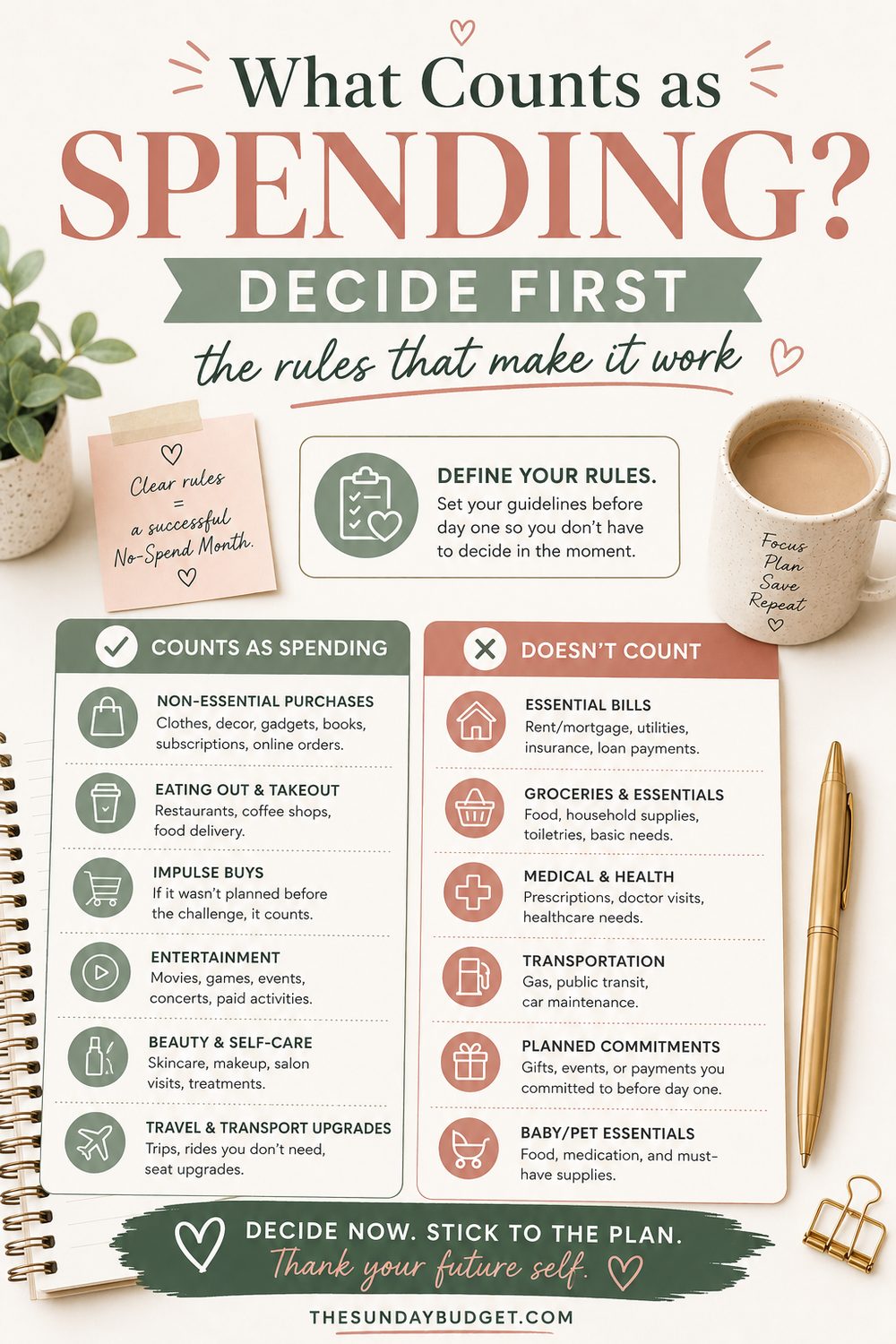
Most no-spend challenges use an allowed list and a banned list. A third list makes the rules much stronger: decide now. It catches the purchases that depend on context.
Write all three lists before day one. Mid-month you can add an essential expense, but you cannot quietly move a want because a coupon arrived.
List 1: allowed
Allowed spending keeps your household, health, income and existing commitments functioning:
- Rent or mortgage
- Utilities, phone and internet
- Minimum debt payments and agreed extra payments
- Insurance, taxes and required fees
- Normal groceries and household basics
- Medication, appointments and health needs
- Childcare, school requirements and dependent care
- Necessary transportation and essential vehicle repairs
- Pet food, medication and necessary veterinary care
- Existing automatic savings and retirement contributions
- Replacement of a genuinely necessary item that cannot wait
- Named exceptions written before the month begins
Allowed does not mean “spend without attention.” You can still meal-plan, compare prices and combine trips. It means the purchase does not break the challenge.
List 2: paused
These are the categories you are deliberately interrupting:
- Restaurants, takeout and delivery
- Coffee runs and convenience snacks
- Clothes, decor, gadgets and casual online shopping
- New subscriptions, upgrades and in-app purchases
- Paid entertainment and impulse outings
- Beauty or hobby purchases that can safely wait
- “Stocking up” on nonessentials because something is discounted
- Buying ahead for after the challenge
- Anything added to the cart because “it is only $12”
List 3: decide now
Set rules for the gray areas before they happen:
| Gray area | A workable rule |
|---|---|
| Gifts | Use the existing gift budget; no extras |
| Work lunch | Allowed only when required, not from forgetting lunch |
| Children's activities | Existing commitments allowed; spontaneous paid extras paused |
| Home repair | Safety and damage prevention allowed; cosmetic projects wait |
| Clothing replacement | Replace only if the item is necessary and unusable |
| Social plans | One named event with a fixed cash limit |
| Travel already booked | Honor committed costs; pause upgrades and add-ons |
| Gift cards and points | Allowed only for planned needs; do not use them to hide spending |
| Returns and refunds | Refund goes to the challenge goal, not a new purchase |
| Business expenses | Necessary revenue-producing costs allowed and tracked separately |
The rule is not “never spend.” The rule is “do not renegotiate with yourself at checkout.”
Pre-decided exceptions are not cheating
Write two or three named exceptions with a date and limit: the family birthday dinner on the 14th, the school trip, one planned outing with friends. A zero-exception challenge often produces one unplanned purchase, a feeling that the month is ruined and then a weekend of abandoned rules.
An exception should pass three tests:
- You know what it is before day one.
- You give it a maximum amount.
- You would still choose it without a discount or social pressure.
“Birthday dinner, maximum $45” is an exception. “Whatever comes up” is the absence of a rule.
When not to start
Delay or modify the challenge if:
- Bills due this month are unclear or already behind
- Your pantry is empty and the challenge would encourage under-buying food
- A medical, school, travel or moving month will require unusual spending
- Your household has not agreed on shared-money rules
- Restrictive challenges worsen anxiety, disordered eating or compulsive behavior
- Someone else controls your access to money or spending decisions
The CFPB's Your Money, Your Goals toolkit includes a spending tracker and bill calendar. Use those first if you do not yet know what is due. A no-spend challenge should happen after essentials are visible, not instead of planning for them.
The seven-day setup
Do not “prepare” by spending $300 on groceries, crafts and entertainment. That only moves the spending into the previous month. Prepare the systems, not a bunker.
Seven days before: choose the goal
- Pick the version and dates
- Review the last two or three months
- Estimate the paused-category baseline
- Name the destination for the money
- Tell anyone affected by the rules
Five days before: protect the bills
- List every bill and due date
- Check upcoming annual or irregular expenses
- Confirm account balances and automatic payments
- Make sure savings transfers will not cause an overdraft
The CFPB recommends keeping a bill calendar somewhere you will review regularly. A surprise annual fee is not a failed challenge; it is a missing calendar item.
Three days before: remove the easy triggers
- Delete saved cards from shopping sites
- Remove delivery and shopping apps from the home screen
- Unsubscribe from promotional emails and texts
- Turn off nonessential sale notifications
- Put the want-it list where the cart used to be
- Make returns before the challenge starts
Do not rely on becoming a different person. Make the old action slightly harder.
One day before: plan replacements
List at least ten free or already-paid options:
- Library books, audiobooks and events
- Parks, walks and free community activities
- Games, films and subscriptions you already own
- Pantry meals and packed lunches
- At-home coffee with a friend
- Unfinished craft, repair or home project
- A clothing swap or borrowed item
- Free museum or community days
- Exercise videos or existing equipment
- The hobby supplies already living in three drawers
A paused purchase leaves a job behind. If takeout solved exhaustion, you need freezer meals or an easy dinner—not a lecture about discipline.
The shape of the month
Days 1–7: novelty and observation
The first week often feels easy because the challenge is new. Use that energy to notice triggers. Every time you want to spend, record what happened immediately before it: boredom, stress, convenience, social pressure, a sale email or genuine need.
Do not celebrate a clean first week by making the rules stricter. Keep collecting data.
Days 8–12: the wall
The old routines push back. This is when delivery apps send discounts, a bad day asks to become a package and “I deserve it” starts presenting oral arguments.
Use a ten-minute interruption:
- Put the item on the want-it list.
- Name the trigger.
- Choose one replacement action.
- Wait ten minutes before deciding again.
You are not proving that wants are bad. You are checking whether the want survives a pause.
Days 13–24: the useful middle
The challenge becomes less dramatic. Pantry meals get easier, free plans feel normal and the spending urges become more predictable. This is where you identify the keepers.
Ask each Sunday:
- Which free replacement was genuinely better?
- Which paused category do I still miss?
- Which “essential” purchase was actually poor planning?
- What system would prevent that next month?
Days 25–31: count and design re-entry
Do not coast into day 32. Review the want-it list, calculate actual savings and decide which rules deserve a permanent place in the budget.
Build a trigger plan
Use this template:
When I want to spend because of [trigger], I will [replacement] before I decide.
Examples:
| Trigger | Replacement |
|---|---|
| Too tired to cook | Use one designated emergency meal |
| Bored at night | Walk, read or start an already-owned project for 15 minutes |
| Sale email | Delete it and add the item to the want-it list |
| Friend suggests an outing | Offer one free plan or use the named social exception |
| Rough workday | Call someone, shower, exercise or use a planned comfort ritual |
| Forgot lunch | Keep two shelf-stable backup lunches at work |
| Household item runs out | Check substitutes, then replace if it is genuinely necessary |
The replacement must solve the same job. “Do nothing” is not a plan when the purchase was buying convenience, connection or relief.
Track more than green squares
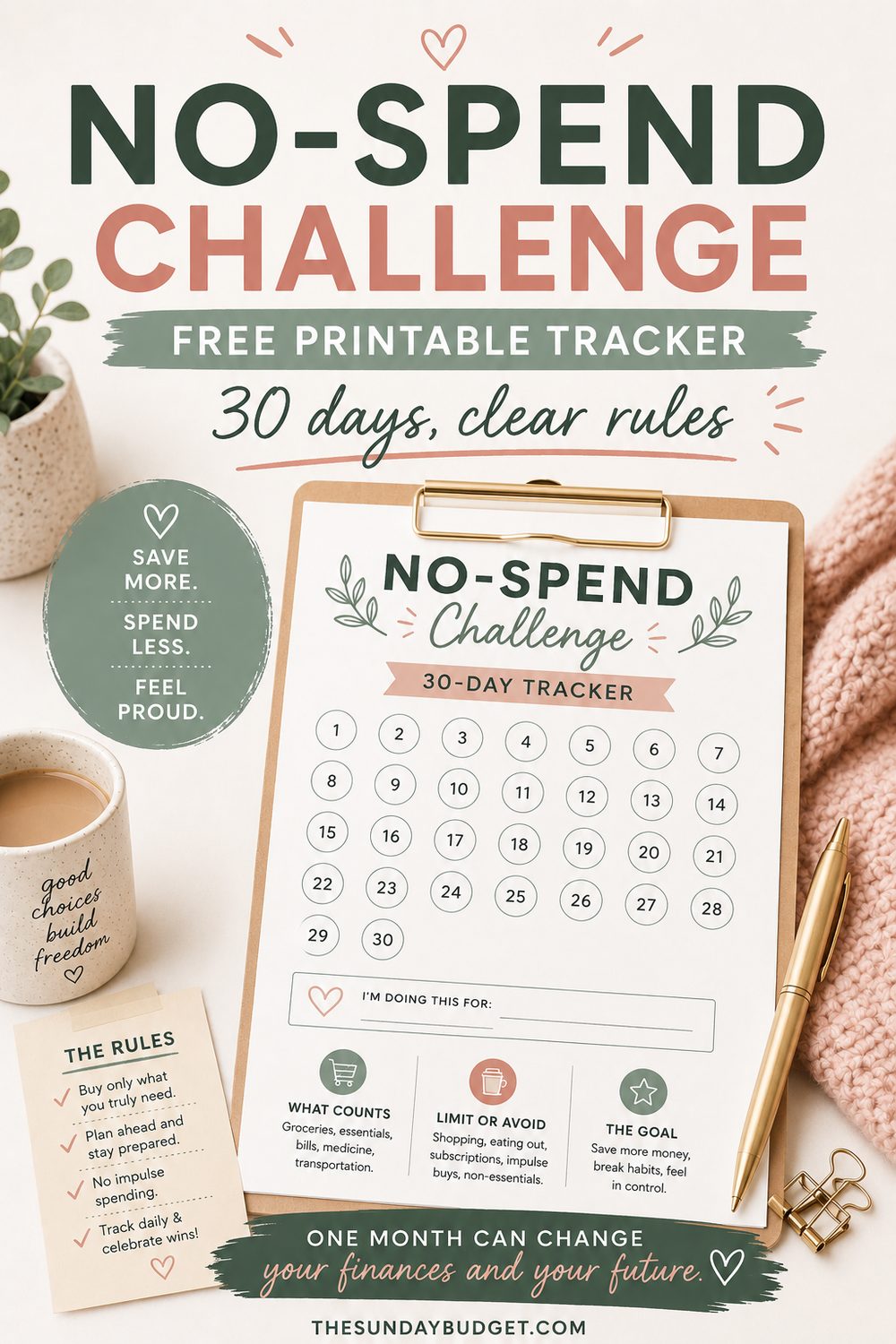
The free Sunday Budget planner includes a no-spend grid on its Challenges tab. Mark each day N for no discretionary spend or S for a spending day, and use the streak counter as motivation—not judgment.
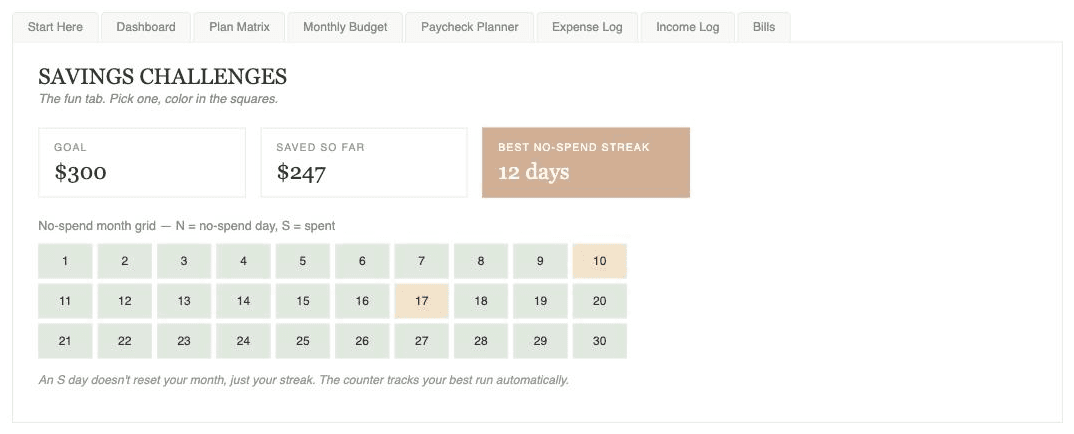
For useful data, also record:
- What you almost bought
- The amount
- The trigger
- The replacement you tried
- Whether you still wanted it 24 hours later
- Money actually transferred
The CFPB notes that the tracking method itself can be flexible: written log, receipts, voice notes, photos or an app. The useful part is getting an accurate picture of where money goes. Use the method you will continue.
How to calculate actual savings
At the end of each week:
Baseline for paused categories − actual category spending − extra replacement costs = challenge savings
Example:
| Item | Amount |
|---|---|
| Normal weekly takeout and shopping | $105 |
| Named birthday exception | −$35 |
| Extra groceries | −$18 |
| Actual challenge savings | $52 |
Transfer the $52, not the imaginary $105. If you leave it in checking, it can be spent twice in your head.
What happens if you spend?
You record it. That is all. No restart, punishment, compensatory restriction or “the month is ruined” speech.
Use the five-minute reset:
- Mark the S honestly.
- Write what you bought and why.
- Decide whether it was essential, an exception or paused spending.
- Fix the trigger if possible.
- Continue with the next decision.
An unexpected prescription is allowed spending. A forgotten packed lunch is a planning clue. A midnight online order is a trigger clue. They are different events and should produce different lessons.
A streak is a game mechanic. The real score is fewer automatic purchases and more money assigned to something you value.
Doing the challenge with a partner or family
Shared money requires shared rules. One person cannot declare a no-spend month and turn everyone else into unwilling participants.
Hold a 20-minute household meeting:
- Choose the goal together
- Define allowed spending and named exceptions
- Protect each person's small amount of independent money
- Decide how children's requests will work
- Put one free family plan on each weekend
- Agree that nobody polices another person's food, medical or personal-care needs
- Choose a weekly check-in without blame
For children, frame the month around a positive goal: “We are building the camping fund,” not “We cannot afford anything.” Let them help choose free activities and color the tracker without making them responsible for adult finances.
If money is already very tight
Do not cut adequate groceries, healthcare, utilities or safe transportation to create an impressive result. Try a structural version:
- Pause one optional category only
- Cancel or downgrade one recurring charge
- Call one provider about a lower plan
- Plan meals from what you already have before shopping normally
- Use a no-spend weekend rather than a month
- Track every purchase without restricting for two weeks
Tracking can reveal opportunities, but it can also confirm that your problem is not discretionary spending. That is valuable. If essentials exceed income, the next moves may involve benefits, bill assistance, income, debt advice or changing major fixed costs—not a stricter coffee rule.
Give the money a job before day one
A no-spend month with no destination tends to refund itself later. Choose one:
- Build the first layer of an emergency fund
- Make an extra payment using your debt payoff plan
- Start a sinking fund for an irregular expense
- Catch up a bill or create a checking-account buffer
- Fund one planned purchase from the want-it list
Transfer weekly at your Sunday budget reset. The FDIC suggests using automatic transfers to make regular saving easier and keeping designated savings separate from everyday checking when appropriate. If automating, check timing, balance requirements and fees first.
Re-entry: make day 32 part of the challenge
The danger is not buying something after the month. The danger is treating delayed purchases as a debt the next paycheck owes you.
Use a three-step re-entry:
1. Review the want-it list
Label every item:
- Expired: you no longer want it
- Useful: it solves a real current need
- Joy: you still value it and can afford it
- Later: it belongs in a sinking fund
Buy nothing from the list on day 32. Give the final list another 48 hours.
2. Keep two permanent changes
Choose only two. Examples:
- One no-spend weekend each month
- A permanent 24-hour waiting rule
- Packed lunch three days a week
- One takeout night in the budget instead of several spontaneous orders
- A monthly subscription review
- Automatic transfer on payday
Trying to preserve every challenge rule turns a reset into permanent deprivation. Keep what worked best.
3. Rebuild the category honestly
If you deeply missed one planned dinner out, put one dinner in the budget. If you never missed online shopping, lower that category. The goal is not the lowest possible budget. It is a budget that reflects what you value enough to maintain.
Frequently asked questions
Do bills and groceries count as spending? They are allowed spending. The challenge targets selected discretionary categories, not survival. Track essentials normally so the month still gives you an accurate cash-flow picture.
Can I use gift cards, rewards or points? Decide before day one. A useful rule is to allow them for planned needs but not use them to disguise a paused purchase. Points are still a resource and can trigger extra spending.
Should I stock up before the month? No. Buy the ordinary groceries and household basics you would normally need. A pre-challenge shopping spree makes the result look better by moving spending into another month.
What if an emergency happens? Handle it. Health, safety, income protection and preventing larger damage take priority. Record the expense accurately and continue if the challenge still makes sense.
Do I need a separate savings account? Not necessarily, but separation can make progress visible and reduce accidental spending. Use an account that fits your access needs and understand any minimums, transfer limits or fees.
How often should I do a no-spend month? A full month once or twice a year is enough for most people to uncover habits. Smaller no-spend weekends or category pauses can be used more often without turning normal spending into a moral test.
What is a good savings target? Use your own baseline. Average the last two or three months in the categories you will pause, then subtract planned exceptions and added replacement costs. There is no honest universal amount.
Start with rules you can finish
This Sunday, choose the version, calculate the baseline, write the three lists and name the destination for the money. Remove the easiest triggers and plan replacements for the purchases that were solving a real problem.
Then start. Mark each day honestly. Transfer the actual savings weekly. If you spend, learn and continue.
The best no-spend month is not the strictest one. It is the one that leaves you with money in the right account, two habits worth keeping and a budget that understands you better than it did thirty days ago.

Written by
I fixed my own money with a spreadsheet and a Sunday morning, and now I build the tools I wish I’d had. I manage a dental practice in Greensboro, North Carolina, and I have never once told anyone their problem was the coffee.